
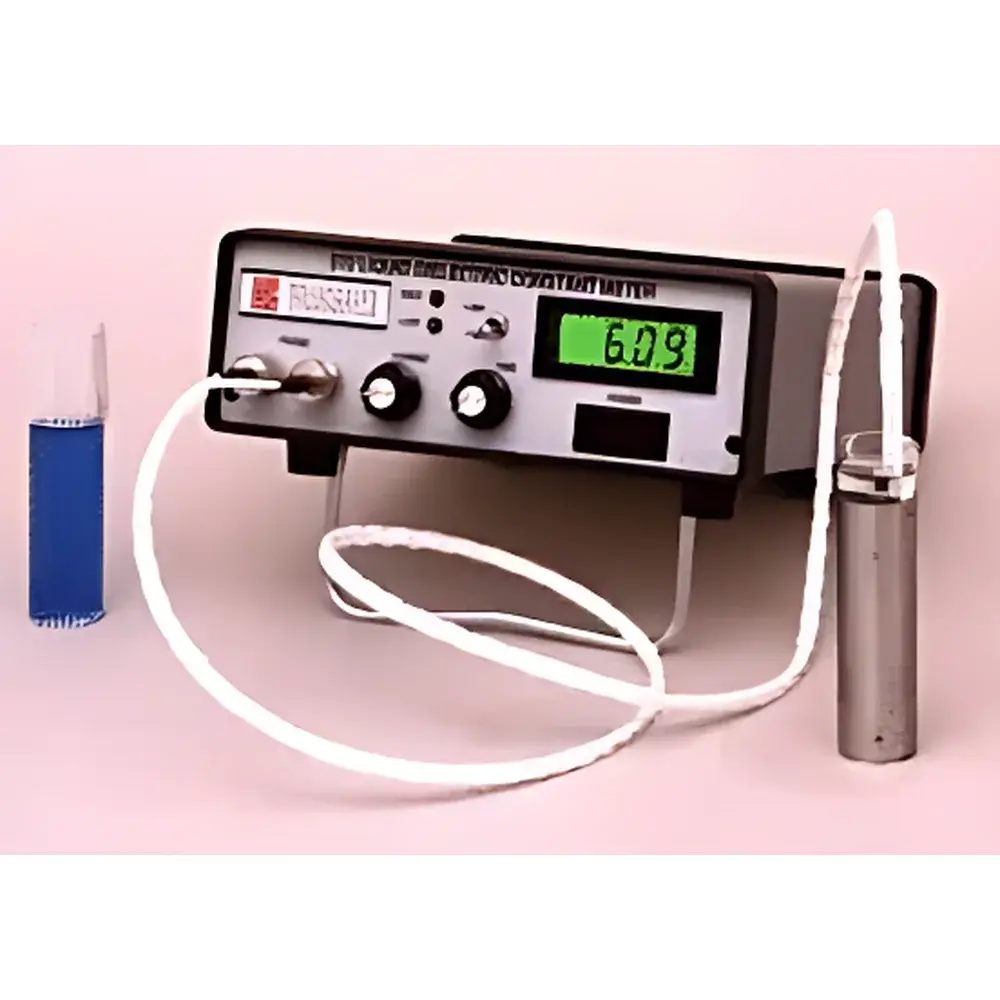
Brookhaven BI-870 Dielectric Constant Meter
| Brand | Brookhaven Instruments |
|---|---|
| Origin | USA |
| Model | BI-870 |
| Measurement Range | 1–20 and 1–200 |
| Accuracy | ±2% |
| Repeatability & Linearity | ±0.2% |
| Max Sample Conductivity | 1 µS/cm (for range 1–20), 10 µS/cm (for range 1–200) |
| Minimum Sample Volume | 25 mL |
| Probe Material | Stainless Steel & PTFE |
| Excitation Signal | Low-distortion 10 kHz sine wave (7 Vrms for 1–20 range |
| Display | LCD |
Overview
The Brookhaven BI-870 Dielectric Constant Meter is a precision laboratory instrument engineered for the accurate, direct measurement of relative permittivity (dielectric constant, εr) of liquid samples—particularly aqueous and organic solvent mixtures—under ambient conditions. Unlike tabulated values applicable only to pure solvents, the BI-870 enables empirical determination of εr in complex, multi-component systems where theoretical estimation is unreliable or unavailable. This capability is critically important in electrophoretic light scattering (ELS) and dynamic light scattering (DLS) workflows, where εr serves as a fundamental input parameter in the Henry equation and Smoluchowski approximation for Zeta potential calculation. The instrument operates on a coaxial cylindrical capacitance principle: a low-distortion 10 kHz sinusoidal excitation voltage is applied to the outer electrode, while the displacement current between inner and outer electrodes is measured under known geometric and electrical boundary conditions. Frequency stability is maintained via temperature-compensated crystal oscillator control, ensuring long-term measurement integrity across repeated analyses.
Key Features
- Two selectable measurement ranges (1–20 and 1–200) optimized for low- and high-permittivity liquids, with automatic range scaling based on sample conductivity thresholds
- High-precision coaxial stainless steel/PTFE probe assembly offering chemical resistance, mechanical robustness, and minimal polarization artifacts
- Stable 10 kHz excitation source with <0.1% total harmonic distortion (THD), minimizing dielectric dispersion effects in lossy media
- ±2% full-scale accuracy with ±0.2% repeatability and linearity—validated per ASTM D150 and IEC 60250 standards for dielectric measurements
- LCD interface providing real-time εr readout, range indication, and status feedback without external software dependency
- Minimal sample requirement of 25 mL, compatible with standard cylindrical sample vials and reusable probe geometry
Sample Compatibility & Compliance
The BI-870 accommodates a broad spectrum of non-corrosive, non-viscous liquids—including water–alcohol blends, aqueous salt solutions, polar organic solvents (e.g., DMF, DMSO), and dilute colloidal dispersions—provided conductivity remains within specified limits (≤1 µS/cm for εr = 1–20; ≤10 µS/cm for εr = 1–200). Samples containing suspended solids or particulates ≥1 µm may require filtration prior to analysis to avoid probe fouling or field distortion. The instrument complies with electromagnetic compatibility (EMC) requirements per FCC Part 15 Class B and CE directives. While not intrinsically rated for hazardous environments, its probe design meets ISO 8502-3 cleanliness verification protocols for lab-grade instrumentation used in GLP-compliant Zeta potential laboratories.
Software & Data Management
The BI-870 operates as a standalone benchtop meter with no embedded data logging or USB connectivity. All measurements are displayed in real time on the integrated LCD panel. For integration into regulated environments (e.g., pharmaceutical QC labs), users may manually record results into electronic lab notebooks (ELN) or LIMS platforms compliant with 21 CFR Part 11. When paired with Brookhaven’s ZetaPALS or NanoBrook systems, the measured εr value can be directly imported into instrument firmware via ASCII text file import, supporting audit-trail-ready workflows. Calibration verification is performed using NIST-traceable reference standards (e.g., deionized water at 25°C, εr = 78.39 ± 0.05) and certified calibration oils (e.g., n-decane, εr = 2.048 ± 0.002).
Applications
- Determination of εr for mixed solvents used in nanoparticle dispersion stabilization and electrophoretic mobility studies
- Validation of dielectric parameters in formulation development for drug delivery systems (liposomes, polymeric micelles)
- Quality control of electrolyte solutions in battery research and electrochemical characterization
- Supporting ISO 13321 and ASTM E2490 guidelines for colloid stability assessment via Zeta potential
- Teaching laboratories requiring hands-on demonstration of dielectric theory, capacitance–permittivity relationships, and frequency-domain impedance concepts
FAQ
Why is direct dielectric constant measurement necessary for Zeta potential analysis?
Because Zeta potential calculations rely on the Henry equation, which explicitly incorporates εr. For mixed solvents—common in biological and pharmaceutical formulations—published εr values are unavailable or inaccurate; empirical measurement eliminates propagation of error.
Can the BI-870 measure conductive aqueous buffers?
Yes, within defined limits: up to 1 µS/cm for the 1–20 range and up to 10 µS/cm for the 1–200 range. Higher conductivity induces parasitic conduction currents that compromise capacitive signal fidelity.
Is probe cleaning required between samples?
Yes. Rinse thoroughly with high-purity solvent (e.g., ethanol or acetone), followed by deionized water and nitrogen drying. Avoid abrasive cleaning agents that degrade the PTFE insulation layer.
Does the instrument support temperature-controlled measurements?
No. The BI-870 assumes ambient temperature operation (20–25°C). For temperature-dependent studies, external thermostatted sample holders must be used, with εr corrections applied post-measurement per established literature correlations.
How often should calibration verification be performed?
Before each analytical session when used in regulated environments; otherwise, daily verification with a primary standard (e.g., DI water) is recommended to ensure traceability and measurement confidence.



