
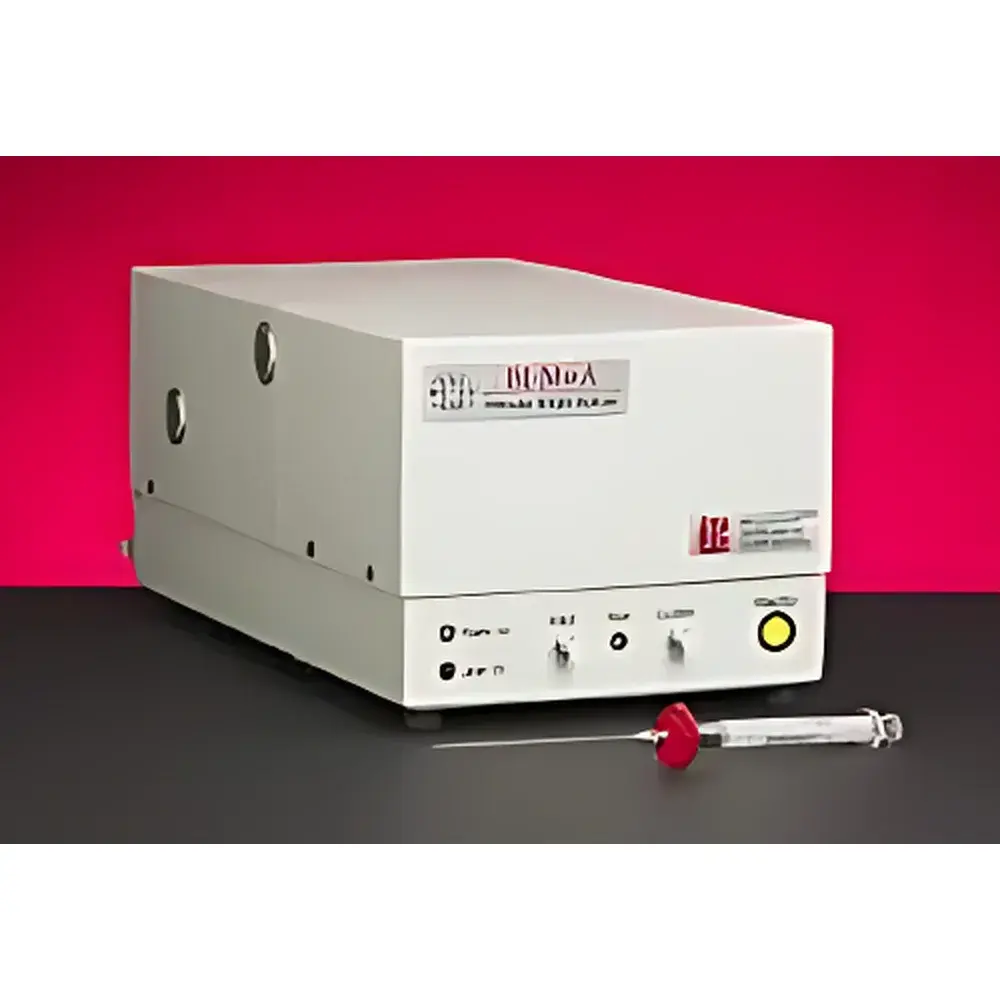
Brookhaven BI-MwA Multi-Angle Static Light Scattering (MALS) Instrument for Absolute Molecular Weight Determination
| Brand | Brookhaven |
|---|---|
| Origin | USA |
| Model | BI-MwA |
| Molecular Weight Range | 500–10⁹ Da |
| Hydrodynamic Size Range | 10–1000 nm |
| Scattering Volume | 20 nL |
| Sample Cell Volume | 100 µL |
| Maximum Back Pressure | 3.5 MPa (500 psi) |
| Detection Angles | 8 fixed angles (35°, 50°, 75°, 90°, 105°, 130°, 145° + reference angle) |
| Detector | High-Sensitivity CCD |
Overview
The Brookhaven BI-MwA is a precision multi-angle static light scattering (MALS) instrument engineered for the absolute determination of macromolecular weight (Mw), radius of gyration (Rg), and second virial coefficient (A2) without reliance on calibration standards. Based on first-principles Rayleigh–Gans–Debye scattering theory, the BI-MwA measures scattered light intensity at eight precisely aligned angles simultaneously—enabling robust Debye, Zimm, or Berry plot analysis. Its 20 nL ultra-low-volume scattering cell minimizes sample consumption while maintaining high signal-to-noise ratio, making it especially suitable for scarce or expensive biopolymers, synthetic polymers, and nanoparticle dispersions. Unlike single-angle or dynamic light scattering (DLS) methods, MALS provides intrinsic, concentration-independent molecular parameters—critical for characterizing branching, aggregation state, conformational transitions, and thermodynamic stability.
Key Features
- Fiber-optic coupled detection architecture ensures temporal synchronization across all eight scattering angles, eliminating time-lag artifacts during kinetic or chromatographic measurements.
- High-sensitivity CCD detector with thermoelectric cooling enables low-concentration measurements (down to ~0.1 mg/mL for proteins) and reliable A2 quantification for colloidal stability assessment.
- Integrated pressure-rated flow cell (up to 3.5 MPa) supports direct coupling with size-exclusion chromatography (SEC), field-flow fractionation (FFF), or asymmetric flow FFF systems.
- Modular design allows seamless integration with optional accessories: TDSLS (Time-Resolved Dynamic Light Scattering) for real-time polymerization kinetics, and NANODLS for concurrent hydrodynamic size distribution analysis under flow conditions.
- Reference-angle normalization corrects for laser intensity fluctuations and solvent background, enhancing measurement reproducibility across extended acquisition periods.
Sample Compatibility & Compliance
The BI-MwA accommodates aqueous and organic solvent-based macromolecular solutions—including proteins, monoclonal antibodies, polysaccharides, dendrimers, PEGylated therapeutics, and synthetic homopolymers or copolymers. It operates within standard laboratory environments (20–25 °C, non-condensing humidity) and complies with IEC 61010-1 safety requirements for electrical equipment. Data integrity workflows align with GLP and GMP expectations: audit-trail-enabled software supports 21 CFR Part 11-compliant electronic signatures, user access control, and immutable raw-data archiving. All MALS-derived parameters satisfy ASTM D7062 (standard practice for MALS characterization of polymers) and ISO 22412 (light scattering particle sizing) guidelines.
Software & Data Management
Instrument operation and data reduction are managed via Brookhaven’s proprietary MwA Control & Analysis Suite. The software performs real-time angular intensity correction, auto-scaling of Zimm plots, and simultaneous fitting of Mw, Rg, and A2 using nonlinear least-squares regression. SEC-MALS mode automatically synchronizes with HPLC/UHPLC timestamps, generating slice-by-slice molecular weight distributions. Export options include CSV, ASCII, and .dx formats compatible with third-party platforms such as OriginLab, MATLAB, and Chromatography Data Systems (CDS). Raw intensity files (.bin) retain full detector metadata for retrospective reprocessing—ensuring long-term analytical traceability.
Applications
- Quantitative assessment of batch-to-batch consistency in therapeutic protein manufacturing (e.g., mAb aggregation propensity, fragment analysis).
- Branching characterization of polyolefins and comb polymers via correlation of Mw/Mn ratios with Rg/Rh scaling exponents.
- In-process monitoring of free-radical or condensation polymerizations using TDSLS-integrated BI-MwA to resolve nucleation, growth, and gelation phases.
- Stability screening of nanocarriers under thermal stress, pH variation, or surfactant titration—tracking Rg evolution and A2 sign reversal as early indicators of phase separation.
- Validation of column calibration curves in SEC by orthogonal absolute measurement—reducing systematic bias from column shear degradation or interaction effects.
FAQ
Can the BI-MwA be used standalone without chromatography?
Yes. The instrument supports batch-mode MALS analysis for direct solution characterization, including Zimm plot generation and virial coefficient calculation.
What is the minimum required sample volume per injection in SEC-MALS mode?
With the standard 100 µL flow cell, typical injections range from 50–200 µL; however, the 20 nL scattering volume ensures high sensitivity even at low loop volumes.
Does the system support temperature-controlled measurements?
Optional Peltier-based cell holders enable precise temperature regulation from 4 °C to 60 °C, critical for thermal denaturation or LCST studies.
How does the BI-MwA handle highly absorbing or fluorescent samples?
The 660 nm solid-state laser minimizes fluorescence interference; optional notch filters and background subtraction algorithms further suppress spectral artifacts.
Is method validation documentation available for regulatory submissions?
Yes—Brookhaven provides IQ/OQ protocols, performance qualification templates, and instrument-specific uncertainty budgets aligned with USP and ICH Q5E guidance.



