
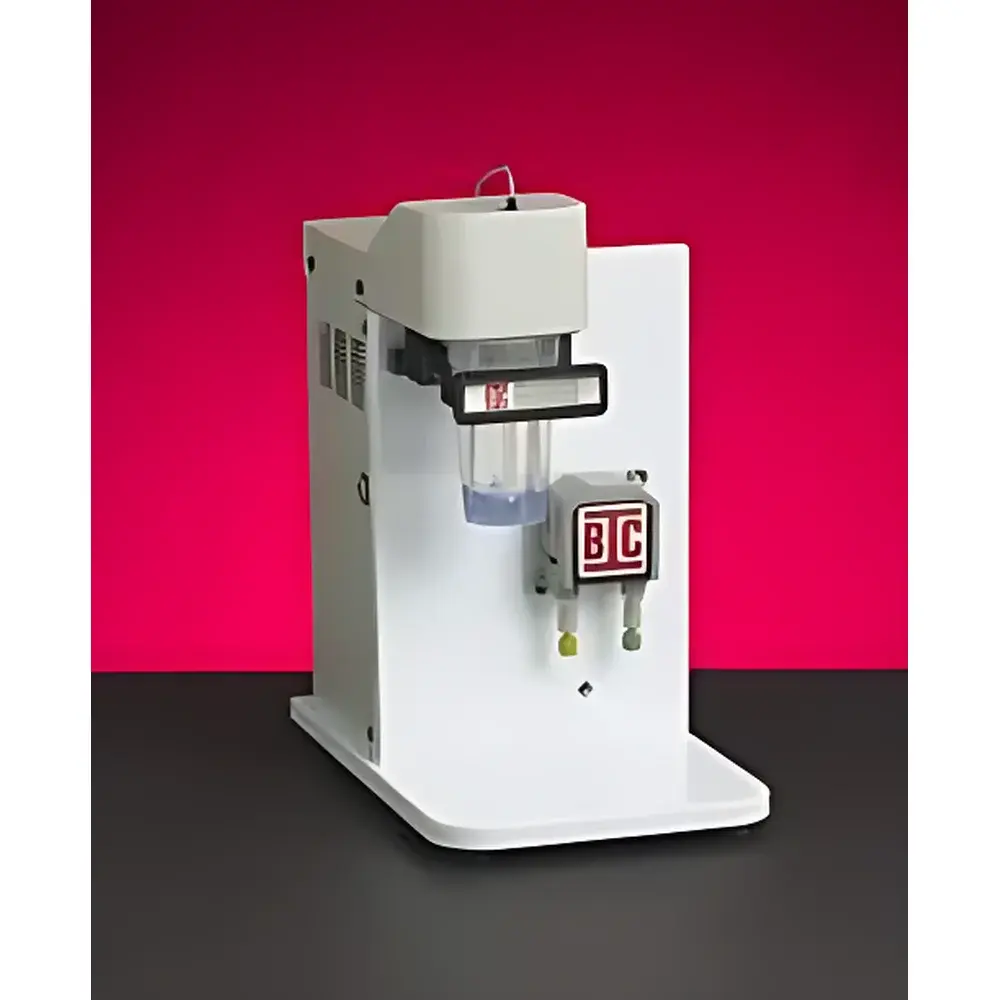
Brookhaven BI-ZTU Automated Titration Unit for Zeta Potential and Particle Size Analysis
| Origin | USA |
|---|---|
| Manufacturer Type | Authorized Distributor |
| Origin Category | Imported Instrument |
| Model | BI-ZTU |
| Pricing | Available Upon Request |
| pH Range | 2–12 |
| Sample Cell Option | Flow-Through Cell |
| Pump Tubing | 1 mm (0.04") ID, Compatible with Teflon®, PEEK®, and EPDM® |
| Included Accessories | Integrated pH Electrode + Four 100 mL Reagent Bottles |
| Drive System | Four Independent Peristaltic Pumps |
Overview
The Brookhaven BI-ZTU Automated Titration Unit is a precision-engineered peripheral module designed exclusively for integration with Brookhaven’s Zeta Potential Analyzers (e.g., BI-200SM, BI-Zeta) and dynamic light scattering (DLS) particle size analyzers. It operates on the principle of controlled peristaltic reagent delivery into a continuously flowing sample stream within a thermostatically stabilized flow-through cell. By automating sequential titrations—spanning pH adjustment (via HCl/NaOH), ionic strength modulation (via KCl, NaCl, or CaCl₂), and surfactant concentration ramping (e.g., SDS, CTAB)—the BI-ZTU enables high-resolution, time-resolved measurement of electrophoretic mobility (converted to zeta potential) and hydrodynamic diameter across variable colloidal stabilization conditions. This eliminates manual sample preparation variability, ensures reproducible titrant addition increments (±0.5% volumetric accuracy), and supports kinetic profiling of surface charge transitions—critical for characterizing polyelectrolyte adsorption, oxide surface protonation, or lipid nanoparticle stability envelopes.
Key Features
- Four independent, digitally controlled peristaltic pumps—each dedicated to a distinct reagent (acid, base, salt, surfactant)—enabling concurrent or sequential titration protocols without cross-contamination.
- Integrated high-precision pH electrode mounted directly in the flow path, providing real-time, in-line pH monitoring with ±0.02 pH unit resolution and automatic temperature compensation (0–50 °C).
- Chemically resistant fluid path: 1 mm inner diameter tubing constructed from fluoropolymer (Teflon®), high-purity PEEK®, and EPDM® elastomer—validated for compatibility with aggressive acids (≤1 M HCl), bases (≤1 M NaOH), organic solvents (e.g., ethanol, isopropanol), and ionic surfactants.
- Modular reagent management: Four standardized 100 mL reservoir bottles with screw-cap lids and integrated tube ports; bottle positions labeled and software-mapped for unambiguous reagent assignment.
- Seamless hardware synchronization: TTL-level triggering and analog feedback signals ensure precise coordination between titrant injection, laser illumination, correlation acquisition, and electrophoretic mobility calculation cycles.
Sample Compatibility & Compliance
The BI-ZTU supports aqueous and polar organic dispersions (e.g., water/ethanol mixtures) with particle concentrations ranging from 0.001 to 10 mg/mL and conductivity up to 200 mS/m. It accommodates nanoparticles (1 nm–10 µm), protein aggregates, liposomes, polymeric micelles, and ceramic colloids. All wetted materials comply with USP Class VI biocompatibility standards. The system architecture supports audit-ready operation under GLP and GMP environments: full electronic log generation (timestamped pump actuations, pH readings, and instrument status flags), user access control via password-protected profiles, and optional 21 CFR Part 11 compliance packages (including digital signatures and immutable data archiving). Method templates adhere to ISO 13099-2 (zeta potential determination) and ASTM E2490 (colloidal stability assessment).
Software & Data Management
Controlled via Brookhaven’s proprietary OmniScan™ software suite (v6.2+), the BI-ZTU integrates as a native module within the instrument’s main acquisition interface. Users define titration sequences using stepwise or gradient-based protocols—including fixed-volume additions, pH-targeted dosing (e.g., “add acid until pH = 4.5”), or conductivity-triggered endpoints. Real-time overlay plots display zeta potential, particle size (Z-average and PDI), pH, and conductivity versus titrant volume or time. Raw data export is available in CSV, TXT, and HDF5 formats; metadata includes instrument configuration, calibration history, and environmental logs (temperature, humidity, operator ID). Batch processing tools enable comparative analysis across multiple samples under identical titration matrices—essential for formulation screening and regulatory submission dossiers.
Applications
- Determination of isoelectric point (IEP) of proteins, silica, titania, and functionalized polymers through automated pH titration coupled with zeta potential reversal detection.
- Quantification of critical coagulation concentration (CCC) by incremental salt addition while monitoring zeta potential collapse and aggregation onset (measured via DLS size growth).
- Optimization of surfactant dosage in nanocarrier formulations—identifying minimum effective concentration (MEC) that maximizes colloidal stability without excess micelle formation.
- Mapping dispersion stability windows across multi-dimensional parameter spaces (pH × ionic strength × surfactant concentration) for QbD-driven process development.
- Accelerated aging studies: simulating long-term storage conditions via controlled ionic drift or pH excursion protocols to predict shelf-life behavior.
FAQ
Can the BI-ZTU be used with non-Brookhaven zeta potential analyzers?
No—the BI-ZTU relies on proprietary electrical signaling, mechanical coupling, and firmware-level synchronization specific to Brookhaven’s Zeta and particle sizing platforms. Retrofitting to third-party instruments is not supported.
Is calibration of the pH electrode performed automatically?
The pH electrode requires manual two-point calibration (pH 4.01 and 7.00 or 10.01 buffers) prior to each session; however, the software stores calibration coefficients and applies temperature-compensated Nernst correction in real time.
What maintenance is required for the peristaltic pumps?
Tubing should be replaced every 200–300 hours of cumulative operation; pump head rollers are factory pre-lubricated and require no routine servicing. A diagnostic mode verifies pump speed accuracy and occlusion pressure before each run.
Does the system support custom reagent delivery profiles beyond linear ramps?
Yes—OmniScan™ allows user-defined scripts (Python-based macros) for non-linear additions, conditional logic (e.g., “if zeta < −15 mV, pause and hold for 60 s”), and external sensor-triggered actions.
How is carryover minimized between titration steps?
The flow-through cell design incorporates a programmable rinse cycle (using deionized water or low-conductivity buffer) between reagent switches, with flow rate and duration fully configurable to achieve <0.1% residual carryover (verified by conductivity baseline recovery).



