
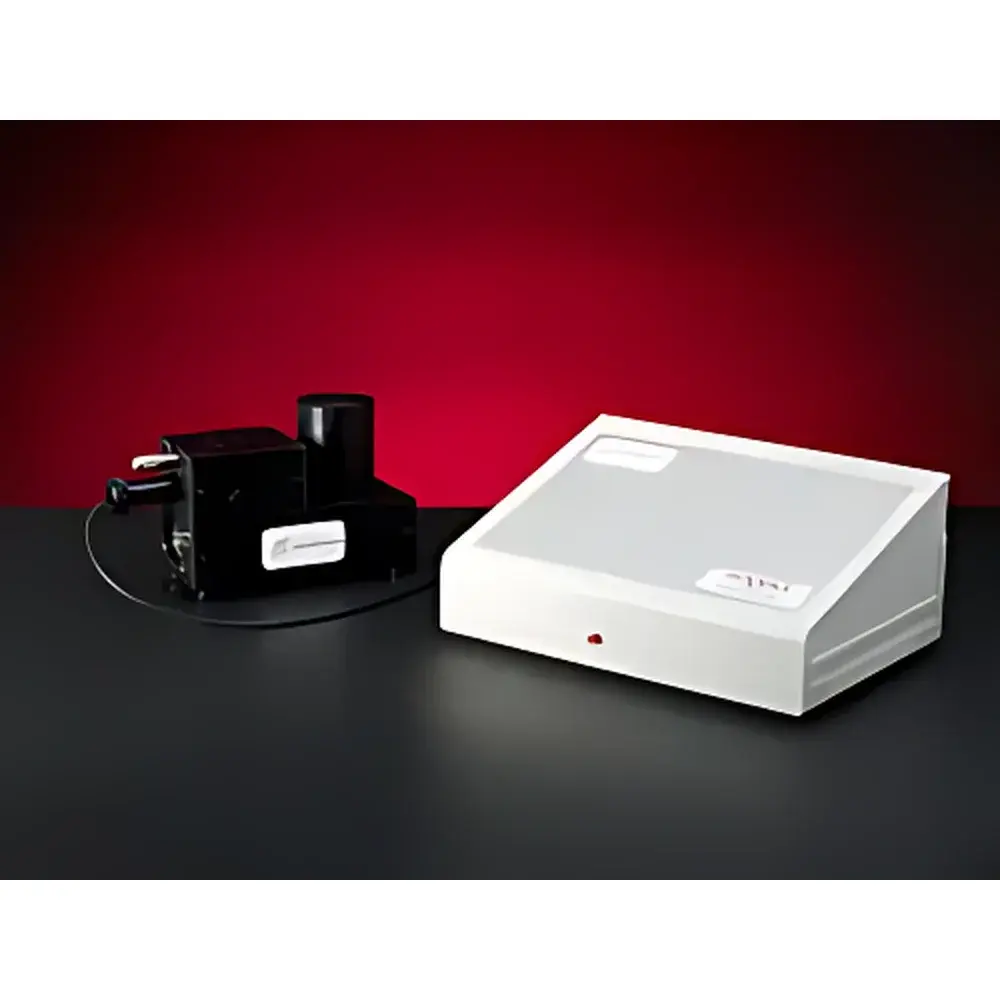
Brookhaven FOQELS Fiber Optic Quasi-Elastic Light Scattering Particle Size Analyzer
| Origin | USA |
|---|---|
| Manufacturer Type | Authorized Distributor |
| Origin Category | Imported |
| Model | FOQELS |
| Pricing | Upon Request |
Overview
The Brookhaven FOQELS Fiber Optic Quasi-Elastic Light Scattering Particle Size Analyzer is a specialized instrument engineered for accurate hydrodynamic size determination of colloidal particles in highly concentrated, optically turbid, or thermally demanding suspensions. Unlike conventional dynamic light scattering (DLS) systems that rely on front- or side-scattering geometries and suffer from multiple scattering artifacts above ~0.1% w/v, the FOQELS platform employs a rigorously optimized backscattering configuration at 145° with fully integrated fiber-optic light delivery and collection. This architecture minimizes path-length-dependent attenuation and enables robust autocorrelation analysis under conditions where traditional DLS fails—extending the practical concentration limit to 40% w/w for many industrial formulations. The system operates on the physical principle of quasi-elastic light scattering (QELS), measuring temporal fluctuations in scattered intensity to derive diffusion coefficients via the Stokes–Einstein relationship. Its design targets applications requiring in-process or formulation-relevant characterization without dilution—such as polymer latexes, ceramic slurries, pharmaceutical nanosuspensions, and high-solid-content lubricants.
Key Features
- Fiber-optic-based optical train ensuring mechanical stability, alignment immunity, and minimal signal loss across extended operational cycles
- Backscattering geometry (145° detection angle) specifically calibrated to suppress multiple scattering contributions in dense dispersions
- Extended concentration range: validated performance from 0.0001% w/w up to 40% w/w, dependent on particle refractive index and size distribution
- Integrated temperature control module with aerospace-grade thermal insulation, supporting stable operation from 6°C to 80°C at ±0.1°C accuracy
- Modular detector options: high-sensitivity photomultiplier tube (PMT) or low-noise avalanche photodiode (APD), selectable based on sample absorbance and required signal-to-noise ratio
- Automated trend analysis capability for real-time monitoring of size evolution versus time, temperature, pH, or additive concentration
- Minimal sample consumption: standard 1 mL quartz cuvette compatible with optional 50 µL micro-volume cell for precious or hazardous materials
Sample Compatibility & Compliance
The FOQELS analyzer accommodates a broad spectrum of colloidal systems—including but not limited to metal oxide nanoparticles, protein aggregates, polymeric micelles, emulsions, and pigment dispersions—provided particles reside within the hydrodynamic diameter range of 0.3 nm to 3 µm. It is particularly suited for samples incompatible with dilution due to instability, aggregation upon dilution, or regulatory constraints (e.g., final-dose biopharmaceutical formulations). Instrument compliance supports laboratory quality frameworks: raw data files include embedded metadata (timestamp, temperature, count rate, correlation function parameters), enabling traceability per FDA 21 CFR Part 11 requirements when deployed with validated software configurations. While not certified to ISO 13321 or ASTM E2490 directly, its measurement methodology aligns with the theoretical foundations and reporting conventions defined therein. Routine verification follows NIST-traceable polystyrene latex standards.
Software & Data Management
Control and analysis are performed via Brookhaven’s proprietary Dynamics software suite, which provides full instrument orchestration, real-time correlation function visualization, and advanced fitting algorithms (including CONTIN, NNLS, and cumulant analysis). All acquired correlation data are stored in vendor-neutral binary format (.dta) with ASCII export options for third-party statistical or process modeling tools. Audit trail functionality logs user actions, parameter changes, and calibration events—supporting GLP/GMP environments when paired with networked deployment and role-based access controls. Batch processing workflows allow automated size distribution reporting across multi-condition experiments (e.g., thermal ramp series or titration sequences), with customizable report templates compliant with internal SOPs.
Applications
- Stability assessment of concentrated drug nanosuspensions during accelerated storage studies
- In-line monitoring of nanoparticle growth kinetics in continuous hydrothermal synthesis reactors
- Quality control of high-solids ceramic slurries used in tape-casting processes
- Aggregation onset detection in monoclonal antibody formulations under thermal stress
- Rheo-optical characterization of associative polymer networks under shear-free thermal cycling
- Characterization of conductive carbon black dispersions in battery electrode slurries prior to coating
FAQ
What is the maximum recommended concentration for reliable size measurement?
For most aqueous and organic colloids with moderate refractive index contrast, the upper validated limit is 40% w/w; however, optimal accuracy is typically achieved below 20% w/w depending on polydispersity and absorption coefficient.
Can FOQELS measure particles larger than 3 µm?
No—the instrument’s detection sensitivity and correlation time resolution are optimized for the sub-micron to low-micron regime; particles >3 µm require complementary techniques such as laser diffraction or imaging-based analysis.
Is the system compatible with corrosive or high-viscosity solvents?
Yes, provided appropriate cuvette material (e.g., sapphire or custom chemically resistant cells) and flow-path modifications are implemented; standard quartz cells are rated for common polar and nonpolar solvents below 80°C.
Does FOQELS support GMP-compliant data archiving?
When configured with Dynamics software v7.2+ and integrated into a validated network infrastructure, it supports electronic signatures, change control logs, and encrypted long-term archival meeting ALCOA+ principles.
How is temperature uniformity maintained during extended thermal ramps?
The heated chamber uses dual-zone PID-controlled Peltier elements combined with vacuum-jacketed insulation and real-time feedback from embedded platinum RTD sensors—ensuring spatial homogeneity better than ±0.15°C across the sample volume.



