
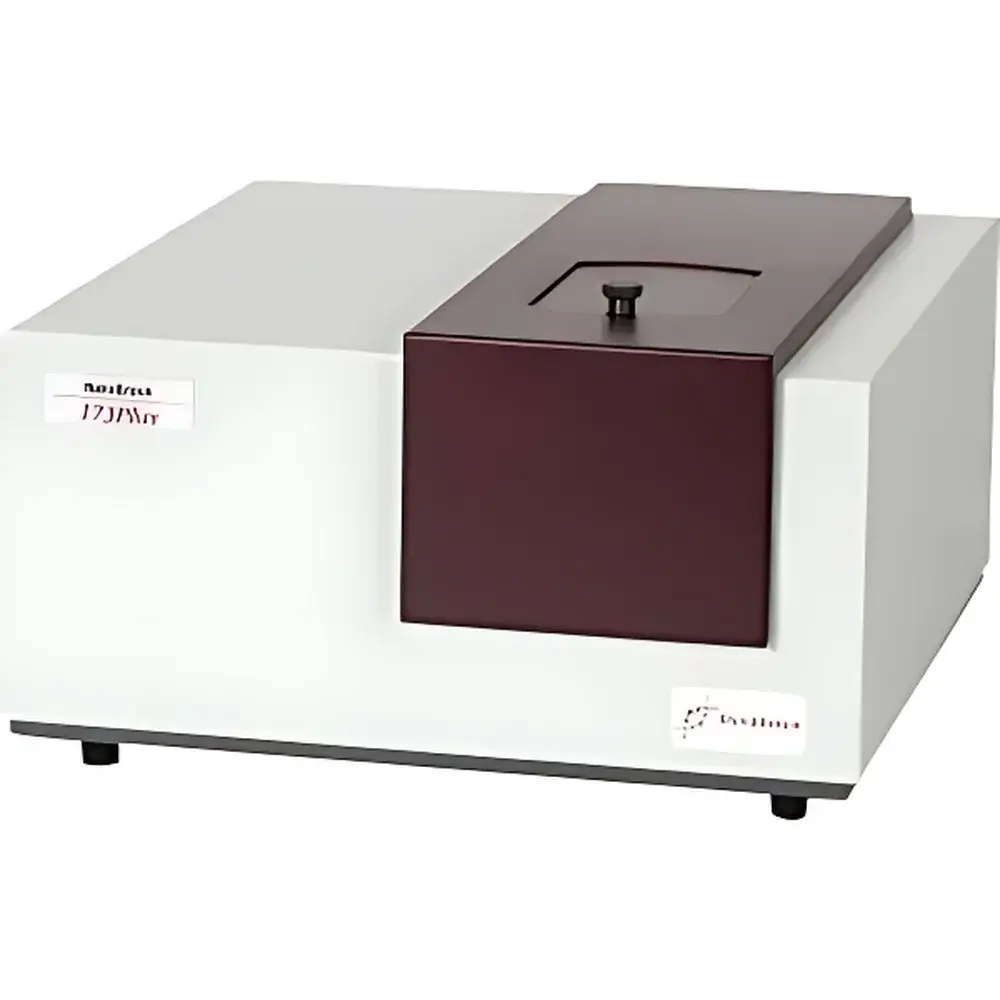
Brookhaven NanoBrook 173Plus Multi-Angle Dynamic Light Scattering (DLS) and Electrophoretic Light Scattering (ELS) Analyzer
| Brand | Brookhaven Instruments |
|---|---|
| Origin | USA |
| Model | 173Plus |
| Particle Size Range | 0.3 nm – 10 μm |
| Concentration Range | 0.1 ppm – 40% w/v |
| Typical Accuracy | ±1% |
| Sample Volume | 10–3000 μL (with 10 μL & 50 μL micro-cells) |
| Molecular Weight Range | 342 – 2×10⁷ Da |
| Temperature Control | −5°C to 120°C (±0.1°C stability) |
| pH Range | 1–14 |
| Laser Source | 40 mW solid-state laser (optional 5 mW He-Ne) |
| Detector | Avalanche Photodiode (APD) |
| Correlator | 4×10¹¹ linear channels, dual-channel cross-correlation support |
| Scattering Angles | 13°, 90°, and 173° (motorized, software-selectable) |
| Optional Modules | Micro-rheology, Zeta Potential, In-line Process Monitoring, Automated Titrator, Dielectric Constant Meter, Viscometer, 21 CFR Part 11 Compliant Software |
Overview
The Brookhaven NanoBrook 173Plus is a high-performance, multi-angle dynamic light scattering (DLS) and electrophoretic light scattering (ELS) analyzer engineered for rigorous colloidal characterization in research, quality control, and regulated manufacturing environments. Unlike conventional single-angle DLS instruments, the 173Plus integrates three precisely calibrated scattering geometries—13°, 90°, and 173°—within a single optical platform. This tri-angle architecture leverages angular-dependent scattering intensity and decay dynamics to resolve heterogeneous particle populations across broad size distributions while maintaining quantitative fidelity at high concentrations (up to 40% w/v). The system employs back-scattering detection at 173° to minimize multiple scattering artifacts in turbid or highly concentrated dispersions, while forward (13°) and side (90°) angles provide complementary sensitivity to sub-nanometer species and larger aggregates. Coupled with a thermally stabilized 40 mW solid-state laser and ultra-low-noise avalanche photodiode (APD), the instrument delivers high signal-to-noise ratio and exceptional reproducibility for both size distribution analysis and zeta potential determination when equipped with optional ELS capability.
Key Features
- Tri-angle scattering optics (13°, 90°, 173°) with motorized angle selection and real-time software optimization
- Extended concentration tolerance: validated performance from 0.1 ppm to 40% w/v without dilution
- High-resolution correlator with 4×10¹¹ linear channels and dual-channel cross-correlation for enhanced noise rejection
- Precise temperature control from −5°C to 120°C (±0.1°C stability) using Peltier-based thermostating
- Micro-volume compatibility: supports analysis with as little as 10 μL using dedicated low-volume cells
- Integrated pH measurement capability (range 1–14) via optional probe interface for colloid stability studies
- Modular expansion architecture supporting micro-rheology, real-time in-line monitoring, automated titration, dielectric constant measurement, and solution viscosity analysis
Sample Compatibility & Compliance
The NanoBrook 173Plus accommodates a wide range of colloidal systems—including nanoparticles, liposomes, protein aggregates, polymer micelles, and inorganic dispersions—suspended in aqueous or organic media. Its angular flexibility enables robust sizing of polydisperse samples where traditional 90° DLS fails due to dominant large-particle scattering or insufficient small-particle signal. The system complies with ISO 22412:2017 (DLS methodology), ASTM E2490 (zeta potential by ELS), and USP and guidelines for subvisible particle assessment in pharmaceutical formulations. When configured with the 21 CFR Part 11 software module, it supports audit trails, electronic signatures, role-based access control, and data integrity protocols required for GLP and GMP-regulated laboratories.
Software & Data Management
Operating on Windows-based Brookhaven BI-9000AT software, the 173Plus provides comprehensive data acquisition, modeling, and reporting tools. Algorithms include CONTIN, NNLS, and cumulant analysis for size distribution deconvolution; phase analysis light scattering (PALS) for high-resolution zeta potential; and time-resolved trend analysis for kinetic studies (e.g., aggregation onset, thermal denaturation). Raw correlation data are stored in vendor-neutral formats (e.g., .COR, .DAT) and exportable to third-party statistical or modeling platforms. The 21 CFR Part 11-compliant version enforces full traceability: all parameter changes, instrument calibrations, and report generations are timestamped and user-logged with immutable audit history.
Applications
- Stability screening of biopharmaceutical formulations under varying pH, ionic strength, and temperature conditions
- Characterization of nanocarriers (e.g., LNPs, polymeric NPs) during process development and batch release testing
- Monitoring colloidal aggregation kinetics during accelerated stability studies
- Determination of hydrodynamic radius and molecular weight of proteins, peptides, and synthetic polymers
- Micro-rheological assessment of weakly structured soft matter (e.g., gels, viscoelastic surfactant solutions)
- In-line process analytical technology (PAT) deployment for continuous nanoparticle synthesis or purification
FAQ
What scattering angles does the NanoBrook 173Plus support, and how are they selected?
The system offers fixed-angle measurements at 13°, 90°, and 173°, selectable via software-controlled motorized optics. Angle choice is optimized based on sample opacity, expected size range, and required resolution.
Can the 173Plus measure zeta potential without hardware modification?
Zeta potential capability requires optional electrophoretic light scattering (ELS) hardware, including high-voltage electrodes and phase-sensitive detection electronics.
Is the 10 μL micro-cell compatible with all scattering angles?
Yes—the micro-cell design maintains optical alignment integrity across all three angles, though optimal signal-to-noise at 13° may require careful cell positioning and refractive index matching.
How does the 173Plus handle highly absorbing or fluorescent samples?
The 40 mW solid-state laser minimizes fluorescence excitation relative to He-Ne sources, and the APD detector’s spectral response (400–1000 nm) allows selection of optimal wavelength via optional laser modules.
Does the system support automated method validation per ICH Q5A/Q5B guidelines?
While the instrument itself does not perform validation, its documented performance specifications, calibration traceability, and 21 CFR Part 11 software enable full compliance with ICH analytical procedure validation requirements when integrated into a validated laboratory workflow.
Related Products



