
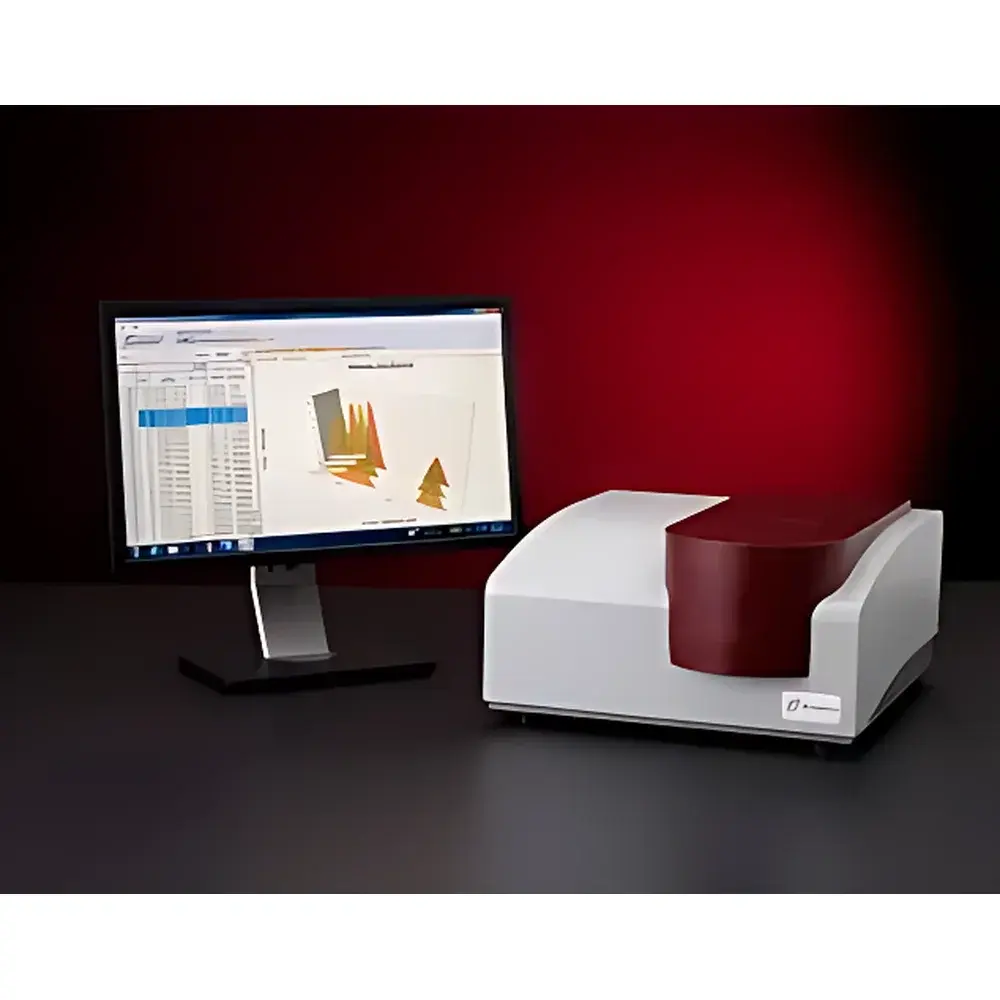
Brookhaven NanoBrook 90Plus Laser Particle Size Analyzer
| Brand | Brookhaven |
|---|---|
| Origin | USA |
| Model | NanoBrook 90Plus |
| Dispersion Method | Wet Dispersion |
| Measurement Range | 0.3 nm – 15 µm |
| Repeatability | ±1% |
| Measurement Time | 1–2 min |
| Temperature Control Range | −5 °C to 110 °C (±0.1 °C) |
| Sample Volume | 10–3000 µL |
| Laser Source | 40 mW Solid-State Laser |
| Detector | PMT or APD |
| Correlator | 4×10¹¹ Linear Channels, 4-Channel Input, Dual Cross-Correlation Support |
| Scattering Angles | 15° and 90° Options |
| Zeta Potential Option | Available |
| Software Compliance | 21 CFR Part 11 Audit Trail Mode |
Overview
The Brookhaven NanoBrook 90Plus Laser Particle Size Analyzer is a high-performance, research-grade instrument engineered for precision particle sizing and molecular characterization in colloidal and nanoscale systems. It operates on the fundamental principle of Dynamic Light Scattering (DLS), where Brownian motion of particles suspended in a liquid medium induces temporal fluctuations in scattered laser intensity. These fluctuations are captured by a high-sensitivity photodetector (PMT or APD) and processed via a state-of-the-art digital correlator with 4×10¹¹ linear channels. The resulting autocorrelation function is fitted using established algorithms to extract the diffusion coefficient, which—via the Stokes–Einstein equation—is converted into hydrodynamic diameter and its distribution. Complementing DLS, the system supports optional electrophoretic light scattering (ELS) for zeta potential analysis, enabling comprehensive physicochemical assessment of colloidal stability and surface charge behavior.
Key Features
- Ultra-broad sizing range from 0.3 nm to 15 µm—covering proteins, polymers, liposomes, nanoparticles, and submicron emulsions—without hardware reconfiguration.
- Dual-angle detection (15° and 90°) optimized for low- and high-concentration samples respectively, minimizing multiple scattering artifacts and enhancing resolution for polydisperse systems.
- Integrated dual-stage thermoregulation system delivering ±0.1 °C stability across −5 °C to 110 °C, critical for temperature-dependent studies such as protein unfolding (Tm), aggregation kinetics, and thermal reversibility.
- Modular microvolume cell options—including 10 µL and 50 µL quartz cuvettes—designed for precious or limited-availability samples while maintaining optical integrity and signal-to-noise ratio.
- Real-time trend analysis engine capable of monitoring size, polydispersity index (PDI), and count rate versus time, temperature, pH, or titrant addition—enabling automated stability screening and formulation development workflows.
- FDA 21 CFR Part 11-compliant software mode with electronic signatures, full audit trail, user access control, and data integrity safeguards—fully aligned with GLP/GMP-regulated environments.
Sample Compatibility & Compliance
The NanoBrook 90Plus accommodates a wide spectrum of sample types: aqueous and organic suspensions, protein solutions, polymer dispersions, micellar systems, and inorganic colloids—provided they are optically transparent at the selected scattering angle. Its open-cell design allows complete rinsing between measurements, eliminating carryover and cross-contamination risks. Instrument compliance extends beyond hardware performance: it meets ISO 22412:2017 (DLS methodology), ASTM E2490-21 (nanoparticle size measurement), and supports validation protocols required under USP , , and ICH Q5A(R2). All firmware and software updates are documented per change control procedures, and raw correlation data files are stored in vendor-neutral formats (e.g., .COR, .DAT) for third-party reanalysis.
Software & Data Management
The proprietary Brookhaven BI-DLS software provides intuitive workflow-driven operation—from automated measurement setup and real-time quality metrics (e.g., count rate, baseline stability, fit residuals) to advanced modeling (cumulant, CONTIN, NNLS). Batch processing, report generation (PDF/Excel), and metadata embedding (operator ID, timestamp, instrument log) are standard. For regulated laboratories, the 21 CFR Part 11 mode enforces role-based permissions, session locking, and immutable audit logs tracking every parameter modification, data export, or calibration event. Raw data and processed results are archived with SHA-256 checksums, supporting long-term data integrity verification and regulatory inspections.
Applications
- Biopharmaceutical development: Monitoring monoclonal antibody aggregation, PEGylated protein stability, and liposomal encapsulation efficiency.
- Materials science: Characterizing quantum dots, metal oxide nanoparticles, and stimuli-responsive polymer micelles under varying pH or ionic strength.
- Quality control: Release testing of nanosuspensions, inhalable dry powders (after dispersion), and parenteral emulsions per pharmacopeial monographs.
- Academic research: Quantifying conformational transitions in intrinsically disordered proteins, studying nanoparticle–biomembrane interactions, and mapping critical micelle concentration (CMC) profiles.
- Formulation optimization: Screening excipient effects on colloidal stability, evaluating freeze-thaw or shear-induced particle growth, and establishing shelf-life predictive models.
FAQ
What particle concentration range is suitable for accurate DLS measurement on the NanoBrook 90Plus?
Optimal concentration depends on particle size and refractive index contrast but typically spans 0.1–10 mg/mL for proteins and 10⁹–10¹² particles/mL for inorganic nanoparticles. The instrument’s wide dynamic range and dual-angle capability allow robust sizing across this spectrum without dilution.
Can the system measure both size and zeta potential in the same sample run?
No—size (DLS) and zeta potential (ELS) require different optical configurations and electrode setups. However, the same sample can be sequentially analyzed using interchangeable cells, with automated parameter transfer between modules.
Is the 10 µL microcell compatible with all scattering angles?
The 10 µL cell is validated for 90° detection only; 15° measurements require the standard 3 mL cell or 50 µL cell due to path-length and alignment constraints.
Does the instrument support GMP-compliant reporting for regulatory submissions?
Yes—when operated in 21 CFR Part 11 mode, all reports include embedded electronic signatures, full traceability, and tamper-evident file packaging compliant with FDA, EMA, and PMDA expectations.
How is temperature calibration verified during routine operation?
The system employs NIST-traceable platinum resistance thermometers (PRTs) with automatic self-calibration checks before each temperature-ramped experiment, logged in the audit trail.



