
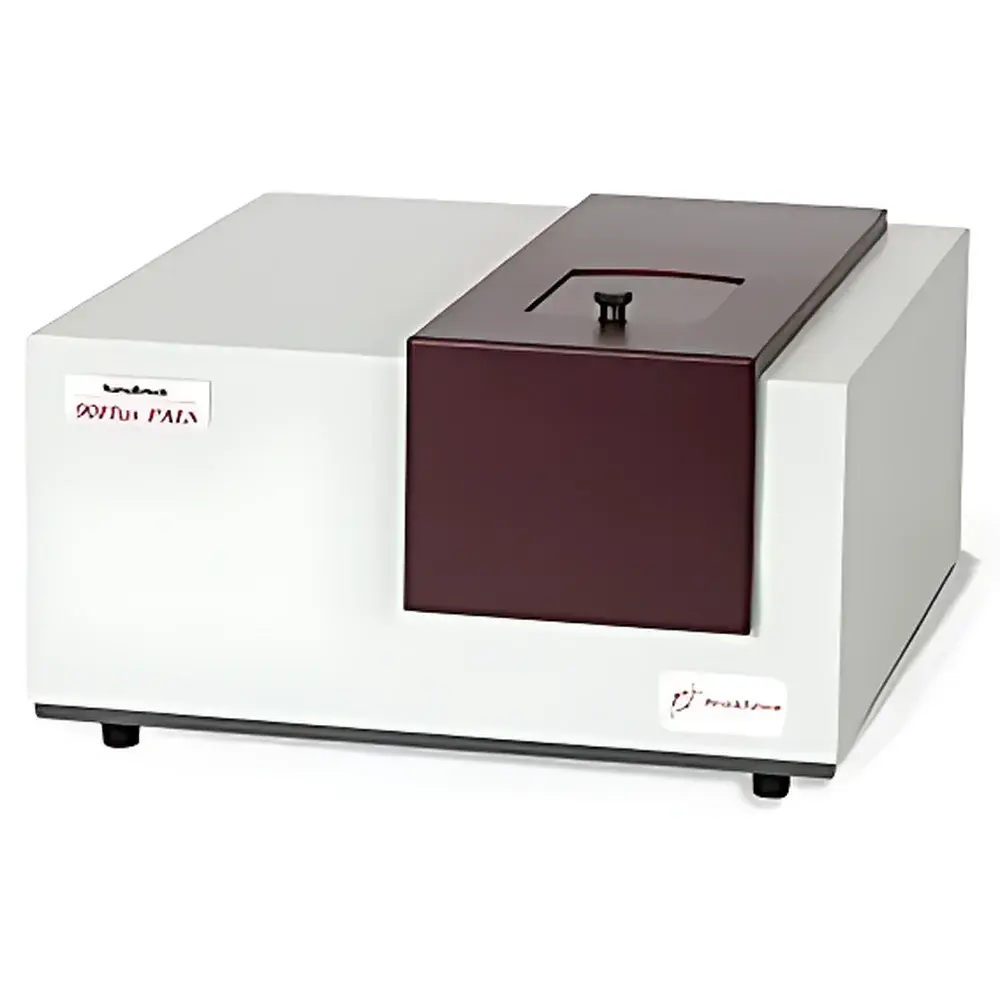
Brookhaven NanoBrook 90plus PALS High-Sensitivity Zeta Potential and Particle Size Analyzer
| Brand | Brookhaven |
|---|---|
| Origin | USA |
| Manufacturer Type | Authorized Distributor |
| Origin Category | Imported |
| Model | NanoBrook 90plus PALS |
| Dispersion Method | Wet Dispersion |
| Particle Size Range | 0.3 nm – 15 µm |
| Repeatability | ±1% |
| Measurement Time | 1–2 min |
| Zeta Potential Measurement Principle | Phase Analysis Light Scattering (PALS) |
| Temperature Control Range | −5 °C to 110 °C (±0.1 °C) |
| Scattering Angles | 15° and 90° |
| Laser Source | 40 mW Solid-State Laser (He-Ne Optional) |
| Detector | APD or PMT |
| Correlator | 4×10¹¹ linear channels, 4-channel input, dual cross-correlation support |
| Electrophoretic Mobility Range | 10⁻¹¹ – 10⁻⁷ m²/V·s |
| Conductivity Range | 0 – 30 S/m |
| pH Range | 1 – 14 |
| Sample Volume | 10 µL – 3 mL (with 10 µL & 50 µL micro-cells) |
| Molecular Weight Range | 342 – 2×10⁷ Da |
Overview
The Brookhaven NanoBrook 90plus PALS is a high-sensitivity, dual-function instrument engineered for simultaneous and independent measurement of particle size distribution and zeta potential in colloidal dispersions. It employs Dynamic Light Scattering (DLS) for hydrodynamic diameter determination and Phase Analysis Light Scattering (PALS) — a proprietary hardware-based electrophoretic light scattering technique — for high-fidelity zeta potential analysis. Unlike conventional frequency-shift-based electrophoretic methods, PALS detects phase shifts induced by particle motion under an applied electric field, delivering up to 1000× greater sensitivity in low-mobility systems. This enables robust characterization of challenging samples including high-salt formulations, organic solvents, low-dielectric media, viscous polymer solutions, and particles near their isoelectric point — conditions where traditional laser Doppler velocimetry often fails.
Key Features
- Hardware-integrated PALS electronics with real-time phase demodulation, eliminating reliance on signal averaging and enabling sub-mV/cm field strength measurements
- Dual-angle detection (15° and 90°) optimized for broad size range coverage: 0.3 nm to 15 µm, validated across refractive index and concentration gradients
- Precision temperature control from −5 °C to 110 °C (±0.1 °C stability), supporting thermal unfolding studies (e.g., protein melting point determination) and accelerated stability testing
- Ultra-low volume capability: compatible with 10 µL and 50 µL quartz micro-cells, minimizing sample consumption for precious biologics and synthetic nanomaterials
- High-resolution digital correlator with 4×10¹¹ linear channels and dual-input cross-correlation architecture, ensuring statistical robustness in polydisperse and weakly scattering systems
- Integrated pH, conductivity, and temperature monitoring during electrophoretic runs — critical for method development under ICH Q5C and USP guidelines
Sample Compatibility & Compliance
The NanoBrook 90plus PALS accommodates a wide spectrum of colloidal systems: proteins, peptides, liposomes, exosomes, polymeric micelles, polysaccharides, surfactant-stabilized emulsions (O/W, W/O), pigment dispersions, ceramic slurries, carbon black suspensions, and wastewater colloids. Its design conforms to key regulatory frameworks for analytical instrumentation used in GMP environments: optional 21 CFR Part 11-compliant software provides full audit trail, electronic signatures, and role-based access control. Instrument materials meet USP Class VI biocompatibility requirements; all optical components are certified for laser safety (IEC 60825-1). Data integrity aligns with ALCOA+ principles, and raw correlation data files (.COR) are vendor-neutral and exportable for third-party validation per ISO/IEC 17025.
Software & Data Management
Particle Solution™ software delivers comprehensive, model-agnostic data analysis: cumulant, CONTIN, NNLS, and regularization-based inversion algorithms for size distribution; Smoluchowski and Henry models with adjustable f(κa) for zeta potential interpretation. Automated trend analysis correlates particle size, polydispersity index (PDI), zeta potential, and intensity over time, temperature, pH, or ionic strength — essential for formulation screening and shelf-life prediction. Batch processing supports IQ/OQ/PQ documentation workflows. Raw data and metadata are stored in HDF5 format, enabling traceability and integration with LIMS or ELN platforms. Optional modules include automated titration control (pH/conductivity/additive ramping), micro-rheology (via DLS-derived mean-square displacement), and online coupling interfaces for SEC/GPC systems using analog voltage output and TTL synchronization.
Applications
- Biopharmaceutical development: monitoring aggregation onset in monoclonal antibodies, assessing colloidal stability of mRNA-LNPs, and characterizing isoelectric behavior of viral vectors
- Advanced material synthesis: optimizing surface charge of quantum dots, cerium oxide nanoparticles, and metal-organic frameworks (MOFs) for dispersion stability
- Coatings & inks: quantifying electrostatic stabilization mechanisms in pigment dispersions and predicting flocculation thresholds via DLVO modeling
- Food & cosmetics: evaluating emulsion breakdown kinetics in dairy analogs and determining surfactant adsorption efficiency on silica nanoparticles
- Environmental science: analyzing zeta potential shifts in natural organic matter–clay complexes under varying ionic strength and pH gradients
FAQ
What distinguishes PALS from standard laser Doppler electrophoresis?
PALS measures phase shift rather than frequency shift in scattered light, enabling direct detection of slow electrophoretic motion without requiring high field strengths or long acquisition times — critical for low-mobility particles in high-conductivity media.
Can the instrument measure zeta potential in non-aqueous solvents?
Yes — its high-sensitivity PALS electronics and optional dielectric constant module allow reliable zeta potential determination in ethanol, THF, toluene, and other low-dielectric media when paired with appropriate electrodes and cell configurations.
Is the system compliant with FDA 21 CFR Part 11 for regulated laboratories?
The optional 21 CFR Part 11 software package provides full electronic record and signature functionality, including audit trails, user authentication, and data encryption — validated for use in pharmaceutical QC and regulatory submissions.
How does the dual-angle configuration improve measurement accuracy?
90° detection maximizes signal-to-noise for small particles (1 µm) and reduces multiple scattering artifacts in concentrated or turbid samples.
What sample preparation protocols are recommended for protein analysis?
Use filtered (0.1 µm) low-conductivity buffers (e.g., 10 mM phosphate, pH 7.4); avoid glycerol or sucrose unless viscosity correction is applied; pre-centrifuge at 14,000 × g to remove aggregates prior to loading into the 10 µL micro-cell.



