
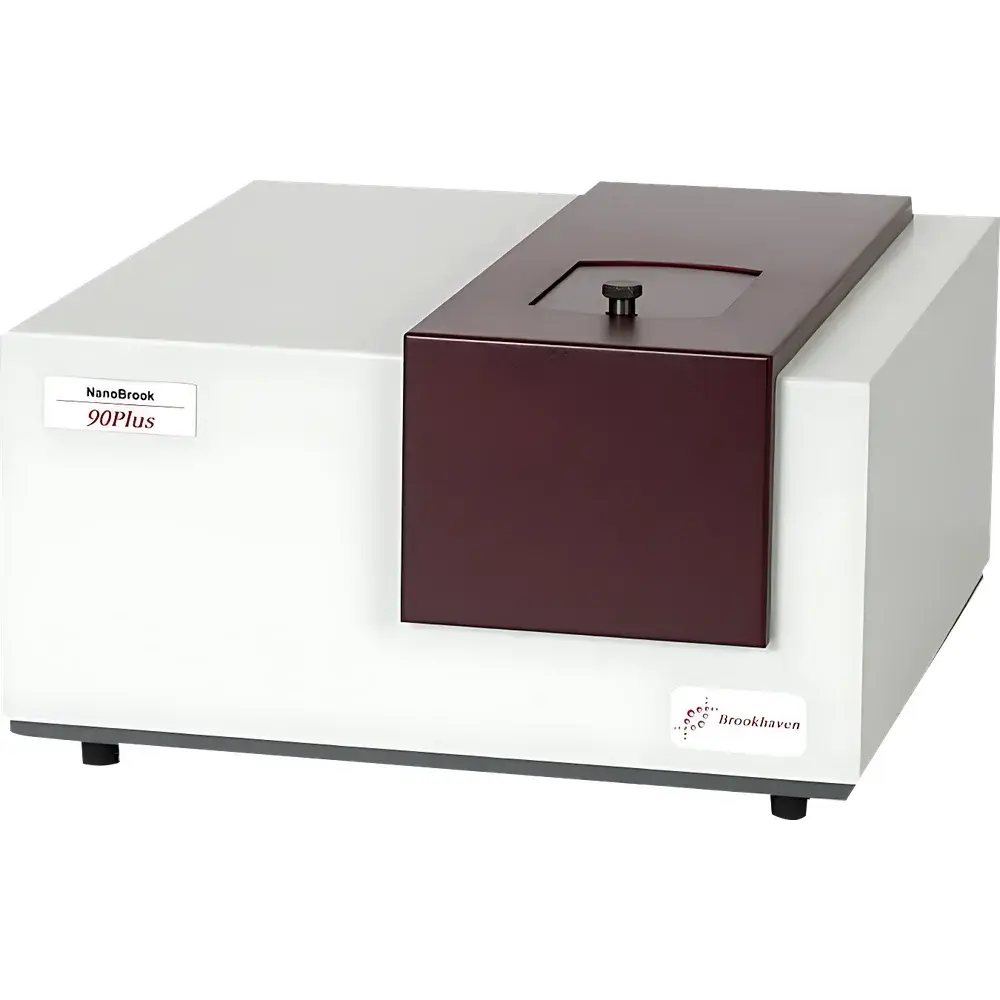
Brookhaven NanoBrook 90Plus Zeta Nanoparticle Size and Zeta Potential Analyzer
| Brand | Brookhaven |
|---|---|
| Origin | USA |
| Manufacturer Type | Authorized Distributor |
| Origin Category | Imported |
| Model | NanoBrook 90Plus Zeta |
| Dispersion Method | Wet Dispersion |
| Instrument Type | Laboratory Laser Particle Size Analyzer |
| Size Range | 0.3 nm – 15 µm |
| Repeatability | ±1% |
| Measurement Time | 1–2 min |
Overview
The Brookhaven NanoBrook 90Plus Zeta is a dual-function benchtop instrument engineered for high-precision, simultaneous characterization of nanoparticle hydrodynamic size and surface zeta potential in colloidal dispersions. It integrates two well-established light-scattering techniques: Dynamic Light Scattering (DLS) for particle sizing and Electrophoretic Light Scattering (ELS) for zeta potential determination. DLS relies on time-dependent fluctuations in scattered laser intensity to compute diffusion coefficients via autocorrelation analysis; ELS applies an oscillating electric field across the sample cell and measures Doppler frequency shifts in scattered light to derive electrophoretic mobility—subsequently converted to zeta potential using the Henry or Smoluchowski approximation. Designed for rigorous R&D and QC environments, the system operates with calibrated thermal stability (±0.1 °C over −5 to 110 °C), dual-angle detection (15° and 90°), and a high-sensitivity avalanche photodiode (APD) or photomultiplier tube (PMT) detector. Its architecture supports both batch and flow-through configurations, enabling integration with SEC/GPC systems for real-time aggregation monitoring during chromatographic separation.
Key Features
- Dual-mode operation: Simultaneous or independent acquisition of DLS-based particle size distribution and ELS-derived zeta potential
- Extended dynamic range: Size measurement from 0.3 nm to 15 µm; zeta potential applicable to particles 1 nm–100 µm in diameter
- High-resolution correlation: 4×10¹¹ linear channels with dual-channel cross-correlation capability for enhanced signal fidelity
- Modular temperature control: Peltier-based thermostating with ±0.1 °C accuracy across −5 °C to 110 °C, supporting protein thermal denaturation studies
- Flexible sample handling: Compatible with standard 1–3 mL cuvettes, 50 µL micro-cells, and ultra-low-volume 10 µL cells for precious biological samples
- Robust electrode design: Corrosion-resistant, reusable insertable electrodes optimized for low-conductivity and high-pH media (pH 1–14)
- Multi-parameter trend analysis: Automated time-, temperature-, pH-, and conductivity-resolved tracking of size and zeta evolution
Sample Compatibility & Compliance
The NanoBrook 90Plus Zeta accommodates a broad spectrum of colloidal systems—including proteins, peptides, liposomes, exosomes, polymeric latices, microemulsions, pigment dispersions, ceramic slurries, and wastewater colloids—provided they are suspended in optically clear, low-viscosity media. It complies with ISO 22412:2017 (DLS) and ISO 13099-2:2012 (ELS) for standardized reporting. Optional 21 CFR Part 11-compliant software provides audit-trail logging, electronic signatures, and role-based access control—meeting GLP and GMP requirements for pharmaceutical development and regulatory submissions. All wetted components are chemically inert (e.g., quartz, PTFE, stainless steel), ensuring compatibility with organic solvents, acidic/basic buffers, and saline solutions up to 20 S/m conductivity.
Software & Data Management
Particle Solution™ software serves as the unified platform for instrument control, data acquisition, and advanced statistical analysis. It implements multiple inversion algorithms (Cumulants, NNLS, CONTIN) and model-based fitting (e.g., spherical, rod-like, core-shell) for polydisperse systems. Built-in modules support automatic baseline correction, viscosity and refractive index compensation, and batch processing of multi-condition experiments. The software exports fully annotated reports in PDF, CSV, and XML formats, with metadata embedded per ASTM E2918-22 guidelines. Optional add-ons include automated titration control (for pH/conductivity sweeps), micro-rheology analysis (via intermediate scattering function), and real-time streaming interfaces for inline process monitoring.
Applications
- Biopharmaceutical development: Stability assessment of monoclonal antibodies, mRNA-LNPs, and viral vectors via size/zeta trending under stress conditions
- Formulation science: Optimization of emulsion invert points, surfactant efficiency, and colloidal charge stabilization in cosmetics and agrochemicals
- Materials synthesis: In situ monitoring of nanoparticle nucleation, growth, and aggregation kinetics during sol-gel processes
- Environmental analysis: Quantification of natural organic matter (NOM) conformational changes and metal oxide colloid behavior across pH gradients
- Quality assurance: Release testing of nanomedicine batches per USP <729> and ICH Q5A(R2) comparability protocols
FAQ
What is the minimum required sample volume for standard measurements?
Standard measurements require 1–3 mL in a quartz cuvette; optional 50 µL and 10 µL micro-cells reduce volume demand for high-value biologics.
Can the instrument measure zeta potential in high-salt or non-aqueous media?
Yes—it supports conductivities up to 20 S/m and offers electrode configurations validated for ethanol, isopropanol, and DMF-based dispersions.
Is calibration traceable to NIST standards?
Size calibration uses NIST-traceable polystyrene and silica nanosphere reference materials (SRM 1963, SRM 8012); zeta calibration employs certified latex standards with documented mobility values.
Does the system support method validation per regulatory guidelines?
Yes—the 21 CFR Part 11 software package includes IQ/OQ documentation templates, performance qualification protocols, and raw data integrity safeguards aligned with FDA and EMA expectations.
How does the dual-angle detection improve measurement robustness?
Simultaneous 15° and 90° scattering enhances sensitivity to both large aggregates (low-angle dominance) and small nanoparticles (high-angle dominance), reducing bias in polydisperse or multimodal samples.



