
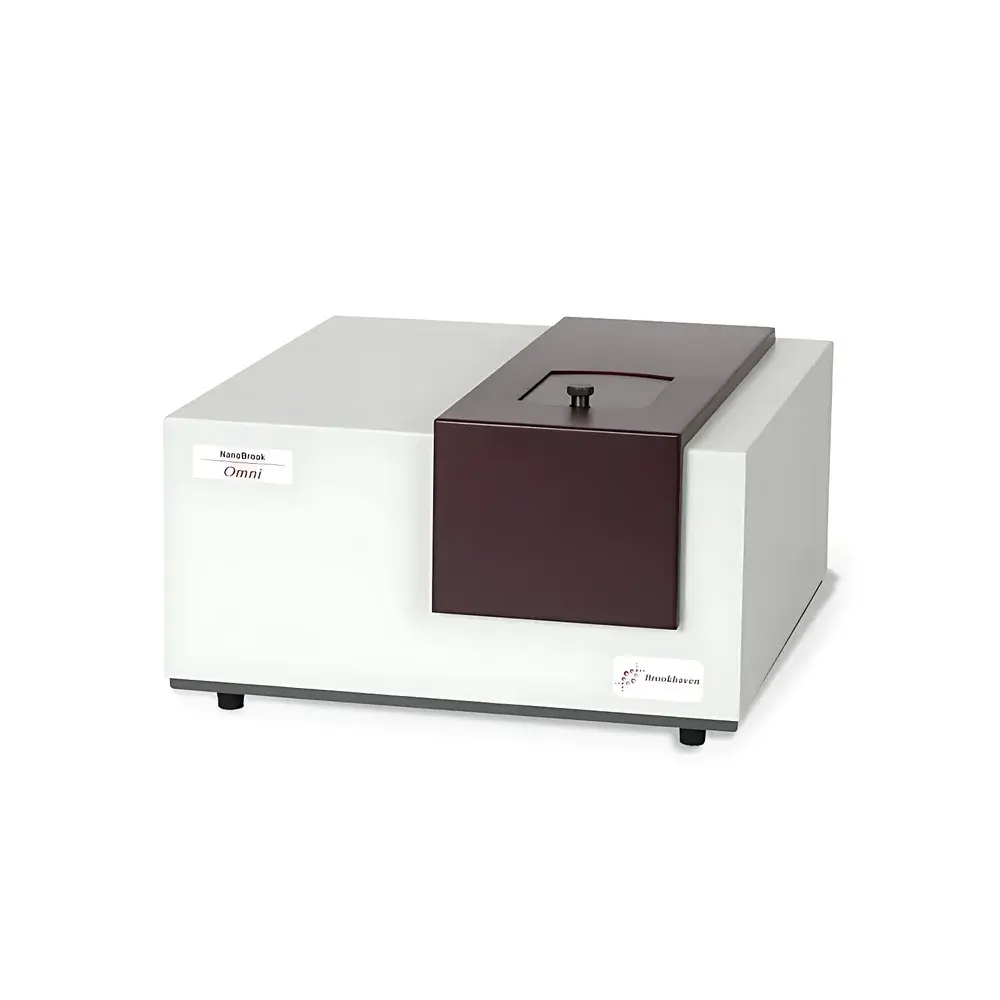
Brookhaven NanoBrook Omni Multi-Angle Particle Size and High-Sensitivity Zeta Potential Analyzer
| Brand | Brookhaven |
|---|---|
| Origin | USA |
| Model | NanoBrook Omni |
| Dispersion Method | Wet Dispersion |
| Particle Size Range | 0.3 nm – 15 µm |
| Repeatability | <1% |
| Measurement Time | 1–2 min |
| Scattering Angles | 13°, 90°, 173° |
| Zeta Potential Technique | Hardware-Based Phase Analysis Light Scattering (PALS) |
| Concentration Range | 0.1 ppm – 40% w/v |
| Temperature Control | −5 °C to 120 °C (±0.1 °C) |
| Sample Volume | 10 µL – 3 mL |
| Laser Source | 40 mW Solid-State Laser (optional 5 mW He-Ne) |
| Detector | APD |
| Correlator | 4×10¹¹ linear channels, 4-channel input, dual cross-correlation support |
| Electrophoretic Mobility Range | 10⁻¹¹ – 10⁻⁷ m²/V·s |
| Conductivity Range | 0 – 30 S/m |
| pH Range | 1 – 14 |
| Molecular Weight Range | 342 – 2×10⁷ Da |
| Optional Compliance | 21 CFR Part 11 Software Module |
Overview
The Brookhaven NanoBrook Omni is a high-performance multi-angle dynamic light scattering (DLS) and electrophoretic light scattering (ELS) analyzer engineered for comprehensive colloidal characterization in research, quality control, and regulatory environments. It integrates three precisely calibrated scattering angles—13°, 90°, and 173°—to simultaneously optimize signal capture across the full particle size spectrum, from sub-nanometer biomolecules to micrometer-scale aggregates. Unlike conventional single-angle DLS systems, the Omni’s backscattering-enhanced optical architecture enables robust measurements at concentrations up to 40% w/v without dilution, eliminating artifacts associated with sample preparation and improving statistical reliability. Its core measurement principle relies on intensity autocorrelation (for size) and phase-resolved heterodyne detection (for zeta potential), implemented via proprietary hardware-based Phase Analysis Light Scattering (PALS). This eliminates reliance on low-signal-frequency-shift analysis, delivering >1000× improved sensitivity for challenging samples—including those in high-salt buffers, organic solvents, viscous media, or near their isoelectric point.
Key Features
- Triple-angle optical configuration (13°, 90°, 173°) for unified size analysis across 0.3 nm – 15 µm, with angle-specific optimization for small particles (173° backscatter), mid-range colloids (90°), and large aggregates (13° forward scatter)
- Hardware-integrated PALS electronics enabling direct phase-difference measurement—no software post-processing—ensuring high reproducibility and minimal voltage-dependent noise
- Wide operational concentration range (0.1 ppm – 40% w/v), validated per ISO 22412:2017 Annex C for concentrated dispersions
- Precise thermal control (−5 °C to 120 °C, ±0.1 °C stability) with programmable ramping and hold profiles for temperature-dependent stability studies (e.g., protein unfolding transitions)
- Modular design supporting optional add-ons: micro-rheology (via passive microrheology mode), surface membrane potential analysis, real-time inline monitoring (compatible with flow cells and GPC/SEC systems), automated titration (pH/conductivity/additive profiling), dielectric constant measurement, and integrated viscometry
- High-sensitivity APD detector coupled to a 4×10¹¹-channel digital correlator with dual-input cross-correlation capability for enhanced signal-to-noise ratio in polydisperse or weakly scattering systems
Sample Compatibility & Compliance
The NanoBrook Omni accommodates diverse sample types relevant to pharmaceutical development, nanomaterial synthesis, and industrial formulation. It supports aqueous and non-aqueous suspensions—including liposomes, exosomes, polymeric micelles, peptide assemblies, latex emulsions, pigment dispersions, and ceramic slurries—with minimal volume requirements (as low as 10 µL using the ultra-low-volume cell). The system complies with GLP/GMP documentation standards when configured with the optional 21 CFR Part 11 software module, which provides electronic signature validation, audit trail logging, user role-based access control, and data integrity safeguards aligned with FDA expectations. All electrokinetic measurements adhere to ASTM D7826–17 (Standard Test Method for Zeta Potential of Colloidal Dispersions) and ISO 13099-2:2012 (Colloidal systems — Methods for zeta-potential determination — Part 2: Optical methods).
Software & Data Management
Particle Solution™ software serves as the unified platform for instrument control, real-time data acquisition, and advanced statistical analysis. It implements multiple established inversion algorithms—including CONTIN, NNLS, and regularization-based distribution modeling—alongside custom-fit models for bimodal and multimodal systems. Time-resolved and temperature-resolved trend analysis tools enable automated monitoring of aggregation kinetics, thermal denaturation profiles, or formulation stability under stress conditions. Raw correlation data, phase traces, and mobility histograms are stored in vendor-neutral formats (e.g., CSV, HDF5) for third-party processing. Audit trails record all parameter changes, measurement events, and user actions with timestamps and operator IDs—fully traceable for regulatory submissions. Optional integration with LIMS and ELN platforms is supported via standard API protocols.
Applications
- Biopharmaceutical characterization: monoclonal antibody aggregation, PEGylated protein stability, mRNA-LNP size uniformity, and zeta potential mapping across pH gradients
- Nanomedicine development: liposome batch consistency, exosome isolation QC, polymeric nanoparticle charge screening for cellular uptake prediction
- Materials science: ceramic slurry rheology prediction via size/zeta correlation, carbon black dispersion stability in electrode inks, pigment flocculation onset detection
- Consumer product R&D: emulsion inversion point identification in cosmetics, sunscreen particle photostability assessment, food-grade nanoemulsion shelf-life modeling
- Environmental analysis: wastewater floc size distribution under varying ionic strength, nanoparticle fate and transport behavior in simulated groundwater matrices
FAQ
What scattering angles does the NanoBrook Omni use, and why are they significant?
The Omni employs 13°, 90°, and 173° scattering geometries. The 173° backscatter angle maximizes signal from nanoparticles (1 µm) while minimizing multiple scattering effects.
How does hardware PALS differ from traditional ELS methods?
Conventional ELS measures frequency shifts in scattered light induced by electrophoretic motion—a low-signal approach prone to noise in conductive or viscous media. Hardware PALS directly digitizes and compares phase differences between reference and scattered beams in real time, yielding higher precision and enabling measurements in electrolyte concentrations up to 30 S/m.
Can the Omni be used for molecular weight estimation?
Yes—when combined with static light scattering (SLS) via optional GPC/SEC coupling or batch-mode SLS calibration, the system calculates absolute molecular weight for macromolecules ranging from 342 Da (small peptides) to 2×10⁷ Da (large protein complexes or synthetic polymers), per Debye and Zimm model implementations.
Is temperature control accurate enough for protein melting studies?
The integrated Peltier system maintains ±0.1 °C stability over the full −5 °C to 120 °C range, with programmable ramp rates down to 0.1 °C/min—sufficient for resolving cooperative unfolding transitions observed in differential scanning calorimetry (DSC)-correlated DLS experiments.
Does the system support automated titration for pKa or IEP determination?
When equipped with the optional automated titrator module, the Omni performs sequential pH or conductivity adjustments while acquiring real-time size and zeta distributions, generating full electrophoretic mobility vs. pH curves and identifying isoelectric points with sub-0.1-unit resolution.



