
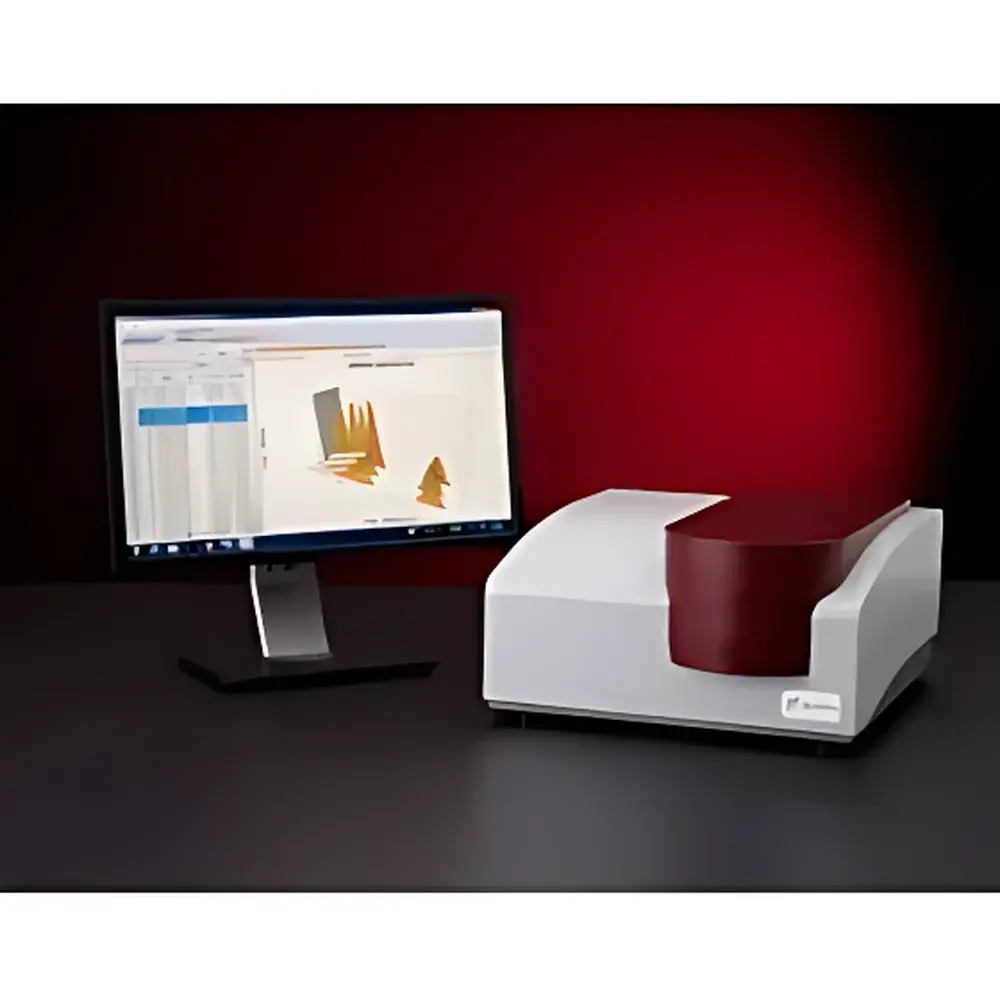
Brookhaven NanoBrook ZetaPALS High-Sensitivity Zeta Potential Analyzer
| Brand | Brookhaven |
|---|---|
| Origin | USA |
| Model | NanoBrook ZetaPALS |
| pH Range | 1–14 |
| Temperature Range | −5 to 110 °C |
| pH Resolution | 0.1 |
| Temperature Resolution | 0.1 °C |
| Accuracy | ±1% |
| Repeatability | ±1% |
| Electrophoretic Mobility Range | 1×10⁻¹¹ to 1×10⁻⁷ m²/V·s |
| Particle Size Range (optional DLS) | 0.001–100 µm |
| Sample Volume | 0.018–1.5 mL |
| Conductivity Range | 0–30 S/m |
| Electric Field Strength | 0–3.2 kV/m |
| Laser Source | 40 mW solid-state laser (wavelength & power customizable) |
| Detector | PMT or APD |
| Electrode Material | Palladium (corrosion-resistant open-cell capillary electrode optional) |
Overview
The Brookhaven NanoBrook ZetaPALS is a high-sensitivity zeta potential analyzer engineered for precision electrophoretic mobility measurement in challenging colloidal systems. It employs Phase Analysis Light Scattering (PALS), a hardware-based, frequency-domain detection method that directly resolves phase shifts induced by particle motion under an applied electric field—distinct from conventional Laser Doppler Velocimetry (LDV) or standard Frequency Modulation (FM) techniques. PALS delivers up to three orders of magnitude higher sensitivity in low-mobility regimes, enabling reliable zeta potential determination for samples with electrophoretic mobilities as low as 1×10⁻¹¹ m²/V·s. This capability is critical for characterizing biomolecules near their isoelectric point (pI), nanoparticles in high-ionic-strength buffers, dispersions in low-dielectric solvents (e.g., ethanol, THF), and viscous polymer solutions—conditions where traditional LDV-based instruments yield insufficient signal-to-noise ratios or fail entirely.
Key Features
- True hardware PALS detection architecture—no software post-processing approximations; phase shift resolution is determined by laser coherence, detector bandwidth, and real-time digital signal processing.
- Wide operational temperature range (−5 °C to 110 °C) with ±0.1 °C stability, supported by Peltier-controlled thermal management and integrated platinum resistance thermometer (Pt100) feedback.
- Electrode system featuring chemically inert palladium electrodes; optional capillary cell configuration minimizes electro-osmotic flow artifacts and enables precise field homogeneity in micro-volume measurements.
- 40 mW solid-state laser source with wavelength flexibility (e.g., 532 nm, 638 nm) to optimize scattering efficiency across diverse refractive index contrasts and absorption profiles.
- Configurable detector options: high-gain photomultiplier tube (PMT) for ultra-low-light applications or avalanche photodiode (APD) for enhanced quantum efficiency in visible/NIR bands.
- Programmable electric field strength (0–3.2 kV/m) with automatic polarity reversal to mitigate electrode polarization and Joule heating effects during extended measurements.
Sample Compatibility & Compliance
The ZetaPALS accommodates aqueous and non-aqueous dispersions, including protein formulations, liposomal drug carriers, polymeric micelles, ceramic slurries, and oil-in-water emulsions. Its broad conductivity range (0–30 S/m) supports direct analysis of physiological saline, industrial process streams, and concentrated electrolyte solutions without dilution. The instrument complies with ISO 13099-2:2012 (Colloidal systems — Methods for zeta-potential determination — Part 2: Optical methods) and aligns with ASTM D7825–14 guidelines for electrophoretic mobility reporting. Optional 21 CFR Part 11-compliant software provides audit-trail logging, electronic signatures, role-based access control, and data integrity safeguards required for GLP/GMP-regulated environments in pharmaceutical development and QC laboratories.
Software & Data Management
ZetaPALS operates with Brookhaven’s proprietary OmniScan™ software, which integrates real-time PALS signal acquisition, automatic baseline correction, and multi-parameter trend analysis (e.g., time-resolved zeta vs. pH, temperature ramping, or titrant addition). Data export adheres to ASTM E1447-22 standards for tabular and metadata-rich CSV/Excel formats. The software supports automated batch processing, statistical outlier rejection per ICH Q5C guidelines, and correlation with optional add-ons—including integrated titration control (for pH/conductivity sweeps), dielectric constant measurement, and dynamic viscosity input for Smoluchowski/Henry model selection. All raw interferograms and phase spectra are retained for reprocessing and regulatory review.
Applications
- Biopharmaceutical characterization: monitoring conformational stability of monoclonal antibodies across pH gradients; assessing surface charge reversal in PEGylated nanoparticles; evaluating aggregation onset in liposome and exosome preparations.
- Materials science: optimizing dispersant dosage in ceramic and carbon black slurries; quantifying surface functionalization efficiency on quantum dots and metal–organic frameworks (MOFs); predicting shelf-life of pigment dispersions in coatings and inks.
- Environmental colloid science: determining transport potential of engineered nanomaterials in groundwater simulants; evaluating coagulant efficacy in wastewater treatment via charge neutralization kinetics.
- Food & personal care: correlating zeta potential with emulsion stability in dairy alternatives and surfactant-free cosmetic formulations; mapping isoelectric behavior of starch and pectin derivatives under thermal processing conditions.
FAQ
What distinguishes PALS from conventional Laser Doppler Electrophoresis (LDE)?
PALS measures the phase shift—not frequency shift—of scattered light, enabling direct quantification of particle velocity even when Doppler broadening is negligible. This yields superior resolution for low-mobility species where LDE signal falls below detection thresholds.
Can ZetaPALS measure zeta potential in organic solvents?
Yes—its wide dielectric tolerance, corrosion-resistant electrode design, and adjustable field strength allow robust operation in solvents such as acetone, DMF, and ethylene glycol, provided optical clarity and conductivity fall within specified ranges.
Is temperature calibration traceable to NIST standards?
The integrated Pt100 sensor is factory-calibrated against NIST-traceable reference thermometers, and users may perform in-situ verification using certified calibration fluids per ISO/IEC 17025 protocols.
Does the system support Good Manufacturing Practice (GMP) documentation requirements?
With the optional 21 CFR Part 11 software package, full ALCOA+ (Attributable, Legible, Contemporaneous, Original, Accurate, Complete, Consistent, Enduring, Available) compliance is achieved—including electronic signature enforcement, change control logs, and immutable data archiving.
How is electro-osmotic flow minimized during measurement?
The open-cell electrode geometry, combined with symmetric field application and optional capillary cell configuration, suppresses bulk fluid motion. Software algorithms further deconvolve residual EOF contributions using dual-field polarity switching and cross-correlation analysis.



