
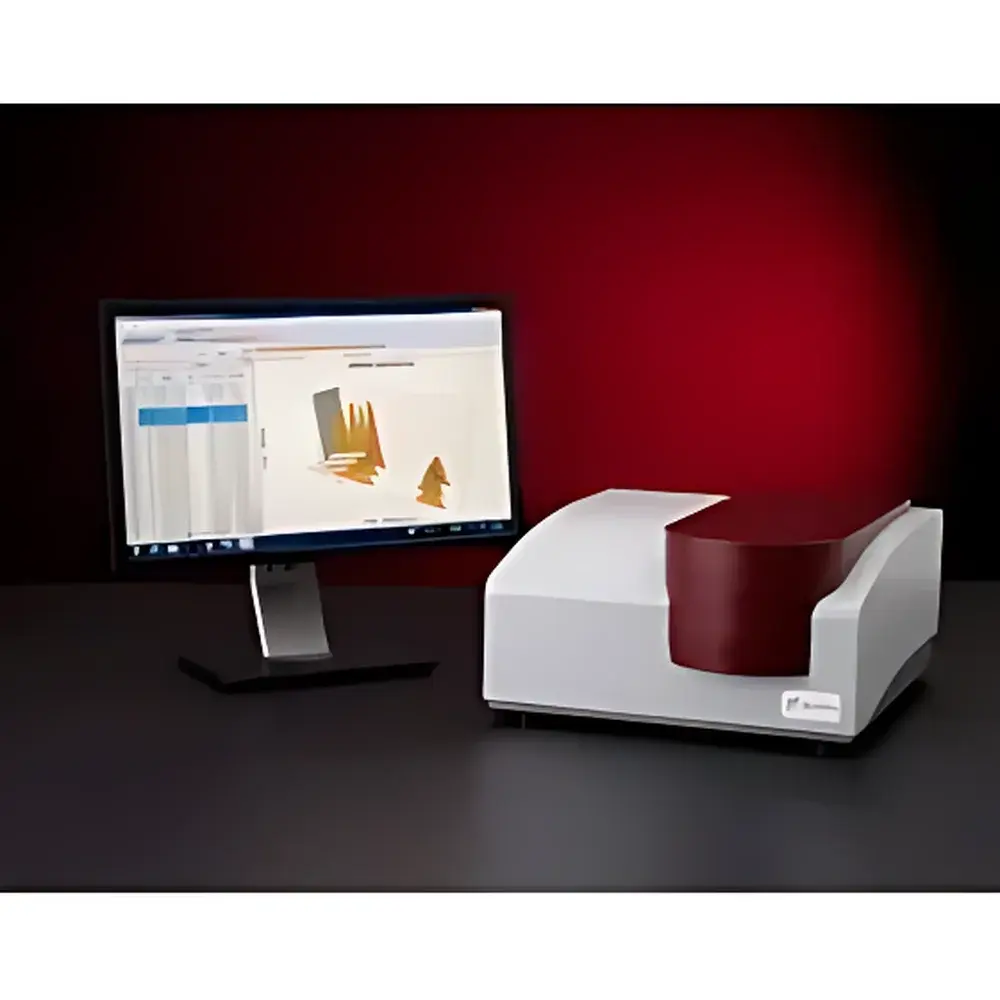
Brookhaven NanoBrook ZetaPlus Zeta Potential Analyzer
| Brand | Brookhaven |
|---|---|
| Origin | USA |
| Model | NanoBrook ZetaPlus |
| Zeta Potential Range | ±500 mV |
| pH Range | 1–14 |
| Temperature Range | −5 to 110 °C |
| pH Resolution | 0.1 |
| Temperature Resolution | 0.1 °C |
| Accuracy | ±1% |
| Repeatability | ±1% |
| Particle Size Range (Electrophoretic Mode) | 0.001–100 µm |
| Sample Volume | 0.18–1.5 mL |
| Conductivity Range | 0–20 S/m |
| Electrophoretic Mobility Range | 1×10⁻¹⁰ to 1×10⁻⁷ m²/V·s |
| Electric Field Strength | 0–3.2 kV/m |
| Electrode Material | Palladium (corrosion-resistant, open-cell design) |
| Laser Source | 35 mW solid-state laser (optional 5 mW He–Ne) |
| Detector | PMT or APD |
| Automated Trend Analysis | time-, temperature-, pH-, and conductivity-dependent |
Overview
The Brookhaven NanoBrook ZetaPlus is a high-precision electrophoretic light scattering (ELS) instrument engineered for the quantitative determination of zeta potential and electrophoretic mobility of colloidal dispersions and macromolecular solutions. It operates on the fundamental principle of laser Doppler velocimetry: charged particles suspended in a conductive medium undergo electrophoretic motion under an applied electric field, inducing a frequency shift (Doppler shift) in the scattered laser light. The NanoBrook ZetaPlus employs advanced spectral shift analysis—rather than intensity-based correlation—to resolve subtle differences in particle velocity distribution, enabling robust detection of multimodal electrophoretic behavior near the isoelectric point. This approach eliminates electro-osmotic flow artifacts inherent in conventional capillary-based systems, delivering intrinsic measurement fidelity without reliance on cell wall correction algorithms. Its open-cell electrode configuration, fabricated from high-purity palladium, ensures chemical inertness across aggressive pH and ionic strength conditions, supporting long-term stability in demanding formulations.
Key Features
- Open-cell, corrosion-resistant palladium electrodes—designed for direct contact with high-conductivity, acidic, or alkaline media without polarization or degradation
- High-sensitivity detection architecture with selectable photomultiplier tube (PMT) or avalanche photodiode (APD) detectors for optimal signal-to-noise across low- and high-scattering samples
- Integrated precision temperature control (±0.1 °C) over a broad operational range (−5 to 110 °C), enabling kinetic and thermodynamic zeta potential profiling
- Wide dynamic range of electrophoretic mobility (1×10⁻¹⁰ to 1×10⁻⁷ m²/V·s) and zeta potential (±500 mV), validated per ISO 13099-2 and ASTM D7826 standards
- Real-time automated trend analysis for zeta potential vs. time, pH, temperature, or conductivity—facilitating formulation optimization and stability mapping
- Modular hardware expansion capability including optional nanoparticle sizing (via integrated DLS module), automatic titration, dielectric constant measurement, and solvent viscosity determination
Sample Compatibility & Compliance
The NanoBrook ZetaPlus accommodates a broad spectrum of sample types—including proteins, peptides, liposomes, exosomes, polymeric latices, microemulsions, pigment dispersions, ceramic slurries, and wastewater colloids—with minimal volume requirements (0.18–1.5 mL). Its open-cell geometry permits direct measurement of opaque, viscous, or highly concentrated suspensions that would clog conventional capillary cells. The system complies with ISO 13099 (Colloidal systems — Methods for determining zeta-potential — Part 2: Optical methods), ASTM D7826 (Standard Test Method for Zeta Potential of Colloidal Dispersions), and supports GLP/GMP workflows through optional 21 CFR Part 11-compliant software, including electronic signatures, audit trails, and user access controls. All wetted materials meet USP Class VI biocompatibility requirements.
Software & Data Management
The instrument is operated via Brookhaven’s proprietary ZetaPlus Control Software, which provides full parameter scripting, real-time spectral visualization, and automated report generation in PDF or CSV formats. The software implements ISO/IEC 17025-aligned data integrity protocols, including timestamped raw spectra storage, metadata tagging (operator ID, calibration status, environmental logs), and version-controlled method templates. Optional 21 CFR Part 11 software adds role-based permissions, electronic signature capture, and immutable audit trail export—fully traceable to FDA inspection criteria. Data export supports integration with LIMS platforms via ODBC and conforms to ASTM E1469 for analytical instrument data exchange.
Applications
The NanoBrook ZetaPlus serves as a core characterization tool in pharmaceutical development (e.g., assessing colloidal stability of mRNA-LNPs, monoclonal antibody aggregates, and PEGylated nanocarriers), advanced materials R&D (ceramic green-body rheology, carbon black dispersion quality, battery slurry zeta mapping), and industrial QC (paint flocculation thresholds, cosmetic emulsion shelf-life prediction, food-grade colloidal stabilization). Its ability to resolve complex electrophoretic distributions makes it indispensable for identifying surface charge transitions during pH titration, evaluating surfactant adsorption kinetics, and validating surface modification efficacy in functionalized nanoparticles.
FAQ
What sample types are compatible with the open-cell design?
Aqueous and non-aqueous colloids, biological macromolecules, high-viscosity polymer solutions, and opaque suspensions—including ceramics, pigments, and activated sludge—can be measured without dilution or filtration.
Does the system support automated pH titration?
Yes—when equipped with the optional autotitrator module, the instrument performs synchronized zeta potential, conductivity, and pH sweeps while maintaining precise temperature control.
How is electro-osmotic error eliminated in this design?
By eliminating fixed walls adjacent to the measurement zone, the open-cell configuration removes boundary-induced fluid drag, ensuring measured particle velocity reflects only electrophoretic mobility—not coupled electro-osmotic flow.
Is calibration traceable to NIST standards?
Yes—Brookhaven provides certified reference materials (CRM) for mobility and zeta potential validation, with calibration documentation aligned to ISO/IEC 17025-accredited laboratories.
Can the same instrument perform both zeta potential and particle size analysis?
Yes—the optional nanoparticle sizing upgrade integrates dynamic light scattering (DLS) functionality using the same optical path and detector, enabling concurrent or sequential zeta and size measurements under identical thermal and compositional conditions.



