
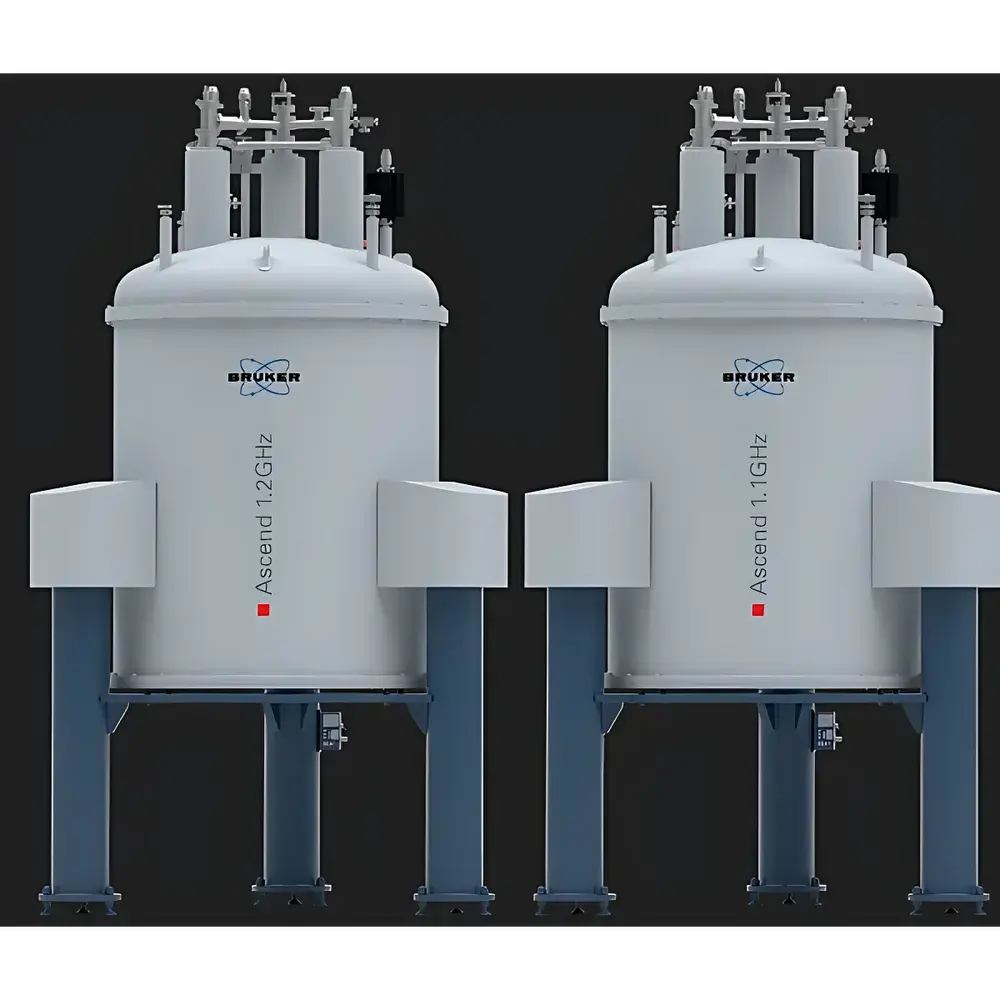
Bruker 1.1 GHz / 1.2 GHz Ultra-High-Field Nuclear Magnetic Resonance Spectrometer
| Brand | Bruker |
|---|---|
| Origin | Germany |
| Instrument Type | Ultra-High-Field NMR Spectrometer |
| Operating Frequencies | 1.1 GHz (⁴⁷/⁴⁹Ti, ¹H), 1.2 GHz (¹H) |
| Sample Compatibility | Solid–Liquid Dual-Mode |
| Acquisition Method | Pulsed Fourier Transform NMR |
| Magnet Technology | Actively Shielded Superconducting Magnet |
| Probe Options | 3 mm TCI Cryoprobe, 5 mm Triple-Axis Gradient Cryoprobe, 111 kHz MAS Solid-State NMR Probe |
| Detection Modes | Direct ¹³C and ¹⁵N Detection, Parallel Multi-Receiver Acquisition |
| Application Focus | Structural Biology, Intrinsically Disordered Proteins (IDPs), Membrane Proteins, Large Macromolecular Complexes |
Overview
The Bruker 1.1 GHz / 1.2 GHz Ultra-High-Field Nuclear Magnetic Resonance Spectrometer represents the current technical frontier in solution- and solid-state NMR instrumentation. Engineered for precision and stability at the gigahertz frequency regime, this system operates at proton resonance frequencies of 1.1 GHz (corresponding to a magnetic field strength of ~25.9 T) and 1.2 GHz (~28.2 T), enabling unprecedented spectral resolution, sensitivity, and dispersion—particularly critical for studying large, dynamic, and heterogeneous biomolecular systems. The spectrometer leverages pulsed Fourier transform (PFT) methodology with cryogenically cooled probes, actively shielded superconducting magnets, and advanced gradient control to deliver high reproducibility across multi-dimensional experiments. Its design addresses fundamental limitations encountered in conventional high-field NMR—including signal overlap, relaxation bottlenecks, and low intrinsic sensitivity—making it uniquely suited for structural and dynamic characterization of intrinsically disordered proteins (IDPs), membrane-embedded targets, transient macromolecular assemblies, and heterogeneous glycoconjugates.
Key Features
- Actively shielded 1.1 GHz and 1.2 GHz superconducting magnet systems with ultra-stable field homogeneity (<0.1 Hz/h drift) and minimal fringe field footprint
- Dual-mode sample handling architecture supporting both liquid-state and solid-state NMR experiments without hardware reconfiguration
- Next-generation cryoprobes: 3 mm TCI (Triple Channel Inverse) probe optimized for GHz-level indirect detection; 5 mm triple-axis gradient cryoprobe for high-fidelity multidimensional experiments; and 111 kHz magic-angle spinning (MAS) probe for ultrafast solid-state NMR of microcrystalline and fibrillar samples
- Parallel multi-receiver acquisition capability enabling simultaneous detection across multiple nuclei (e.g., ¹H, ¹³C, ¹⁵N) to reduce experiment time and improve coherence transfer efficiency
- Direct ¹³C and ¹⁵N detection workflows engineered for IDP studies, minimizing reliance on ¹H-mediated transfer pathways and preserving dynamic information lost under rapid relaxation
- Fully integrated digital RF architecture with sub-nanosecond timing resolution and real-time pulse shaping for advanced coherence selection and artifact suppression
Sample Compatibility & Compliance
This spectrometer accommodates a broad range of biological and synthetic samples—from isotopically labeled proteins in aqueous or membrane-mimetic environments (e.g., nanodiscs, bicelles, liposomes) to insoluble amyloid fibrils, polymers, and inorganic materials. Sample formats include standard 3 mm and 5 mm NMR tubes, MAS rotors (0.7–3.2 mm), and custom-insert configurations for in situ or paramagnetic applications. All hardware and firmware comply with IEC 61000-6-4 (EMC emission standards) and IEC 61000-6-2 (immunity). Data acquisition and processing workflows support audit trails, electronic signatures, and metadata tagging aligned with FDA 21 CFR Part 11 requirements when deployed in regulated GMP/GLP environments. Method validation protocols conform to ICH Q5C (biopharmaceutical characterization) and ASTM E2821 (NMR-based structural analysis of biomolecules).
Software & Data Management
Control and processing are unified under Bruker’s TopSpin 4.2+ platform, extended with proprietary modules including CcpNmr Analysis 3.1 integration, NMRFx Processor, and the IDP-specific DYNAMO framework for ensemble-based modeling. Real-time data streaming supports automated peak picking, chemical shift referencing (via internal DSS or external reference standards), and iterative spectral reconstruction during acquisition. Raw FIDs are stored in Bruker’s binary format with embedded JSON metadata (sample ID, pulse sequence, temperature, shimming history, probe tuning logs). Export options include NMR-STAR 3.1 for deposition to BMRB, CIF for PDB submissions, and HDF5 for machine learning pipelines. Backup and versioning are managed via optional integration with enterprise-grade NAS or cloud object storage compliant with ISO/IEC 27001.
Applications
- Atomic-resolution structural ensembles of intrinsically disordered proteins (IDPs) and their complexes using sparse restraints from RDCs, PREs, and paramagnetic relaxation enhancement
- Conformational dynamics mapping of membrane proteins in native-like lipid bilayers via ¹⁹F and ²H-labeled side chains
- Transient interaction interfaces in large ribonucleoprotein complexes (e.g., spliceosome subunits) through methyl-TROSY and dark-state exchange saturation transfer (DEST)
- Site-specific quantification of post-translational modifications (PTMs)—including phosphorylation, ubiquitination, and acetylation—in full-length histone variants and tau isoforms
- Structural fingerprinting of therapeutic monoclonal antibodies and ADCs, including aggregation state analysis, glycosylation heterogeneity, and domain orientation
- Metabolite identification and quantification in complex biofluids (CSF, plasma) using 2D J-resolved and HSQC-TOCSY methods enhanced by field-dependent dispersion
FAQ
What is the primary advantage of operating at 1.1 GHz versus conventional 800–900 MHz systems?
The 1.1 GHz platform delivers ~30% higher ¹H chemical shift dispersion and ~2.3× greater intrinsic sensitivity per unit time compared to 900 MHz, significantly reducing ambiguity in resonance assignment for large, flexible proteins and enabling detection of low-population conformational states.
Can this system perform both solution- and solid-state NMR on the same sample?
No—sample modality is determined by probe hardware and experimental setup. However, the platform supports rapid probe exchange (under cryogenic conditions) and shared console architecture, allowing seamless transition between liquid-state (e.g., TCI cryoprobe) and solid-state (e.g., 111 kHz MAS) configurations within a single instrument frame.
Is remote operation supported for collaborative structural biology projects?
Yes—TopSpin supports secure SSH-based remote access, real-time spectral monitoring via WebSpectra, and scheduled batch acquisition with email/SMS alerts upon completion or failure.
How does the system address the challenge of radiation damping in ultra-high-field ¹H detection?
The console integrates active radiation damping compensation using real-time feedback loops synchronized with the ADC sampling clock, combined with optimized preamplifier bandwidth and passive damping networks in the probe head.
Are method development services available for IDP-specific pulse sequences?
Bruker’s Application Support Group provides validated pulse sequence libraries (e.g., HNCO-based IDP-optimized variants, ¹³C-detected CAFI, and ¹⁵N-optimized SOFAST-HMQC) along with on-site training and co-development pathways for academic and industrial users.
Related Products



