
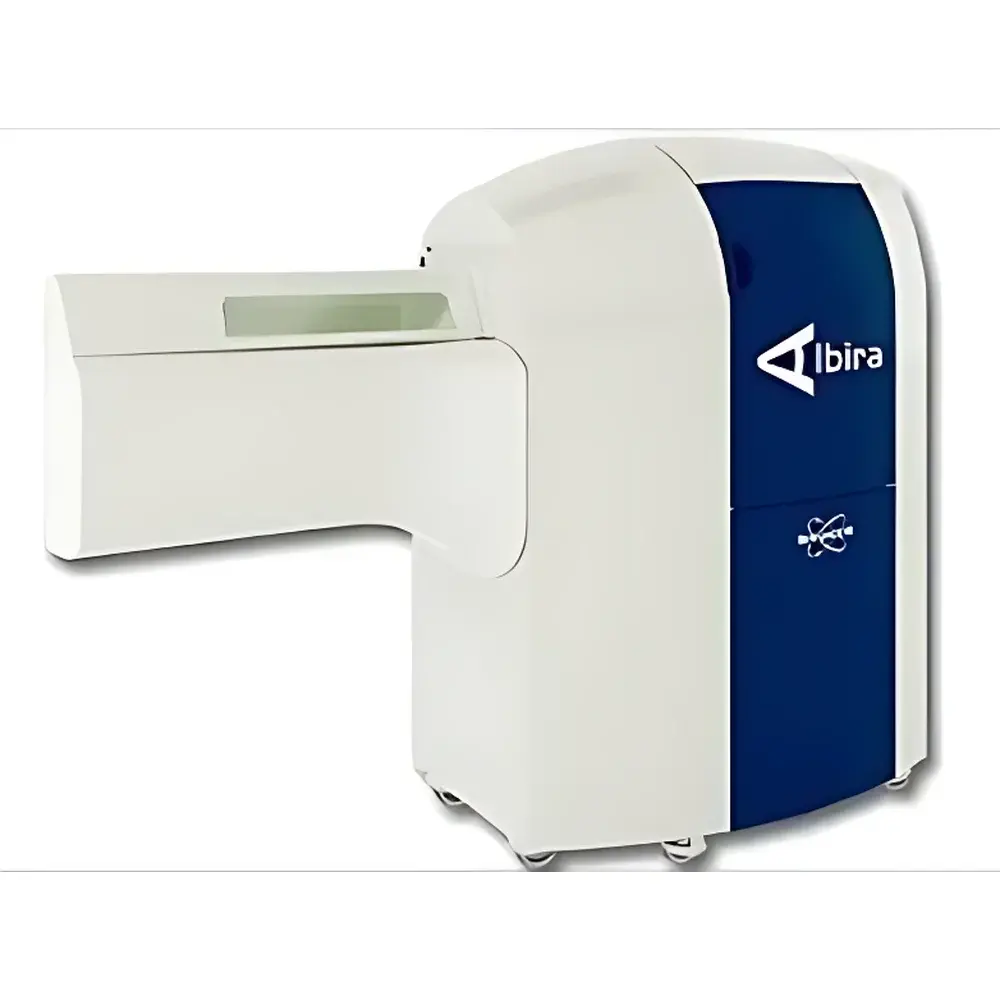
Bruker Albira Si Trimodal PET/SPECT/CT Preclinical Imaging System
| Brand | Bruker |
|---|---|
| Origin | USA |
| Manufacturer Type | Authorized Distributor |
| Origin Category | Imported |
| Model | Albira Si |
| Price Range | USD 1,100,000 – 1,380,000 (based on FOB US pricing and typical import duty/tax structure) |
| Instrument Type | Trimodal Molecular Imaging System |
Overview
The Bruker Albira Si is a fully integrated trimodal preclinical imaging platform engineered for high-sensitivity, quantitative in vivo molecular imaging in small animal models. It combines time-of-flight (TOF) positron emission tomography (PET) based on silicon photomultiplier (SiPM) detector technology, high-resolution single-photon emission computed tomography (SPECT), and diagnostic-grade micro-computed tomography (micro-CT) within a single gantry architecture. Unlike sequential or loosely coupled multimodal systems, the Albira Si employs a shared animal handling system, co-registered field-of-view geometry, and synchronized acquisition protocols—enabling true simultaneous or interleaved PET/SPECT/CT data collection with sub-millimeter spatial alignment and consistent attenuation correction. The SiPM-based PET subsystem delivers improved timing resolution (<400 ps FWHM), enhanced photon detection efficiency, and superior count-rate performance compared to conventional PMT-based detectors—critical for longitudinal studies requiring low-dose radiotracer administration and high temporal reproducibility. Its design adheres to GLP-compliant instrumentation principles, supporting traceable calibration, automated quality assurance (QA) routines, and audit-ready operational logs.
Key Features
- SiPM-based TOF-PET with <400 ps coincidence timing resolution and 1.3 mm intrinsic spatial resolution (NEMA NU-4)
- Triple-head SPECT with interchangeable collimators (pinhole, parallel-hole, multi-pinhole) supporting isotopes including 99mTc, 111In, 125I, and 177Lu
- Micro-CT subsystem with 50 kVp x-ray source, 10 µm focal spot size, and isotropic voxel resolution down to 45 µm
- Motorized, touch-screen–controlled animal positioning system with real-time optical monitoring and respiratory/gating synchronization
- Integrated dual-gated acquisition for cardiac and respiratory motion compensation in both PET and SPECT modalities
- Unified reconstruction engine supporting iterative OSEM, MAP, and PSF modeling across all three modalities
- Modular animal bed system with physiological monitoring (ECG, temperature, respiration) and anesthesia integration (isoflurane/O2)
Sample Compatibility & Compliance
The Albira Si accommodates mice (up to 50 g), rats (up to 500 g), and rabbit neonates, with adjustable bed inserts and dedicated coils for optimized signal-to-noise ratio. All imaging protocols comply with ISO 17025–accredited calibration standards for quantitative radionuclide imaging. The system supports FDA 21 CFR Part 11–compliant data handling through optional electronic signature and audit trail modules. Image metadata conforms to DICOM 3.0 Supplement 127 (Nuclear Medicine) and MIAME-compliant annotation frameworks. Regulatory documentation—including CE marking (Class IIa medical device), IEC 62304-compliant software lifecycle records, and ISO 13485 manufacturing certification—is provided for global regulatory submissions (e.g., IND, IMPD, pre-IND meetings).
Software & Data Management
Acquisition, reconstruction, and analysis are managed via Bruker’s Syngergy software suite—a validated, modular platform supporting Windows 10 LTSB and virtualized deployment. Core capabilities include: dynamic PET kinetic modeling (Patlak, Logan, SRTM), voxel-wise parametric mapping, SPECT quantification with Monte Carlo–based scatter correction, CT-based attenuation correction, and rigid/non-rigid multimodal image fusion. Raw data export follows NIfTI-1 and MINC 2.0 formats; processed results integrate with MATLAB, Python (via PyDicom, NiBabel), and commercial platforms such as PMOD and VivoQuant. Audit trails log user actions, parameter changes, and calibration events with ISO/IEC 17025–traceable timestamps. Optional cloud-based backup and DICOM PACS integration support multi-site collaboration under HIPAA- and GDPR-aligned security protocols.
Applications
The Albira Si enables rigorous investigation across oncology (tumor metabolism, angiogenesis, immuno-oncology checkpoint tracer kinetics), neurology (amyloid/tau deposition, dopamine transporter occupancy, neuroinflammation), cardiology (myocardial perfusion, infarct sizing, stem cell engraftment), and pharmacokinetics/pharmacodynamics (PK/PD modeling of novel biologics and radiopharmaceuticals). Its quantitative accuracy supports dose–response characterization per ICH S9 and E14 guidelines, while longitudinal tracking capability fulfills requirements for chronic disease modeling per OECD TG 407 and 408. The system is routinely deployed in academic core facilities, CROs conducting GLP-compliant toxicology studies, and pharmaceutical R&D labs engaged in first-in-human trial design.
FAQ
What radiotracers are compatible with the Albira Si PET subsystem?
The system supports standard clinical and preclinical PET isotopes including 18F-FDG, 18F-FLT, 64Cu-PTSM, 89Zr-DFO-mAbs, and 68Ga-labeled peptides—validated via NEMA NU-4 sensitivity and recovery coefficient testing.
Can Albira Si data be exported for third-party analysis?
Yes—raw sinogram/projection data, reconstructed volumes, and ROI time–activity curves are exportable in NIfTI, DICOM, and CSV formats with full metadata preservation.
Is MRI compatibility limited to hardware co-location?
No—the Albira Si includes RF-shielded animal transfer modules and DICOM-based workflow integration for seamless PET/MRI correlation; no proprietary MRI hardware is required.
How is system calibration maintained over time?
Daily automated QA includes flood-field uniformity checks, energy calibration, and center-of-rotation verification; annual recalibration is performed by Bruker Field Service Engineers using traceable 22Na and 57Co sources.
Does the system support GMP-aligned workflows?
With optional 21 CFR Part 11 module, it provides electronic signatures, role-based access control, and immutable audit trails—validated per Annex 11 and ALCOA+ data integrity principles.



