
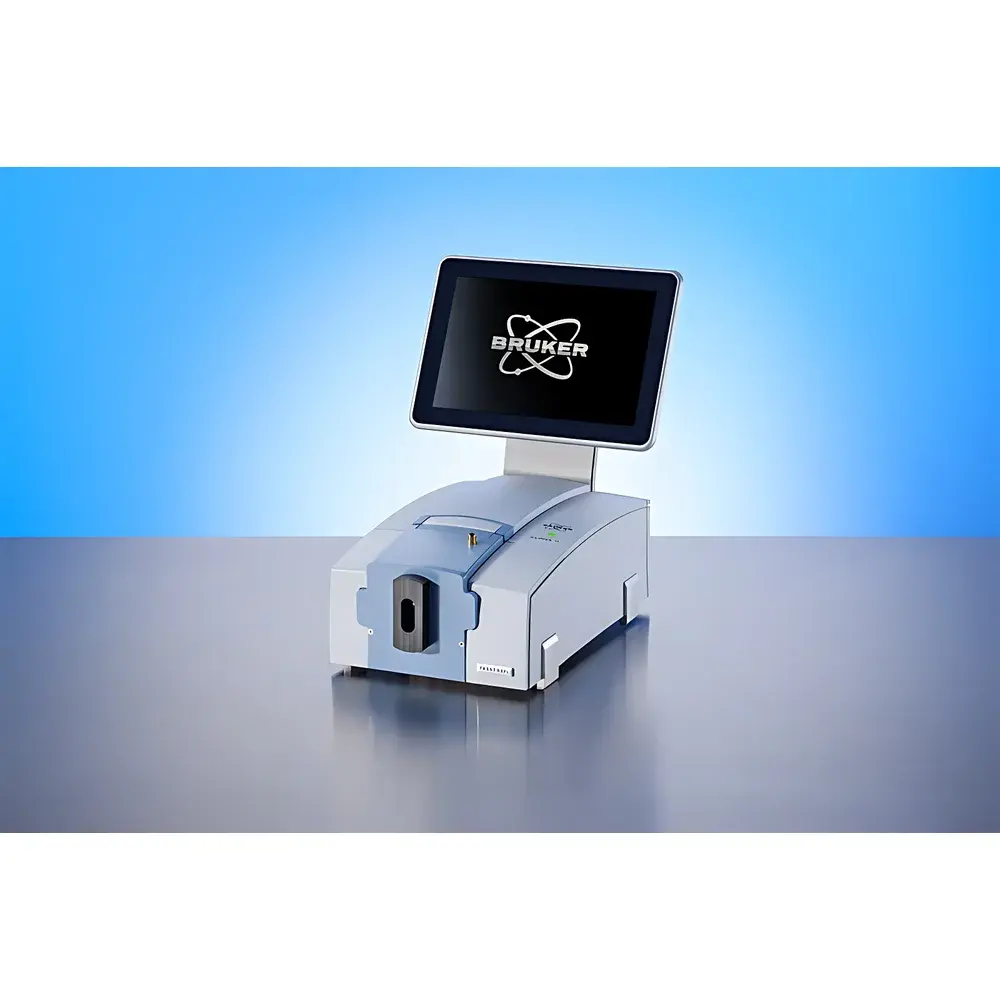
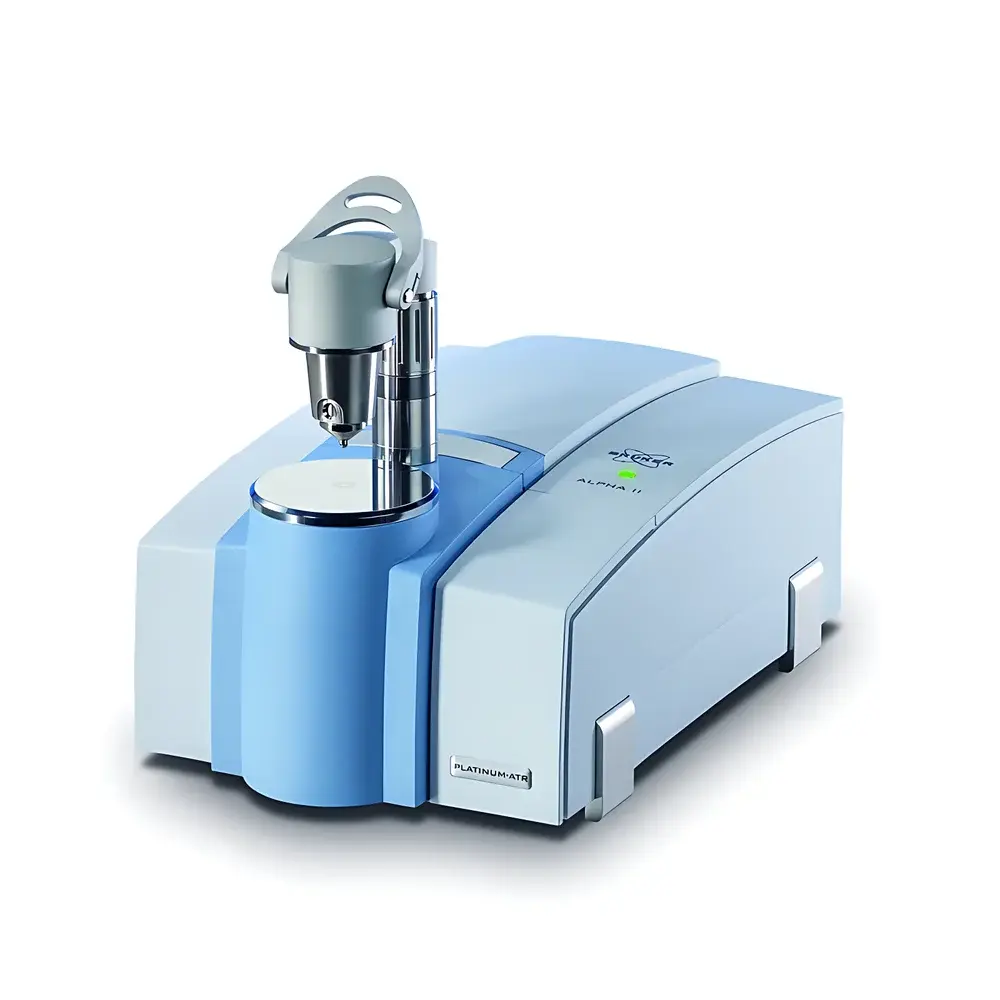
Bruker ALPHA II Fourier Transform Infrared (FT-IR) Spectrometer
| Brand | Bruker |
|---|---|
| Origin | Germany |
| Model | ALPHA II |
| Instrument Type | Benchtop Laboratory FT-IR Spectrometer |
| Spectral Range | 7500–375 cm⁻¹ |
| Spectral Resolution | 0.8 cm⁻¹ |
| Scan Speed | 3 spectra/sec |
| Signal-to-Noise Ratio | 50,000:1 (at 4 cm⁻¹, 1 min measurement) |
Overview
The Bruker ALPHA II Fourier Transform Infrared (FT-IR) Spectrometer is a compact, fully integrated benchtop instrument engineered for precision molecular identification and quantitative analysis across research, quality control (QC), regulatory compliance, and educational environments. Based on Michelson interferometry with permanent optical alignment, the ALPHA II delivers high-fidelity mid-infrared absorption spectra by measuring the interference pattern of broadband IR radiation modulated through a RockSolid™ interferometer. Its core architecture—featuring a center-mounted torsion bearing, gold-coated corner-cube mirrors, and a stabilized diode laser reference—ensures long-term spectral reproducibility, minimal drift, and immunity to mechanical vibration. Designed for robust daily operation in non-ideal lab conditions—including gloveboxes, fume hoods, and production floors—the system maintains consistent photometric accuracy and wavenumber fidelity without routine realignment.
Key Features
- RockSolid™ Interferometer: Permanently aligned, center-of-mass torsion-bearing design with gold-coated cube-corner mirrors; rated for >10 years of maintenance-free operation and exceptional shock resistance.
- CenterGlow™ IR Source: Thermally optimized globar source with precisely positioned emission zone, delivering maximum radiant flux and stable output over ≥5 years.
- Temperature-Stabilized Detector: High-sensitivity DTGS or optional MCT detector with active thermal regulation, minimizing baseline drift across ambient temperature fluctuations (15–30 °C).
- PermaSure™ System Intelligence: Embedded self-diagnostic suite continuously monitors interferometer performance, laser stability, detector response, source intensity, and internal humidity levels via PerformanceGuard™ software routines.
- QuickSnap™ Modular Sampling: Electronically encoded, tool-free sampling modules—including Platinum™ Diamond ATR, liquid cells, transmission holders, and specular reflectance accessories—automatically configure instrument parameters upon attachment.
- Integrated Touch Interface: Built-in industrial-grade touchscreen PC with OPUS-Touch™ software enables intuitive workflow navigation, method-driven acquisition, and real-time spectral preview without external computing hardware.
Sample Compatibility & Compliance
The ALPHA II supports direct analysis of solids, liquids, pastes, films, and powders—without extensive sample preparation—via its Platinum™ Diamond ATR module, which exhibits chemical inertness, scratch resistance, and >10-year operational lifetime. Optional accessories enable transmission, diffuse reflectance (DRIFTS), and external reflection measurements, accommodating ISO 18389, ASTM E1252, and USP compliant methodologies. For regulated environments, the system meets GLP/GMP requirements through FDA 21 CFR Part 11–compliant audit trails, electronic signatures, and role-based access control within OPUS software. The integrated Internal Validation Unit (IVU) contains NIST-traceable polystyrene and water vapor standards, enabling automated Operational Qualification (OQ) and Performance Qualification (PQ) per ICH Q2(R2) and EU Annex 15 guidelines.
Software & Data Management
OPUS-Touch™ provides a streamlined, icon-driven interface optimized for routine users while retaining full spectroscopic control for advanced analysts. Predefined application methods—including polymer identification, pharmaceutical assay, contaminant screening, and raw material verification—guide step-by-step acquisition, processing, and reporting. All spectral data are stored in Bruker’s proprietary OPUS format (.0), supporting metadata embedding (sample ID, operator, timestamp, instrument configuration). Batch processing, spectral library searching (with >10,000 reference spectra), chemometric modeling (PCA, PLS), and PDF report generation are natively supported. Data integrity is enforced via encrypted database logging, version-controlled method templates, and configurable backup protocols compatible with networked storage and LIMS integration.
Applications
- Raw Material Verification: Rapid confirmation of incoming chemical identity and batch consistency in pharma, polymer, and fine chemical manufacturing.
- Failure Analysis: Identification of contaminants, degradation products, or foreign particulates in electronics, automotive components, and medical devices.
- Quantitative Analysis: Calibration-based concentration determination in liquid formulations (e.g., solvent blends, API suspensions) using fixed-pathlength cells or ATR with internal standard correction.
- Educational Use: Self-contained platform for undergraduate and graduate instruction in vibrational spectroscopy principles, functional group analysis, and spectral interpretation.
- Field-Deployable QC: Portable operation in controlled environments (cleanrooms, pilot plants) due to compact footprint (A5-sized), low power draw (<60 W), and vibration-insensitive optics.
FAQ
What regulatory documentation is provided for GxP environments?
Bruker supplies a complete qualification package—including Design Qualification (DQ), Installation Qualification (IQ), Operational Qualification (OQ), and Performance Qualification (PQ) protocols—alongside test reports, calibration certificates, and SOP templates aligned with ISO/IEC 17025 and 21 CFR Part 11.
Can the ALPHA II be used for in-line process monitoring?
While designed as a benchtop analyzer, the ALPHA II supports fiber-optic coupling (via optional accessories) for at-line applications; however, dedicated process FT-IR systems (e.g., Tensor series with flow cells) are recommended for true real-time in-line deployment.
Is spectral library search functionality included?
Yes—OPUS software includes the Bruker KnowItAll® IR Library (≥10,000 spectra) and supports user-defined library creation, hierarchical searching, and hit-quality scoring based on correlation coefficients and residual analysis.
How often does the instrument require recalibration?
The RockSolid™ interferometer and CenterGlow™ source eliminate routine wavelength recalibration; PermaSure™ diagnostics and IVU-based validation ensure traceable performance verification before each critical measurement session.
What warranty coverage applies to key optical components?
Bruker offers a 10-year limited warranty on the RockSolid™ interferometer, diode laser, and Platinum™ Diamond ATR crystal; a 5-year warranty covers the CenterGlow™ IR source and temperature-stabilized detector assembly.
Related Products






