
Bruker Ascend Evo 1.0 GHz Nuclear Magnetic Resonance Spectrometer
| Brand | Bruker |
|---|---|
| Origin | Germany |
| Manufacturer Type | Authorized Distributor |
| Origin Category | Imported |
| Model | Ascend Evo 1.0 GHz NMR |
| Price Range | USD $10–20 million |
| Instrument Type | High-Field NMR Spectrometer |
| Sample Compatibility | Solid-State & Solution-State |
| Operating Frequency | 1.0 GHz |
| Acquisition Mode | Pulsed Fourier Transform (PFT) & Continuous Wave (CW) |
Overview
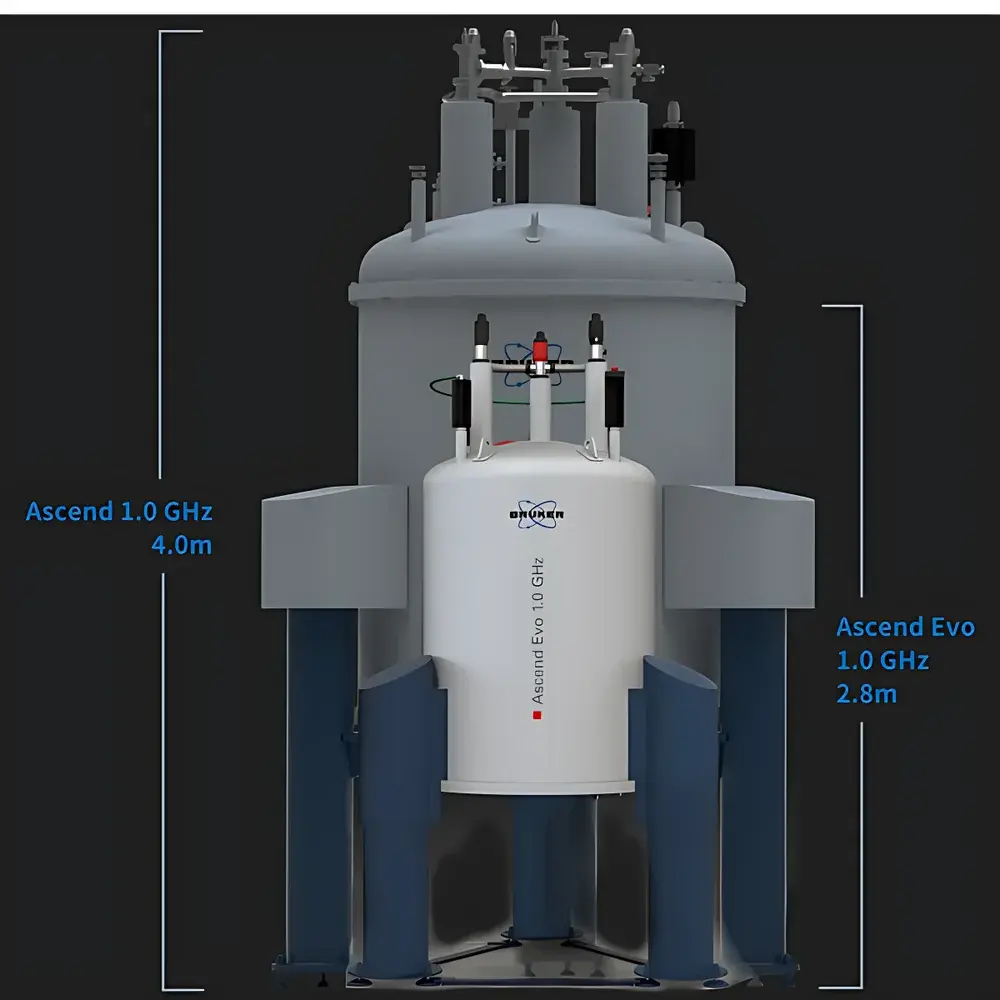
The Bruker Ascend Evo 1.0 GHz Nuclear Magnetic Resonance (NMR) Spectrometer represents a paradigm shift in high-field magnetic resonance infrastructure. Engineered around a proprietary compact superconducting magnet operating at 1.0 GHz (corresponding to a 1H Larmor frequency of 1.0 GHz, or ~23.5 T), the system leverages advanced cryogenic architecture and hybrid conductor coil design to deliver ultra-high magnetic field homogeneity and temporal stability—critical for atomic-resolution structural biology, complex mixture analysis, and dynamic solid-state NMR studies. Unlike conventional 1.0 GHz systems relying on low-temperature superconductors (LTS) at 2 K, the Ascend Evo magnet operates stably at 4.2 K using an optimized LTS/HTS hybrid winding configuration, eliminating the need for complex 2 K cryoplants while retaining full spectral resolution and sensitivity. This thermodynamic and mechanical redesign enables deployment in standard single-story laboratories with ceiling heights as low as 3.25 m (10.7 ft), significantly expanding accessibility beyond specialized high-field facilities.
Key Features
- Compact 1.0 GHz superconducting magnet with 4.2 K operational temperature—reducing helium consumption by >70% versus prior-generation 1.0 GHz systems
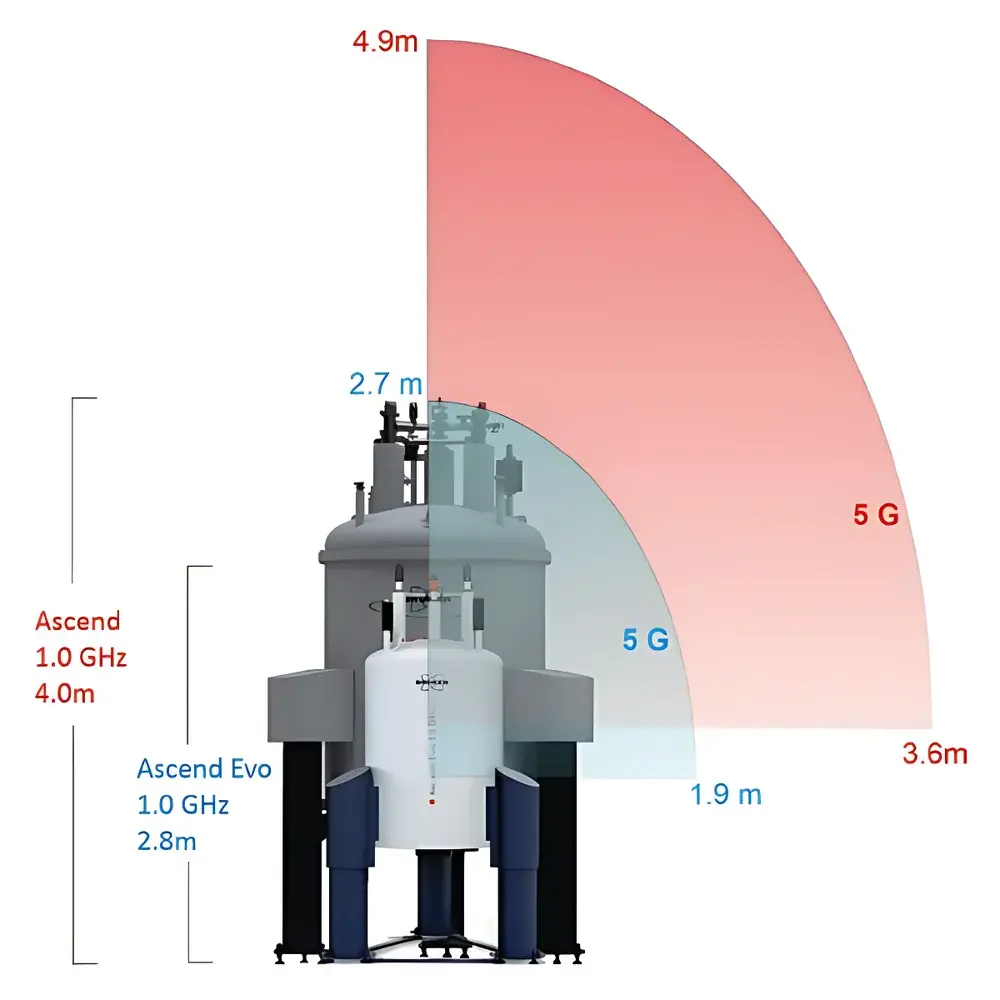
- Stray field footprint reduced to 15% of legacy 1.0 GHz magnets—enabling installation in proximity to adjacent instrumentation without magnetic shielding interference
- Total system footprint less than one-third that of previous 1.0 GHz platforms—no dedicated pump control cabinet, no external cryogenic piping, and zero requirement for overhead service gantries or operator platforms
- Modular transport and assembly: magnet sections compatible with standard freight elevators, doorways, and corridors; final assembly performed using an A-frame rig—no crane or hydraulic lifting equipment required
- Integrated Bruker Smart Liquid Nitrogen Liquefier (BSNL): achieves 100% nitrogen re-liquefaction, eliminating routine liquid nitrogen replenishment and associated logistics
- Full compatibility with Bruker’s TopSpin 4.2+ software suite, including automated shimming, pulse sequence library support for multidimensional solid- and solution-state experiments, and real-time spectral reconstruction
Sample Compatibility & Compliance
The Ascend Evo supports both solution-state and solid-state NMR methodologies across a broad range of sample formats—including 1.7 mm, 3.2 mm, and 4 mm MAS rotors; 5 mm and 10 mm solution tubes; and microcoil probes for mass-limited biological samples. It meets essential regulatory and quality framework requirements for analytical laboratories operating under GLP, GMP, and FDA 21 CFR Part 11 environments. All instrument control, data acquisition, and processing workflows are traceable via audit-log-enabled TopSpin modules, supporting electronic signature validation and secure user role management. The system complies with IEC 61000-6-3 (EMC emission standards) and IEC 61000-6-2 (immunity), and its magnetic field containment adheres to ICNIRP 2010 occupational exposure limits for static magnetic fields.
Software & Data Management
Data acquisition and processing are fully integrated within Bruker’s TopSpin 4.2+ platform, which supports automated calibration routines, real-time spectral preview, and batch processing of multi-dimensional datasets. The system includes native support for NMR-STAR and BMRB-compliant metadata export, facilitating structural database deposition. For enterprise-scale deployment, optional connectivity to Bruker’s LabScape middleware enables centralized instrument monitoring, predictive maintenance alerts, and federated data storage aligned with ISO/IEC 17025 documentation requirements. All raw FID data are stored in vendor-neutral, self-describing JCAMP-DX format, ensuring long-term archival integrity and third-party software interoperability.
Applications
- Atomic-resolution structure determination of membrane proteins and large macromolecular complexes via 13C/15N-labeled solid-state NMR
- Metabolite identification and quantification in complex biofluids using high-sensitivity 1D/2D 1H–13C HSQC and TOCSY
- Dynamic conformational analysis of intrinsically disordered proteins (IDPs) under physiological conditions
- Quantitative polymer microstructure characterization via 13C CP-MAS with high-power decoupling
- Reaction monitoring of catalytic processes in situ using flow-NMR and stopped-flow probe configurations
FAQ
What is the minimum ceiling height required for installation?
A clear height of 3.25 m (10.7 ft) is sufficient for full system integration, including cryostat access and probe insertion.
Does the system require external liquid nitrogen delivery?
No—when equipped with the optional Bruker Smart Liquid Nitrogen Liquefier (BSNL), the system achieves full nitrogen re-liquefaction and eliminates routine LN2 refills.
Is the magnet compatible with existing Bruker console hardware?
Yes—the Ascend Evo integrates natively with Avance IVDr and Avance NEO console families, supporting all current generation RF amplifiers, receivers, and gradient systems.
Can the system perform both solution- and solid-state experiments without hardware reconfiguration?
Yes—dual-mode probe options (e.g., QCI-F cryoprobe with MAS capability) enable seamless switching between solution and magic-angle spinning modes using software-selectable tuning and matching.
What cryogen consumption rate can be expected during steady-state operation?
Typical liquid helium boil-off is ≤0.8 L/day under nominal operating conditions—approximately 30% of legacy 1.0 GHz systems—and further reduced when combined with BSNL-assisted nitrogen management.
Related Products




