
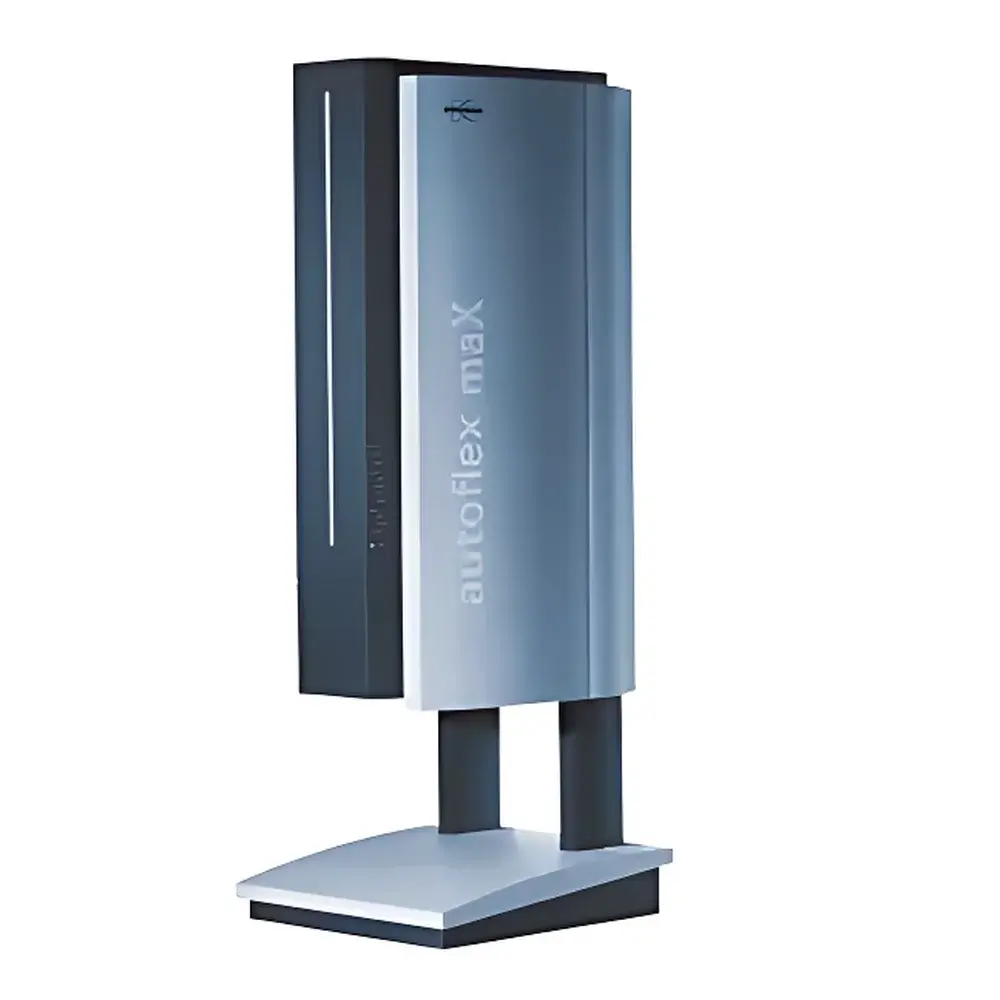
Bruker autoflex maX MALDI-TOF/TOF Mass Spectrometer
| Brand | Bruker |
|---|---|
| Origin | Germany |
| Model | autoflex maX |
| Instrument Type | TOF-TOF |
| Application Scope | Universal |
| Laser Repetition Rate | up to 2 kHz |
| Mass Resolution | up to 26,000 (m/z 1,000–5,000) |
| Mass Accuracy | sub-ppm (calibrated) |
| Detection Sensitivity | low amol (for peptides) |
| Ion Source | Perpetual™ laser-cleanable MALDI source |
| Detector | FlashDetector™ with 10-bit digitizer |
| Software Suite | Compass (flexControl, flexAnalysis, BioTools, GlycoWorkbench, Polymerix) |
Overview
The Bruker autoflex maX MALDI-TOF/TOF mass spectrometer is a high-performance, benchtop time-of-flight tandem mass spectrometer engineered for robust, reproducible analysis of biomolecules across diverse research and quality control environments. Built upon Bruker’s proven matrix-assisted laser desorption/ionization (MALDI) platform, the system employs orthogonal acceleration (oa-TOF) and reflectron geometry to deliver high mass resolution, sub-part-per-million mass accuracy, and extended dynamic range—enabling confident identification and characterization of analytes ranging from small peptides and glycans to intact monoclonal antibodies and synthetic polymers. Its dual-stage TOF architecture supports both high-sensitivity MS mode and post-source decay (PSD) or laser-induced dissociation (LID) for structural elucidation in MS/MS mode—without requiring liquid chromatography separation. Designed for routine operation in regulated and non-regulated laboratories alike, the autoflex maX integrates hardware stability, intelligent ion source management, and comprehensive software tools into a single, scalable platform.
Key Features
- SmartBeam™ II Solid-State Laser: Delivers uniform, stable UV laser pulses at up to 2 kHz repetition rate—enabling rapid acquisition, enhanced shot-to-shot reproducibility, and reduced sample consumption per spectrum.
- Perpetual™ MALDI Ion Source: Features automated, laser-based cleaning functionality; completes full source decontamination in under 15 minutes without disassembly—ensuring sustained sensitivity and inter-run reproducibility over extended operation cycles.
- PAN™ (Parallel Accumulation–Serial Fragmentation) Technology: Optimizes ion transmission and fragmentation efficiency in TOF/TOF mode, supporting high-fidelity MS/MS spectra even for labile post-translational modifications (PTMs) and heterogeneous glycoforms.
- FlashDetector™ with 10-bit Digitizer: Provides extended dynamic range (>4 orders), sub-ppm mass accuracy (with internal calibration), and detection limits in the low attomole range for peptide standards—critical for quantitative profiling and low-abundance biomarker detection.
- Horizontal Auto-Target Design: Enables seamless integration with robotic sample handling systems for unattended, high-throughput screening—ideal for clinical microbiology, biopharmaceutical lot release, and imaging workflows.
Sample Compatibility & Compliance
The autoflex maX accepts standard 96- and 384-well MALDI target plates, supporting direct analysis of purified proteins, enzymatic digests, oligosaccharides, synthetic polymers, and tissue sections. It accommodates common MALDI matrices—including α-cyano-4-hydroxycinnamic acid (CHCA), sinapinic acid (SA), and 2,5-dihydroxybenzoic acid (DHB)—and enables on-target derivatization for enhanced ionization of acidic or hydrophobic species. The instrument complies with ISO/IEC 17025 requirements for analytical testing laboratories and supports audit-trail-enabled data acquisition under FDA 21 CFR Part 11 when configured with appropriate Compass software licensing and network authentication protocols. Routine performance verification follows Bruker’s standardized QC procedures aligned with ASTM E2920 and USP guidelines for analytical instrument qualification.
Software & Data Management
The Compass software suite provides integrated instrument control, real-time data processing, and application-specific interpretation modules. flexControl enables method-driven acquisition—including automated laser rastering, intensity-based spot selection, and scheduled calibration—while flexAnalysis delivers peak detection, deconvolution, and database searching (via MASCOT, ProteinScape, or GlycoWorkbench). For regulated environments, optional Compass LIMS Link and Compass Audit Trail modules ensure traceability, electronic signatures, and secure data archiving compliant with GLP and GMP documentation standards. All raw data are stored in Bruker’s proprietary fid format—fully compatible with third-party open-data platforms (e.g., ProteoWizard, OpenMS) via vendor-neutral converters.
Applications
- Biopharmaceutical Characterization: Intact mass analysis of mAbs, ADCs, and biosimilars; confirmation of primary sequence, glycosylation profiles, and oxidation/deamidation hotspots.
- Clinical Microbiology: Rapid microbial identification (to species and strain level) directly from colonies using spectral library matching (Biotyper DB).
- Glycomics & Polymer Analysis: High-resolution profiling of N-/O-glycans, heparinoids, and synthetic polyethylene glycols (PEGs) via mass distribution modeling and compositional annotation.
- Molecular Imaging (MALDI-IMS): Spatial mapping of peptides, lipids, and metabolites in FFPE tissue sections, plant leaves, or biofilm models—with pixel sizes down to 20 µm and acquisition rates exceeding 100 spectra/sec.
- Quality Control & Release Testing: Batch consistency assessment, host-cell protein detection, and stability-indicating assays under ICH Q5 and Q5A regulatory frameworks.
FAQ
What is the maximum mass range supported in TOF/TOF mode?
The autoflex maX achieves reliable detection and fragmentation up to ~50 kDa in MS mode and supports MS/MS analysis of precursor ions up to ~10 kDa, depending on matrix choice and instrument tuning.
Can the system be validated for GMP compliance?
Yes—when deployed with Compass Audit Trail, electronic signature modules, and documented IQ/OQ/PQ protocols, the platform meets key elements of FDA 21 CFR Part 11 and EU Annex 11 for computerized system validation.
Is thin-layer chromatography (TLC)-MALDI coupling supported?
Yes—the horizontal target design and high laser repetition rate enable direct coupling with TLC plates; optimized workflows for lipid and small-molecule analysis are available in the Compass application library.
How often does the Perpetual™ ion source require manual maintenance?
Under typical usage (≤ 8 hrs/day), no manual cleaning is required for ≥6 months; automated laser cleaning is performed as needed between batches or during overnight idle periods.
Does the system support external database search integration?
Yes—flexAnalysis natively connects to MASCOT, ProteinPilot, and UniProt via standard XML export; custom API access is available for enterprise LIMS or ELN integration.



