
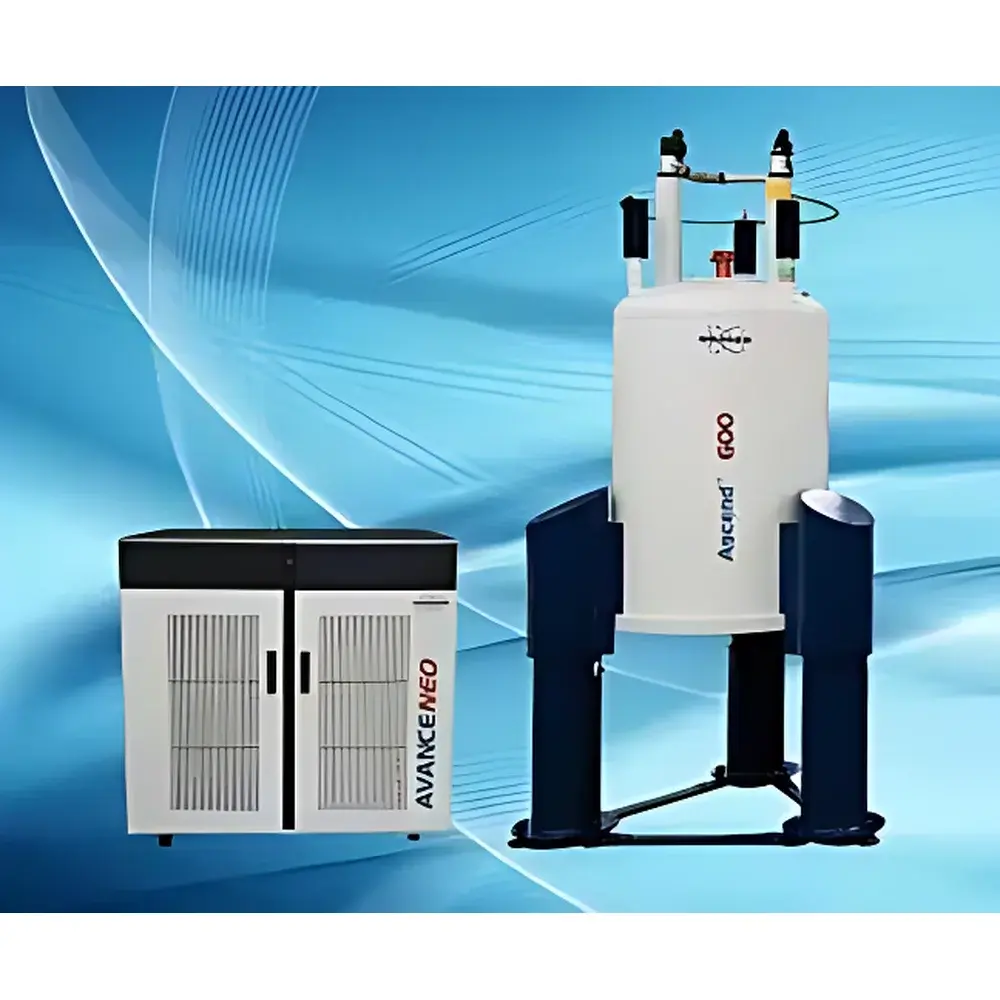

Bruker AVANCE NEO High-Field Nuclear Magnetic Resonance (NMR) Spectrometer
| Brand | Bruker |
|---|---|
| Origin | Germany |
| Model | AVANCE NEO |
| Instrument Type | High-Field NMR Spectrometer |
| Sample Compatibility | Solid-State & Solution-State (Dual-Mode) |
| Operating Frequency Range | 300–800 MHz (scalable to ≥1.25 GHz) |
| Data Acquisition Method | Pulse Fourier Transform (PFT) |
| Architecture | Integrated Transceiver-Based Digital RF Platform |
| Software Platform | TopSpin 4.x or later with Embedded Acquisition Server |
| Compliance | Designed for GLP/GMP environments |
Overview
The Bruker AVANCE NEO High-Field Nuclear Magnetic Resonance (NMR) Spectrometer represents the current benchmark in high-performance, research-grade NMR instrumentation. Engineered on a fully digital, transceiver-based architecture, the AVANCE NEO implements pulse Fourier transform (PFT) methodology to deliver quantitative, reproducible spectral data across solution-state, solid-state, and hybrid experimental modalities. Its core design philosophy centers on deterministic real-time control, ultra-low-latency RF waveform generation, and hardware-level synchronization—enabling precise execution of multi-pulse, multi-dimensional, and decoupling-intensive experiments. The system operates across a scalable frequency range from 300 MHz to 800 MHz (with field strength extensible to ≥1.25 GHz via magnet upgrade), supporting both standard proton-decoupled heteronuclear experiments and advanced solid-state techniques such as MAS, DNP, and REDOR. Unlike legacy architectures reliant on centralized analog signal routing, the AVANCE NEO distributes full transmit/receive capability across independent RF channels—each functioning as a self-contained spectrometer node with dedicated digital synthesis, amplitude/phase modulation, and digitization resources.
Key Features
- Transceiver Architecture: Each RF channel integrates four independent Numerically Controlled Oscillators (NCOs), enabling simultaneous frequency, amplitude, and phase setting within 12.5 ns—critical for shaped pulse fidelity and coherence pathway selection.
- High-Dynamic-Range Digitization: 1.852 GHz intermediate frequency (IF) receiver with 7.5 MHz spectral width acquisition bandwidth; dual-precision FID accumulation prevents overflow artifacts in long-term averaging or hypercomplex data collection.
- Unified Broadband Amplification: Single broadband RF amplifier covering all nuclei (¹H to ¹⁹F, ³¹P, ¹³C, etc.)—delivering >100 W at high-gamma frequencies and >500 W for low-γ nuclei—eliminating need for separate HF/LF amplifier modules.
- High-Performance Low-Noise Amplifier (HPLNA): GaAs-based preamplifier with active T/R switching (4 kW peak power), optimized for CryoProbe integration; achieves sub-0.2 dB noise figure and exceptional EMI rejection—validated against ambient RF sources including HDTV and Wi-Fi bands.
- Digital Field-Frequency Lock (DigitalLock): FPGA-accelerated lock system (320 MHz clock rate) with real-time DSP processing; supports multi-solvent locking (e.g., CDCl₃/DMSO-d₆ mixtures) and maintains stability under fluctuating environmental conditions.
- SmartVT & SmartCooler Integration: Modular VT controller with nine simultaneous temperature sensor inputs, four independent heater zones, and closed-loop gas flow regulation—enabling ±0.1 K thermal stability over 20–400 K range; direct communication with DigitalLock enables solvent-aware temperature safety limits and NMR thermometry calibration.
Sample Compatibility & Compliance
The AVANCE NEO accommodates both solution-phase and solid-state NMR samples without hardware reconfiguration. Standard 5 mm and 3 mm NMR tubes are supported, alongside MAS rotors (0.7–4 mm) for high-resolution solid-state studies. Probe options include BBFO, QCI, TCI, and cryogenically cooled configurations (e.g., CryoProbe™ Prodigy). All electronics and firmware comply with IEC 61000-4 electromagnetic compatibility standards. When deployed with TopSpin’s secure authentication, electronic signature, and audit trail modules, the system meets analytical traceability requirements outlined in FDA 21 CFR Part 11 and EU Annex 11. Routine operation aligns with ISO/IEC 17025 method validation frameworks, particularly for pharmaceutical impurity profiling, polymer microstructure analysis, and structural biology applications requiring quantitative reproducibility.
Software & Data Management
Control and data acquisition are managed through TopSpin 4.x or later—a client-server application built on a Linux-based embedded acquisition server. This decouples instrument operation from local workstation OS dependencies, allowing remote access via secure SSH or browser-based interfaces—including cloud-initiated experiment queuing and monitoring. Raw FID data is stored in Bruker’s proprietary binary format (ser/acqus), with metadata-rich headers compliant with NMR-STAR and ISA-TAB-NMR standards. Batch processing pipelines support automated phasing, baseline correction, peak picking (via CMC-se, Chenomx, or Mnova integration), and statistical modeling (PCA, PLS-DA). Audit logs record user identity, timestamp, parameter changes, and data export events—configurable for GLP-compliant reporting.
Applications
The AVANCE NEO serves as a primary analytical platform in academic structural biology labs (protein-ligand binding, dynamics, folding), pharmaceutical R&D (API polymorphism, excipient interaction, forced degradation product identification), materials science (polymer tacticity, crosslink density, battery electrolyte speciation), and metabolomics (biofluid fingerprinting, isotopic enrichment tracking). Its flexibility supports routine ¹H/¹³C 1D/2D experiments (COSY, TOCSY, HSQC, HMBC), quantitative NMR (qNMR) per USP , diffusion-ordered spectroscopy (DOSY), and advanced solid-state methods including CP-MAS, 2D exchange, and dynamic nuclear polarization (DNP)-enhanced detection.
FAQ
What is the maximum achievable magnetic field strength with AVANCE NEO?
The AVANCE NEO electronics platform supports magnets up to ≥1.25 GHz (29.4 T), though standard commercial configurations operate at 300–800 MHz (7.05–18.8 T). Field extension requires magnet upgrade and probe recalibration.
Can AVANCE NEO run both liquid and solid-state experiments on the same console?
Yes—hardware-level channel independence and modular probe interface enable seamless switching between solution-state and MAS solid-state configurations without software reinstallation or firmware reload.
Is TopSpin 4 backward-compatible with older AVANCE III HD data?
Yes—TopSpin 4 maintains full read/write compatibility with legacy ser/acqus files and supports migration of pulse programs, parameter sets, and macro libraries from AVANCE III HD systems.
Does AVANCE NEO support automated sample changers?
It integrates natively with Bruker SampleJet and SampleCase robotic handlers, with scheduling and error-handling logic embedded in TopSpin’s Experiment Queue Manager.
How is regulatory compliance enforced during routine operation?
Through optional TopSpin Security Pack: role-based access control, electronic signatures, immutable audit trails, and automatic backup of raw data and processing history—all configurable to satisfy FDA 21 CFR Part 11 Subpart B requirements.
Related Products




