
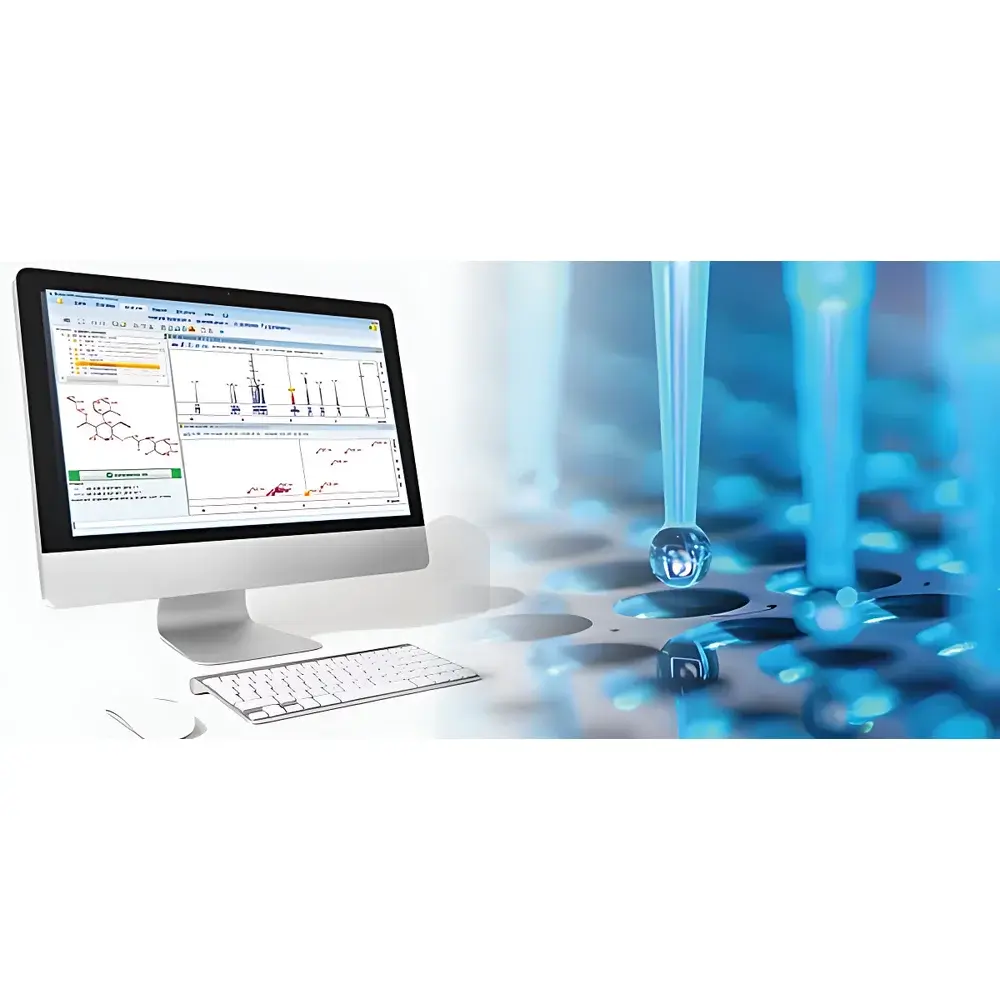
Bruker CMC-assist 2.4 NMR Data Analysis Software Suite
| Brand | Bruker |
|---|---|
| Origin | Germany |
| Instrument Type | High-Field NMR Spectrometer Software Module |
| Sample Compatibility | Solid and Liquid Samples (Unified Workflow) |
| Sensitivity | Signal-to-Noise Ratio (SNR)-Driven Analysis Validation |
| Resolution | Linewidth-Based Spectral Fidelity Assessment |
| Deployment | Native Integration with Bruker TopSpin™ and IconNMR™ Platforms |
| Regulatory Alignment | Supports GLP/GMP Documentation Requirements, FDA 21 CFR Part 11 Compliant Audit Trail (Optional Configuration) |
Overview
Bruker CMC-assist 2.4 is a validated, domain-specific software module engineered for automated, reproducible, and regulatory-compliant interpretation of nuclear magnetic resonance (NMR) spectroscopic data. Unlike generic spectral processing tools, CMC-assist operates within the physical constraints of NMR measurement theory—leveraging quantum mechanical spin dynamics, Fourier-transformed time-domain signals, and empirically calibrated reference standards—to deliver chemometrically grounded conclusions. It is not a standalone spectrometer but an integral component of Bruker’s high-field NMR ecosystem, designed to augment routine quality control (QC), structural verification, and quantitative analysis workflows in pharmaceutical development, polymer characterization, natural product isolation, and academic synthetic chemistry laboratories. The software implements deterministic algorithms for peak detection, multiplet analysis, integration consistency checking, and chemical shift referencing—each traceable to IUPAC-recommended conventions and aligned with ASTM E2903 (Standard Guide for NMR Data Evaluation) and ISO/IEC 17025–compliant data integrity principles.
Key Features
- Automated processing and interpretation of 1D 1H, 13C, 19F, and 2D NMR experiments (COSY, TOCSY, HSQC, HMBC, NOESY) acquired on Bruker Avance™ and Ascend™ platforms
- Concentration quantification via internal or external standard calibration, with uncertainty propagation based on SNR, linewidth, and integration precision
- Structural consistency assessment against user-defined molecular templates or IUPAC SMILES-encoded references
- Multi-level reporting architecture: technical validation reports (for internal QC), regulatory submission-ready summaries (for FDA/EMA filings), and publication-grade figure generation (SVG/PDF export with spectral annotation)
- Real-time feedback loop with IconNMR™: automatic flagging of outlier spectra, recommendation of reacquisition parameters (e.g., increased scans, adjusted relaxation delay), and dynamic update of batch-wise statistical process control (SPC) charts
- Fully auditable workflow: timestamped action log, user-identity binding, electronic signature support, and immutable archive export compliant with 21 CFR Part 11 when deployed with Bruker’s eLabFramework™
Sample Compatibility & Compliance
CMC-assist 2.4 supports unified processing of solution-state and solid-state NMR datasets without requiring manual mode switching. For liquid samples, it accommodates standard 5 mm tubes, capillary microprobes, and flow-cell configurations; for solids, it interfaces with MAS (magic angle spinning) datasets processed via Bruker’s TopSpin™ ssNMR modules. All analytical routines are validated per ICH Q5C (stability-indicating method performance) and USP (NMR-based assay validation). The software conforms to ISO/IEC 17025:2017 clause 7.7 (ensuring data traceability) and supports laboratory accreditation documentation through embedded metadata tagging (instrument ID, pulse sequence, temperature, shimming history).
Software & Data Management
CMC-assist 2.4 integrates natively into Bruker’s Unified Software Platform (USP), enabling bidirectional communication with TopSpin™, Delta™, and CMC-sequence™. Processed datasets are stored in vendor-agnostic BZIP2-compressed NMR-Data-Exchange (NDE) format, preserving raw FID, processed spectra, phase tables, and decision logic trees. Batch processing queues support parallel execution across multi-core workstations, with configurable memory allocation and GPU-accelerated FFT where available. All report outputs include machine-readable JSON manifests for LIMS ingestion and automated ELN (electronic lab notebook) synchronization.
Applications
- Pharmaceutical QC release testing: identity confirmation, assay quantitation, and impurity profiling per ICH Q2(R2) guidelines
- Polymorph screening and crystallinity assessment via 13C CP-MAS NMR pattern matching
- Metabolite identification in biofluids using 2D HSQC-guided binning and PCA-driven outlier detection
- Batch-to-batch comparability studies for biologics and complex generics
- Academic structure elucidation with automated assignment propagation across related analogues
FAQ
Is CMC-assist 2.4 compatible with non-Bruker NMR spectrometers?
No—it requires native acquisition metadata generated by Bruker TopSpin™ or IconNMR™ and relies on proprietary pulse sequence descriptors and hardware calibration files.
Does CMC-assist perform de novo structure determination?
No—it assumes a candidate structure is provided; its role is validation, not prediction. Structural hypotheses must originate from synthetic planning, MS/NMR correlation, or computational modeling.
Can audit trails be exported independently of the Bruker eLabFramework?
Yes—CSV-formatted action logs with cryptographic hash signatures are available via the “Compliance Export” utility, meeting ALCOA+ (Attributable, Legible, Contemporaneous, Original, Accurate) requirements.
What level of user training is required to operate CMC-assist 2.4?
Basic NMR literacy is required; however, the GUI enforces procedural discipline via guided workflows, reducing reliance on expert spectroscopist intervention for routine analyses.
Is cloud deployment supported?
No—CMC-assist 2.4 is licensed for on-premise installation only, ensuring full data sovereignty and alignment with GxP IT infrastructure policies.
Related Products




