
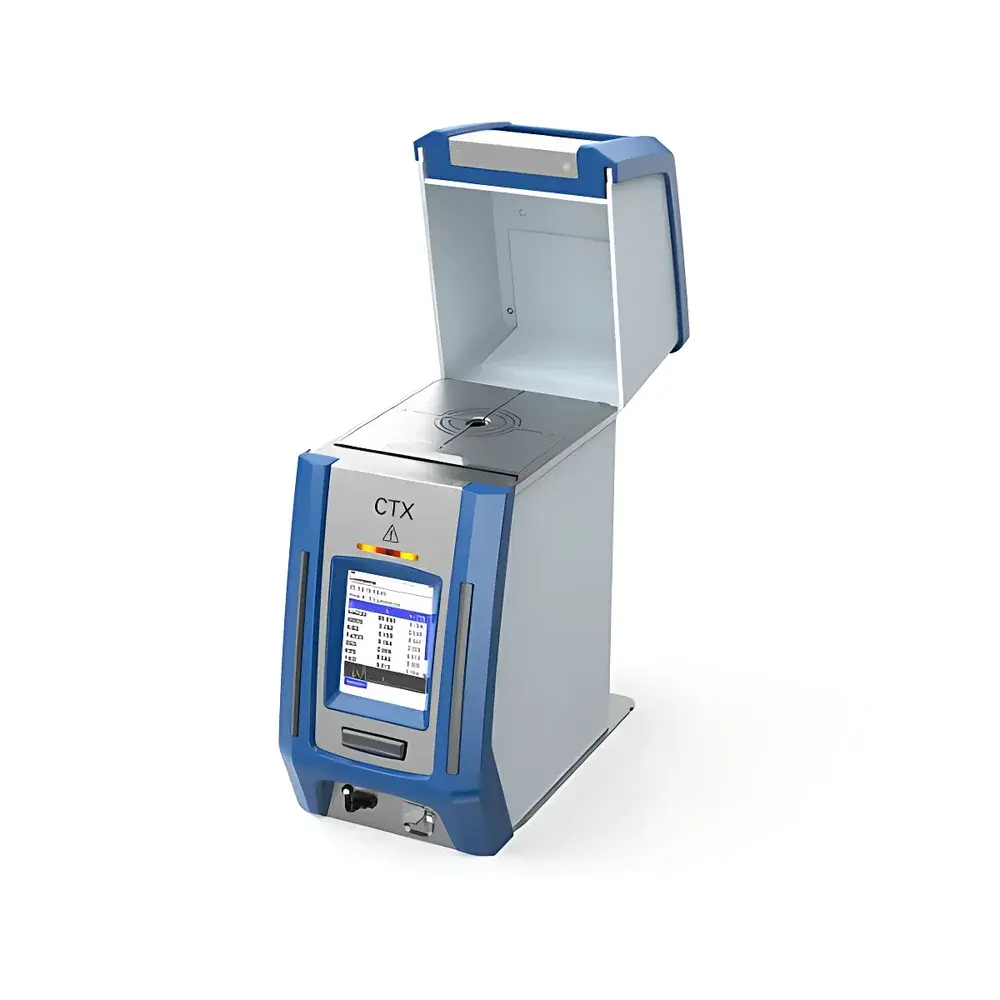
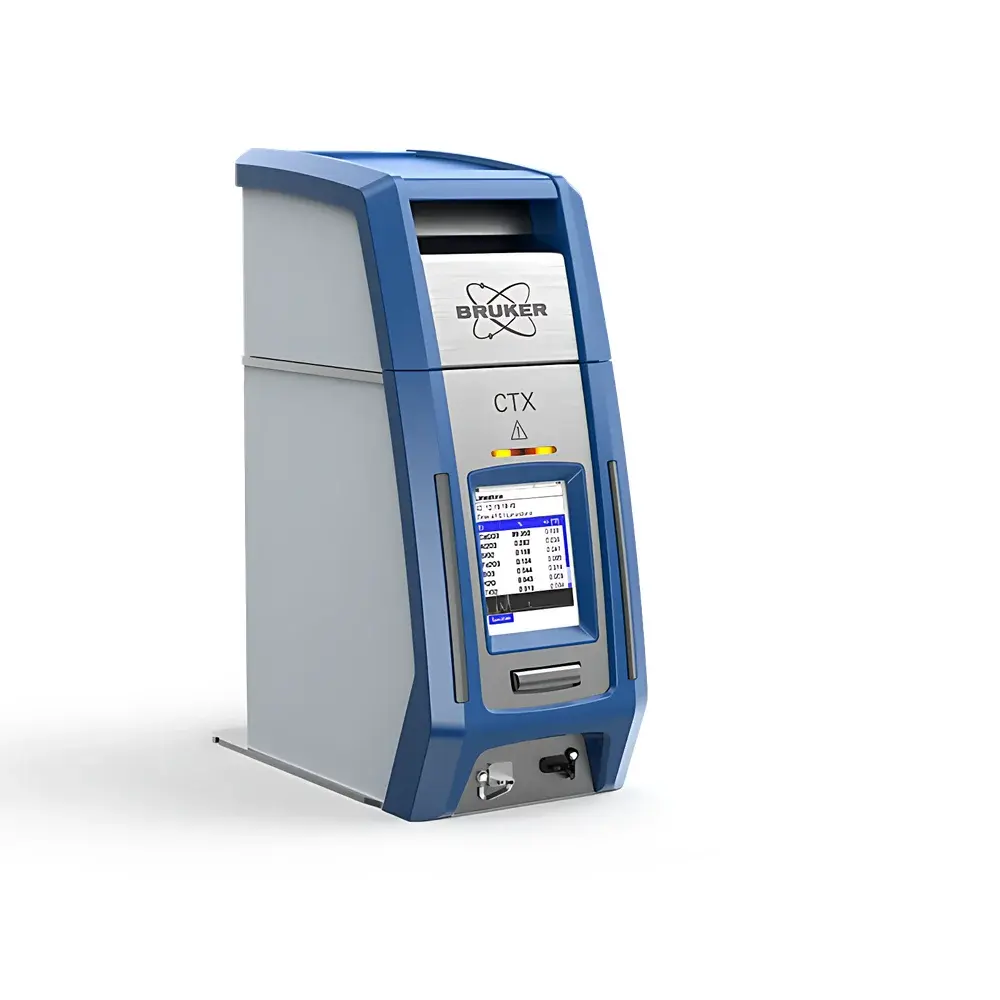
Bruker CTX Portable Benchtop Energy Dispersive X-Ray Fluorescence Spectrometer
| Brand | Bruker |
|---|---|
| Origin | USA |
| Manufacturer Type | Authorized Distributor |
| Origin Category | Imported |
| Model | CTX |
| Application | Portable/Benchtop |
| Industry Type | General-Purpose |
| Elemental Range | Mg to U |
| Quantification Range | ppm to % |
| Energy Resolution | 145 eV |
Overview
The Bruker CTX is a self-contained, benchtop energy dispersive X-ray fluorescence (EDXRF) spectrometer engineered for high-precision elemental analysis in both laboratory and field-deployable environments. Unlike handheld XRF systems, the CTX integrates a shielded sample chamber, fixed geometry optics, and a thermoelectrically cooled silicon drift detector (SDD), enabling superior spectral resolution (145 eV at Mn Kα), improved counting statistics, and enhanced reproducibility—particularly critical for low-concentration quantification and regulatory compliance workflows. Its design adheres to IEC 61010-1 safety standards for electrical equipment and incorporates dual mechanical/electrical interlocks to prevent inadvertent X-ray emission during chamber access. The system operates with a low-power microfocus X-ray tube (typically 50 kV, 1 mA), optimized for excitation of elements from magnesium (Mg, Z=12) through uranium (U, Z=92), supporting quantitative and semi-quantitative analysis across solid, powdered, and liquid matrices without requiring vacuum or helium purge.
Key Features
- Dual hardware interlock system: Ensures automatic beam shutdown when the sample chamber door is opened, meeting ANSI N43.3 and IEC 62495 radiation safety requirements.
- High-brightness, wide-angle LED-backlit touchscreen display: Enables clear visualization under variable ambient lighting conditions—including outdoor daylight and low-light laboratory settings.
- Real-time status indicators: Amber LED signals “X-ray Ready”; red LED confirms active irradiation—providing unambiguous operational feedback to users.
- Integrated sample presence sensor: Prevents analysis initiation unless a valid sample is detected, reducing operator error and enhancing data integrity.
- Role-based access control: Password-protected user accounts support multi-level permissions for instrument configuration, method editing, and report generation—facilitating GLP/GMP-aligned audit trails.
- Pre-start radiation warning: Audible and visual notifications are triggered during system boot-up, reinforcing procedural adherence to ALARA (As Low As Reasonably Achievable) principles.
- Rear-mounted master power switch: Provides centralized, fail-safe power isolation compliant with facility electrical safety protocols.
Sample Compatibility & Compliance
The CTX accommodates samples in diverse physical forms—including bulk solids, pressed pellets, loose powders, filter media, liquids in sealed cups, and thin-film substrates—without mandatory sample preparation beyond homogenization or containment. Optional sample holders (e.g., polypropylene cups, Mylar-backed pouches, quartz cuvettes) ensure compatibility with volatile, corrosive, or particulate-laden matrices. All internal shielding—including the TITAN DetectorShield™ and sealed sample tray—meets ISO 21879-1:2020 requirements for detector protection against contamination and mechanical damage. The system supports method validation per ASTM E1621 (Standard Guide for XRF Analysis of Metals), ASTM D7039 (Sulfur in Fuel Oils), and ISO 12885 (Environmental Soil Analysis), and its software architecture enables full traceability required under FDA 21 CFR Part 11 for electronic records and signatures.
Software & Data Management
Operating on Bruker’s proprietary S1 PXRF software platform, the CTX delivers intuitive method setup, real-time spectrum visualization, and automated peak deconvolution using fundamental parameters (FP) and empirical calibration algorithms. Preloaded application-specific calibrations—validated for food safety (Fe, Ca, Pb, Cd, As), soil geochemistry (Al, Si, Fe, Mn, Zn, Ni, Cr, U), fuel sulfur (per MARPOL Annex VI), and precious metal fineness (Au, Ag, Pt, Pd)—enable rapid deployment without user-developed calibration curves. Data export supports CSV, PDF, and XML formats; optional integration with LIMS via ODBC ensures seamless alignment with enterprise quality management systems. Audit logs record all user actions—including method modifications, result overrides, and calibration updates—with timestamps and operator IDs, satisfying ISO/IEC 17025 clause 7.7 on result reporting and traceability.
Applications
- Food & Feed Safety: Quantification of nutritional fortificants (e.g., Ca in milk powder), toxic metals (Pb, Cd, Hg), and adulterants (e.g., melamine surrogates) at ppm-level sensitivity—supporting HACCP and FSMA verification protocols.
- Agricultural & Environmental Monitoring: Multi-element profiling of soils, plant tissues, irrigation water, and fertilizers to assess bioavailability, contamination risk, and nutrient balance—enabling precision agronomy and remediation validation.
- Geoscience & Exploration: Rapid elemental fingerprinting of drill cuttings, core samples, and stream sediments for pathfinder element detection (e.g., U, Mo, REEs), supporting exploration targeting and grade control.
- Materials Verification & Recycling: Alloy grade identification (e.g., stainless steels, superalloys), precious metal assay (karat determination, catalyst recycling), and restricted substance screening (RoHS, POPs, CPSIA).
- Fuel & Lubricant Analysis: Sulfur content measurement in marine fuels (per ISO 8712 and IMO 2020), wear metal monitoring in engine oils, and biodiesel blend verification.
- Border Security & Customs: Non-destructive screening of consumer goods, electronics, and mineral shipments for conflict minerals (3TG), counterfeit alloys, and hazardous substances (e.g., Pb in toys, Cd in textiles).
FAQ
Is the CTX certified for use in regulated environments such as food testing labs or environmental monitoring facilities?
Yes—the CTX complies with ISO/IEC 17025:2017 general requirements for competence of testing and calibration laboratories, and its software supports 21 CFR Part 11-compliant electronic signatures and audit trails.
Can the CTX analyze liquids without spill risk?
Yes—samples are placed in sealed, X-ray-transparent containers (e.g., 10 mm polypropylene cups with Mylar film windows); the integrated drip-resistant sample tray and sealed chamber prevent leakage-related contamination.
Does the system require external cooling or vacuum pumps?
No—the CTX uses a Peltier-cooled SDD and operates at atmospheric pressure; no cryogens, vacuum lines, or forced-air cooling are necessary.
How is calibration maintained across different sample types and matrices?
Bruker provides matrix-matched reference materials and FP-based correction algorithms; users may also deploy empirical calibrations validated per ASTM E2857 for specific applications.
What radiation safety documentation is provided with the instrument?
Each unit ships with a full radiation safety dossier—including type test reports, interlock validation records, dose rate measurements (<1 µSv/h at 5 cm), and installation compliance checklists aligned with national regulatory frameworks (e.g., NRC, Health Canada, BfS).





