
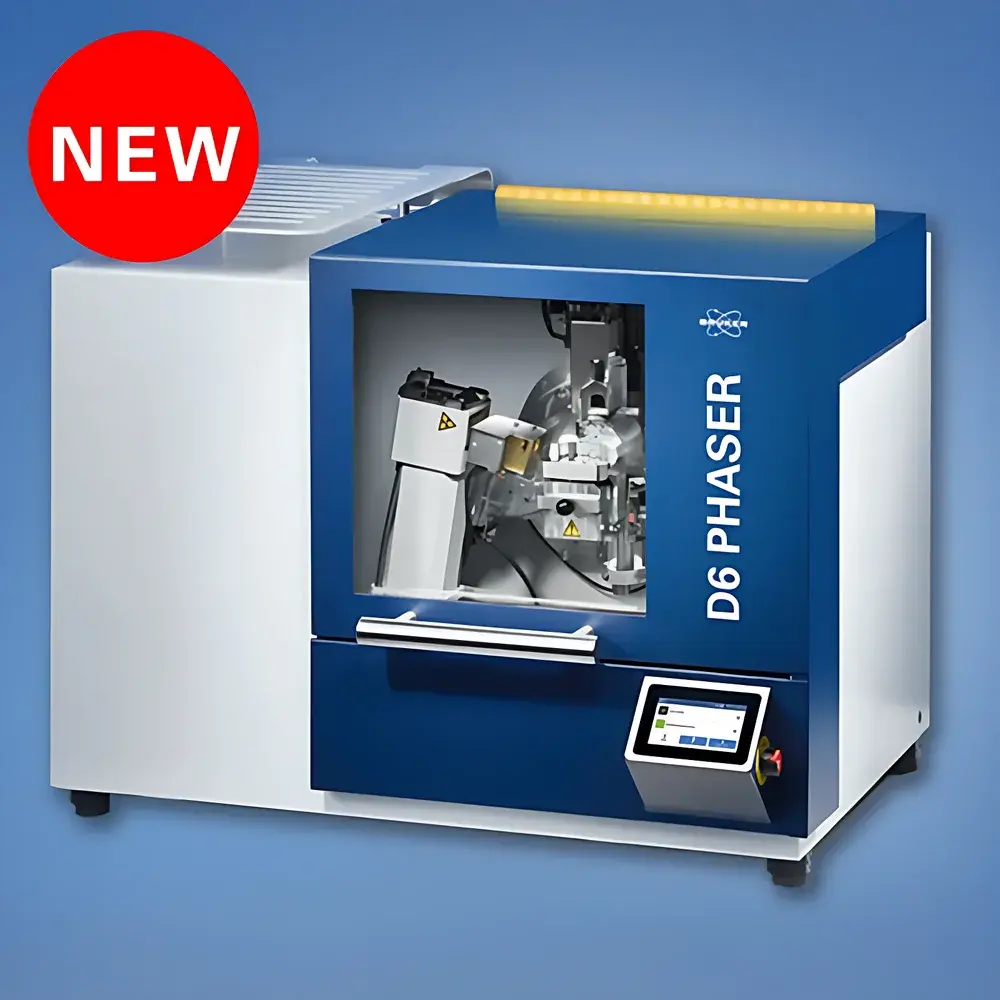
Bruker D6 PHASER Benchtop X-ray Diffractometer
| Brand | Bruker |
|---|---|
| Origin | Germany |
| Model | D6 PHASER |
| Instrument Type | Powder X-ray Diffractometer |
| Generator Power | 600 W or 1200 W |
| 2θ Calibration Accuracy | ±0.01° |
| Detector | LYNXEYE XE-T Energy-Resolving Detector |
| Beam Optimization | Dynamic Beam Optimization (DBO) |
| Cooling | Air-Cooled (No External Water Chiller Required) |
| Footprint | Compact Benchtop Design |
| Measurement Geometries | Bragg–Brentano Reflection, Transmission, Grazing-Incidence XRD (GIXRD), X-ray Reflectivity (XRR), Residual Stress Analysis, Texture Analysis |
Overview
The Bruker D6 PHASER is a fully integrated, benchtop X-ray diffractometer engineered for high-precision powder X-ray diffraction (PXRD) and advanced structural characterization of polycrystalline, thin-film, and bulk materials. Unlike conventional benchtop systems limited to Bragg–Brentano reflection geometry, the D6 PHASER implements a modular goniometric architecture that supports multiple measurement configurations—including transmission, grazing-incidence XRD (GIXRD), X-ray reflectivity (XRR), residual stress analysis via sin²ψ method, and pole figure acquisition for texture evaluation. Its core measurement principle relies on monochromatic Cu Kα radiation (λ = 1.5418 Å) generated by a sealed-tube X-ray source, coupled with an energy-resolving LYNXEYE XE-T detector enabling high dynamic range, low background, and intrinsic discrimination of fluorescence and higher-order radiation. Designed and manufactured in Germany, the system complies with IEC 61010-1 safety standards and meets electromagnetic compatibility (EMC) requirements per EN 61326-1 for laboratory environments.
Key Features
- Modular multi-geometry platform supporting PXRD, GIXRD, XRR, stress, and texture analysis—without hardware reconfiguration between modes
- High-power X-ray generator options: 600 W standard or 1200 W high-intensity configuration, delivering superior photon flux for rapid data collection and weak-phase detection
- Dynamic Beam Optimization (DBO) technology maintains optical alignment and beam intensity across all sample stages and optical paths; ensures 2θ peak position reproducibility better than ±0.01° even after automatic stage exchange
- LYNXEYE XE-T silicon-strip detector with energy discrimination, 1D linear array format, and real-time background suppression—eliminates need for monochromators or pulse-height analyzers
- Air-cooled design with integrated thermal management: no external water chiller required, reducing infrastructure dependencies and operational complexity
- Compact footprint (≤ 0.8 m²) suitable for shared labs, QC facilities, and university teaching laboratories with space constraints
- Motorized optical component switching and sample stage positioning controlled via intuitive touchscreen interface
Sample Compatibility & Compliance
The D6 PHASER accommodates a wide range of sample formats: standard powder holders (13 mm, 25 mm), thin-film substrates (Si wafers, glass slides, flexible polymers), bulk metal coupons, and textured ceramics. Optional motorized sample changers support unattended sequential analysis of up to 36 samples. All measurement protocols are compatible with ISO 17873:2016 (XRD phase identification), ASTM E975 (residual stress determination), and ISO 12781-2 (surface roughness via XRR). The system’s software architecture supports audit trails, electronic signatures, and user-level access control—enabling compliance with GLP, GMP, and FDA 21 CFR Part 11 requirements when deployed in regulated environments.
Software & Data Management
Operation is driven by Bruker’s DIFFRAC.SUITE software platform, which integrates instrument control, real-time data visualization, and quantitative analysis workflows—including phase identification (ICDD PDF-4+ database), Rietveld refinement (TOPAS engine), crystallite size/strain analysis (Williamson–Hall, Warren–Averbach), thin-film modeling (REFLEX), and stress tensor calculation. Data files adhere to the industry-standard .raw and .udf formats, ensuring interoperability with third-party tools (e.g., GSAS-II, FullProf). Automated report generation includes metadata embedding (operator ID, timestamp, calibration logs), and raw data export supports FAIR principles (Findable, Accessible, Interoperable, Reusable). Remote monitoring and diagnostics are enabled via secure HTTPS-based web interface.
Applications
- Pharmaceutical solid-form screening and polymorph quantification under non-ambient conditions (with optional environmental stage)
- Quality control of battery cathode/anode materials (LiCoO₂, NMC, Si anodes) for crystallinity, impurity detection, and lattice parameter tracking
- Thin-film metrology in semiconductor fabrication: thickness, density, interfacial roughness, and interdiffusion analysis via XRR
- Mechanical property correlation in metallurgy: residual stress mapping in weld zones, turbine blades, and additive-manufactured components
- Geological and mineralogical analysis of clays, zeolites, and cementitious phases using semi-quantitative Rietveld methods
- Academic research in MOFs, perovskites, and nanomaterials where rapid method switching between bulk and surface-sensitive geometries accelerates hypothesis testing
FAQ
Does the D6 PHASER require external water cooling?
No—the system uses an integrated air-cooling architecture with intelligent thermal load balancing, eliminating dependency on chilled water units.
Can the same sample holder be used for both reflection and transmission measurements?
Yes; the modular sample stage design supports interchangeable holders optimized for each geometry, with automatic recognition and calibration via RFID tags.
Is the LYNXEYE XE-T detector compatible with fluorescence suppression for transition-metal-containing samples?
Yes; its energy-discrimination capability inherently rejects characteristic fluorescence from Fe, Co, Ni, and Mn, enabling robust analysis without Kβ filters or monochromators.
What level of training is required to operate the system for routine PXRD analysis?
Minimal: the touchscreen-guided workflow and context-sensitive help system allow new users to acquire and process standard powder patterns within one hour of installation.
How is traceability ensured for regulatory submissions?
DIFFRAC.SUITE provides full electronic audit trail, including raw data integrity checks, operator authentication, and version-controlled method templates aligned with ALCOA+ principles.





