
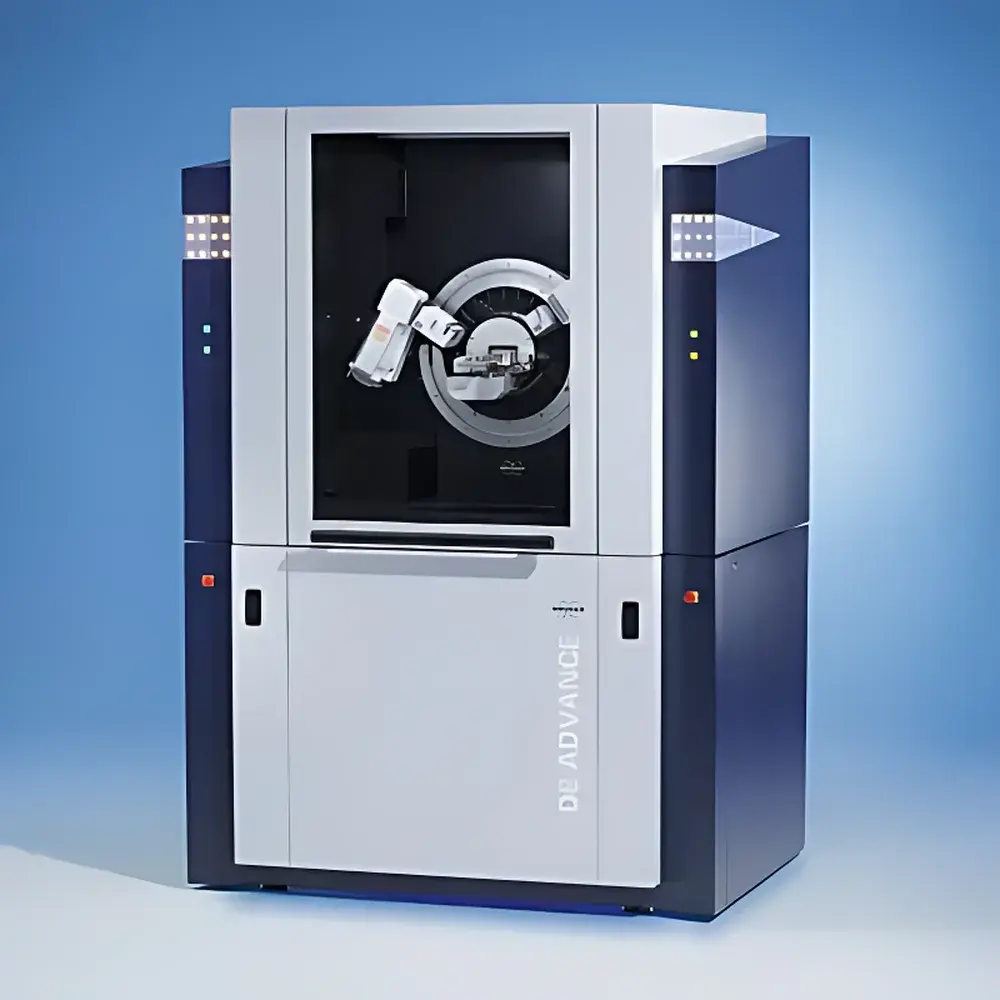
Bruker D8 ADVANCE X-ray Diffractometer
| Brand | Bruker |
|---|---|
| Origin | Germany |
| Manufacturer Type | Authorized Distributor |
| Origin Category | Imported |
| Model | D8 ADVANCE |
| Instrument Type | Powder X-ray Diffractometer |
| Power | 0.0001° angular resolution |
| 2θ Range | −110° to +168° |
| X-ray Tube Targets | Cr / Co / Cu (standard-size) |
| Detector Options | LYNXEYE Array Detector, LYNXEYE XE-T Energy-Dispersive Detector |
| Dimensions | 1868 × 1300 × 1135 mm |
| Weight | 770 kg |
Overview
The Bruker D8 ADVANCE is a high-performance, modular powder X-ray diffractometer engineered for precision phase identification, quantitative analysis, microstructural characterization, and thin-film metrology. Based on Bragg-Brentano focusing geometry and parallel-beam optics, the system employs Bruker’s patented TWIN-TWIN optical configuration—enabling fully automated, software-driven switching between analytical modes without manual realignment or beam recalibration. This architecture supports simultaneous optimization for bulk powder analysis, grazing-incidence diffraction (GID), X-ray reflectivity (XRR), and small-angle X-ray scattering (SAXS), all within a single platform. The instrument integrates a high-precision θ/θ vertical goniometer with ≤0.0001° angular resolution across its full −110° to +168° 2θ range, ensuring traceable peak position accuracy compliant with ISO 17873 and ASTM E975 standards for diffraction data validation.
Key Features
- TWIN-TWIN Optical Architecture: Dual independent beam paths allow seamless, motorized switching between Bragg-Brentano (BB) geometry for powder analysis and parallel-beam geometry for thin-film and surface-sensitive measurements—no optical reconfiguration required.
- TwistTube Technology: Enables rapid (<60 s) transition between line-source (powder, GID, XRR) and point-source (texture, stress, micro-diffraction) configurations via automated collimator and optic exchange.
- Dynamic Beam Optimization (DBO): Synchronized motorized divergence slits, anti-scatter blades, and variable detector apertures dynamically adapt beam conditioning in real time—maximizing signal-to-noise ratio, especially at low 2θ angles (<5°), per ISO 13121 requirements for SAXS data integrity.
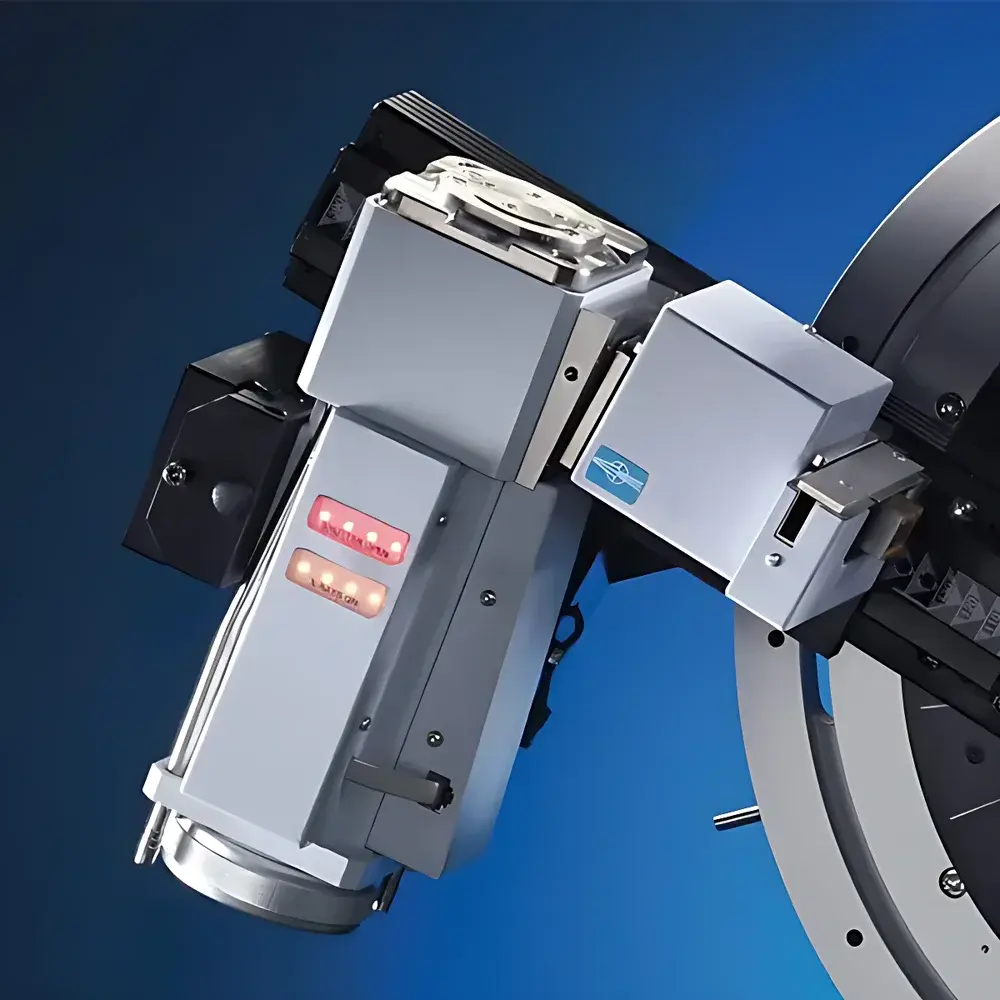
- LYNXEYE XE-T Energy-Dispersive Detector: Capable of simultaneous 0D, 1D, and 2D detection across Cr–Ag wavelengths; delivers >380 eV energy resolution for complete Kα fluorescence suppression (e.g., Fe Kα under Cu radiation) without mechanical filters or secondary monochromators—eliminating intensity loss and artifact generation.
- Guaranteed Detector Performance: Every LYNXEYE XE-T unit is factory-tested and shipped with zero defective pixels—documented in the Certificate of Conformance per ISO/IEC 17025 calibration records.
Sample Compatibility & Compliance
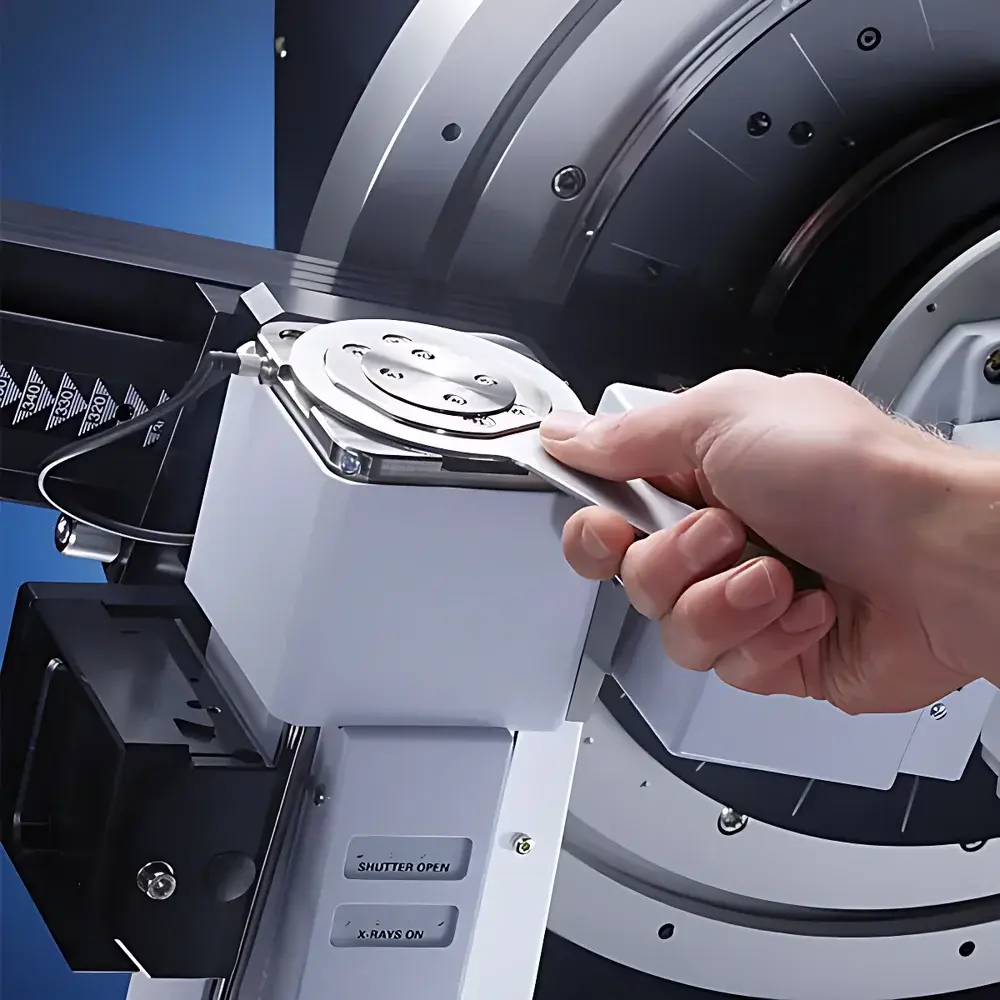
The D8 ADVANCE accommodates diverse sample formats—including powders, bulk solids, fibers, foils, coatings, epitaxial thin films (amorphous, polycrystalline, single-crystal), and mesoporous materials—without hardware modification. Its environmental flexibility extends to optional stages for in situ heating (RT–1600°C), cooling (10–600 K), humidity control, and gas atmospheres (N₂, O₂, vacuum). All firmware and acquisition modules comply with FDA 21 CFR Part 11 for electronic records and signatures, supporting audit trails, user access control, and electronic signature workflows required under GLP and GMP environments. Data files adhere to the IUCr CIF 1.1 standard and are exportable in NeXus/HDF5 format for long-term archival per ISO 16363 trustworthiness criteria.
Software & Data Management
EVA, TOPAS, DIFFRAC.SUITE, and DIFFRAC.TOPAS provide end-to-end workflow integration—from raw data acquisition and background subtraction to Rietveld refinement, crystallite size/strain modeling (Williamson-Hall, Warren-Averbach), texture analysis (ODF calculation), and thin-film parameter extraction (density, roughness, layer thickness). Real-time data processing supports live Rietveld updates during in situ experiments. All software modules undergo annual verification against NIST SRM 660c (LaB₆) and SRM 640e (Si) reference materials. Audit logs record operator ID, timestamp, parameter changes, and data export events—fully traceable for regulatory review.
Applications
- Qualitative and quantitative phase analysis (QPA) per ASTM E1423 and ISO 21390
- Crystallinity and amorphous content determination using internal standard or whole-pattern fitting methods
- Lattice parameter refinement with sub-ppm precision for strain and composition mapping
- Crystallite size and microstrain analysis via Williamson-Hall and anisotropic broadening deconvolution
- Grazing-incidence XRD (GIXRD) for depth-resolved phase distribution in multilayer stacks
- X-ray reflectivity (XRR) modeling of film density, interfacial roughness, and layer thickness (≤0.1 nm resolution)
- Residual stress evaluation using sin²ψ method per ASTM E915
- Small-angle X-ray scattering (SAXS) for pore size distribution in mesoporous silica and MOFs
- Texture analysis and orientation distribution function (ODF) reconstruction for rolled metals and ceramics
- In situ thermal, mechanical, or electrochemical experiments with time-resolved pattern collection
FAQ
Does the D8 ADVANCE support automated alignment routines for new users?
Yes—Bruker’s AutoAlign routine performs full optical centering, beam height calibration, and detector positioning in under 5 minutes using built-in laser and encoder feedback.
Is the LYNXEYE XE-T detector compatible with all X-ray tube anodes?
Yes—it operates natively with Cr, Co, Cu, Mo, and Ag anodes without hardware modification, maintaining optimal energy resolution and count-rate linearity across the full range.
Can the system perform non-destructive analysis of coated or layered samples?
Yes—parallel-beam geometry combined with GID and XRR modes enables non-contact, depth-profiling analysis of coatings down to sub-nanometer thicknesses without sputtering or cross-sectioning.
What compliance documentation is provided with the instrument?
Each shipment includes a Factory Acceptance Test (FAT) report, ISO/IEC 17025-accredited calibration certificate for goniometer and detector, and a 21 CFR Part 11 compliance package including SOP templates and validation protocols.
How is data integrity ensured during long-duration in situ experiments?
The system implements cyclic checksum verification, redundant RAM buffering, and automatic recovery checkpoints—ensuring zero frame loss even during multi-day synchrotron-style acquisitions.





