
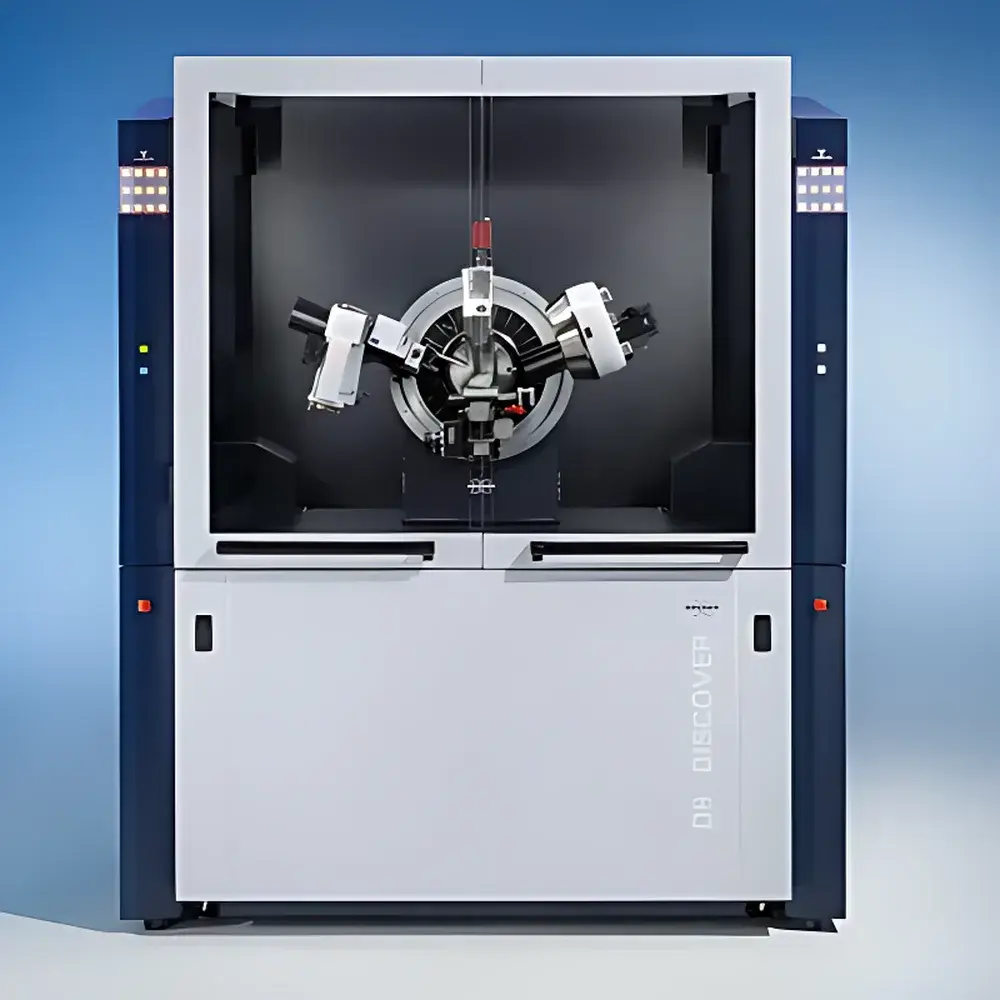
Bruker D8 DISCOVER Advanced X-ray Diffractometer
| Brand | Bruker |
|---|---|
| Origin | Germany |
| Model | D8 DISCOVER |
| Instrument Type | Powder X-ray Diffractometer |
| Power Rating | 0.0001 kW |
| Compliance | Fully Compliant with ISO 17025, ASTM E975, and IEC 61000-6-3 for Electromagnetic Compatibility |
Overview
The Bruker D8 DISCOVER is a high-performance, modular X-ray diffractometer engineered for advanced materials characterization in academic, industrial, and national laboratory settings. Built upon Bruker’s patented Da Vinci geometry — a goniometer architecture that decouples sample and detector motion to maximize flexibility and precision — the system enables simultaneous optimization of incident and diffracted beam paths across a wide range of scattering geometries. Its core measurement principle is Bragg diffraction of monochromatic Cu Kα (or optional Mo, Co, Cr) X-rays from crystalline lattices, supporting both θ–2θ scanning and area-detector-based 2D data acquisition. Unlike conventional fixed-geometry systems, the D8 DISCOVER integrates motorized, software-controlled alignment of optics, sample stages, and detectors, allowing seamless transitions between high-resolution XRD (HRXRD), X-ray reflectivity (XRR), grazing-incidence diffraction (GID), in-plane GID, GISAXS, residual stress mapping, and texture analysis — all within a single platform.
Key Features
- Da Vinci optical geometry with independent, synchronized control of incident and diffracted beam optics
- Integrated DIFFRAC.SUITE™ software suite with automatic accessory recognition and plug-and-play configuration
- Full 2D XRD2 capability via high-speed, large-area VÅNTEC-500 or PILATUS3 R detectors
- Motorized six-circle Eulerian cradle (χ, φ, ω, 2θ, x, y) for precise sample orientation in HRXRD and texture studies
- Programmable incident-beam optics including Göbel mirrors, multilayer monochromators, and parallel-beam collimators
- High-stability temperature-controlled sample stages (–180 °C to +1000 °C) compatible with in situ/operando experiments
- Comprehensive radiation safety compliance per IEC 60529 (IP20), EN 61000-6-4, and local regulatory requirements
Sample Compatibility & Compliance
The D8 DISCOVER accommodates diverse sample formats: thin films (single-layer to complex heterostructures), powders, bulk crystals, nanocomposites, and liquid-phase samples in capillaries or environmental cells. It supports non-destructive, quantitative analysis of epitaxial layers down to sub-nanometer thicknesses and strain resolution better than 10−4. All measurement protocols adhere to internationally recognized standards, including ASTM E1478 (XRR), ASTM F3265 (HRXRD for semiconductor heterostructures), ISO 12781-2 (surface texture), and ISO 21947 (residual stress by XRD). The system meets GLP/GMP documentation requirements when configured with audit-trail-enabled DIFFRAC.SUITE™ and optional 21 CFR Part 11-compliant user access controls.
Software & Data Management
DIFFRAC.SUITE™ serves as the unified control, acquisition, and analysis environment — featuring real-time feedback during alignment, automated calibration routines, and intelligent parameter inheritance across techniques. LEPTOS™, integrated within the suite, provides model-based fitting of HRXRD reciprocal space maps (RSMs) and XRR density/roughness profiles using dynamical diffraction theory. Data files conform to the industry-standard HDF5 format with embedded metadata (sample ID, instrument configuration, operator, timestamp), ensuring FAIR (Findable, Accessible, Interoperable, Reusable) data principles. Raw and processed datasets are exportable to third-party tools (e.g., MATLAB, Python SciPy, GSAS-II) via open APIs.
Applications
- Epitaxial thin-film metrology: layer thickness, composition, strain state, relaxation degree, and lateral correlation length
- Quantitative phase identification and quantification (Rietveld refinement) in polycrystalline and multiphase systems
- Nanoscale interfacial structure analysis via XRR and GISAXS for porous dielectrics, block copolymers, and biomimetic coatings
- Crystallographic texture evaluation using pole figure and ODF reconstruction for metallurgical and additive manufacturing QA/QC
- In situ thermal, mechanical, or electrochemical studies with time-resolved diffraction and Rietveld tracking
- Residual stress profiling in turbine blades, weld zones, and printed electronics using sin²ψ methodology
FAQ
Is the D8 DISCOVER suitable for routine QC applications in semiconductor fabs?
Yes — its automated alignment, recipe-driven operation, and integration with factory MES systems make it deployable in high-throughput environments requiring traceable, repeatable measurements.
Can the system perform both XRR and HRXRD on the same sample without hardware reconfiguration?
Yes — the Da Vinci geometry and motorized optics allow software-switched transition between XRR (specular scan mode) and HRXRD (rocking curve or RSM mode) in under 90 seconds.
Does Bruker provide application support for custom data modeling beyond LEPTOS™?
Yes — Bruker’s Application Scientists offer collaborative method development, including custom Python-based fitting scripts, finite-element strain simulations, and integration with TCAD workflows.
What detector options are certified for use with the D8 DISCOVER platform?
Certified detectors include the VÅNTEC-500 (large-area gas-filled proportional counter), PILATUS3 R (hybrid photon-counting pixel detector), and EIGER2 R (next-generation high-dynamic-range detector), all with factory-calibrated linearity and energy response.
Is remote operation and diagnostics supported?
Yes — via Bruker’s secure Remote Access Gateway (RAG), enabling off-site instrument monitoring, troubleshooting, and scheduled maintenance alerts through encrypted TLS 1.3 channels.




