
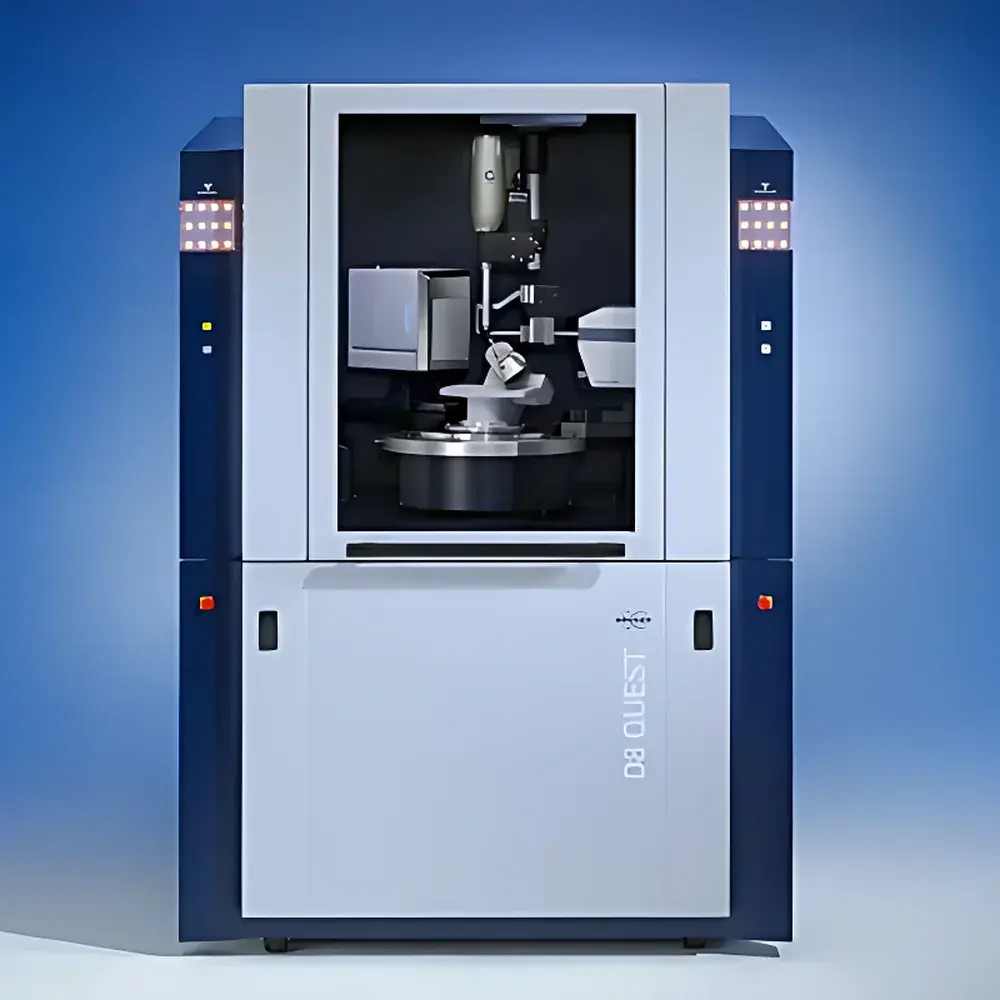
Bruker D8 QUEST Single-Crystal X-ray Diffractometer
| Brand | Bruker |
|---|---|
| Origin | Germany |
| Model | D8 QUEST |
| Instrument Type | Single-Crystal X-ray Diffractometer |
| Power | 200 W (0.0002 MW) |
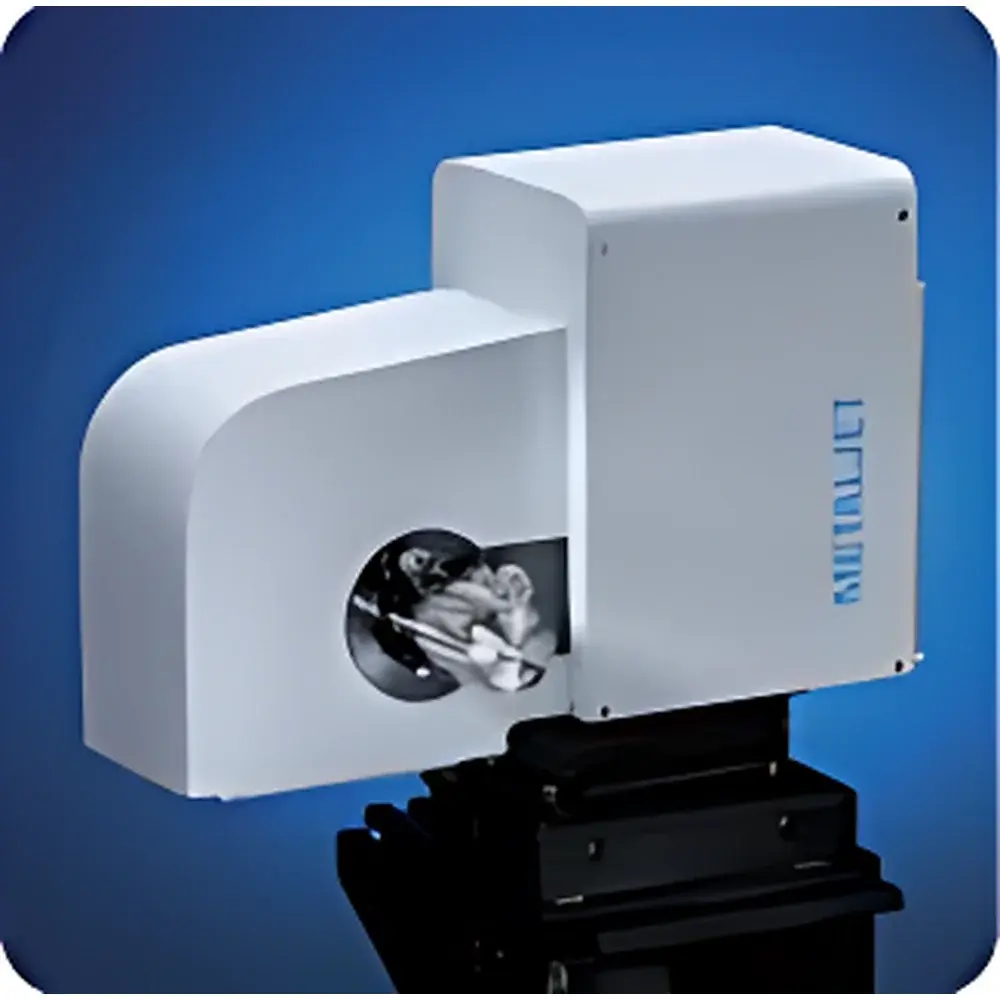
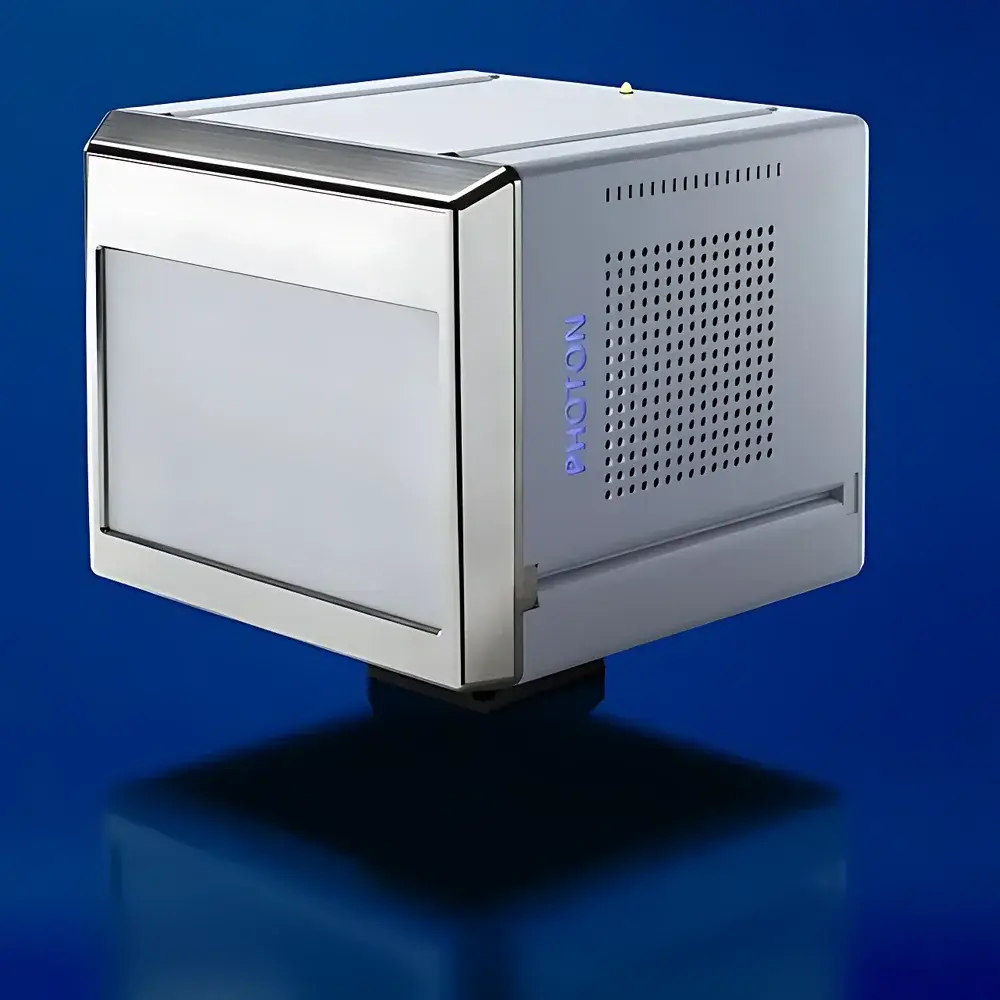
| Detector | PHOTON III MMPAD Hybrid Photon Counting Detector |
| Source Options | Microfocus Rotating Anode (Cu/Mo), Liquid Metal Jet (Ga/In), Dual-Target Auto-Switching |
| Software | APEX3 / PROTEUM3 |
| Compliance | ISO 17025-ready, GLP/GMP-supportive data audit trails, FDA 21 CFR Part 11 compliant modules available |
Overview
The Bruker D8 QUEST is a high-performance single-crystal X-ray diffractometer engineered for structural determination across small-molecule crystallography, metal–organic frameworks (MOFs), coordination polymers, and macromolecular crystallography—including challenging membrane proteins such as GPCRs. It operates on the fundamental principle of Bragg diffraction: monochromatic X-rays impinge upon a single crystal, producing a three-dimensional diffraction pattern that encodes atomic-level positional and thermal information. The instrument integrates advanced source technology—including microfocus sealed-tube and liquid-metal-jet (MetalJet) anodes—with fourth-generation hybrid photon-counting detection to deliver exceptional signal-to-noise ratios, high dynamic range, and sub-pixel spatial resolution. Its modular architecture supports both routine academic structure solution and demanding industrial R&D workflows requiring traceable, auditable, and reproducible data acquisition.
Key Features
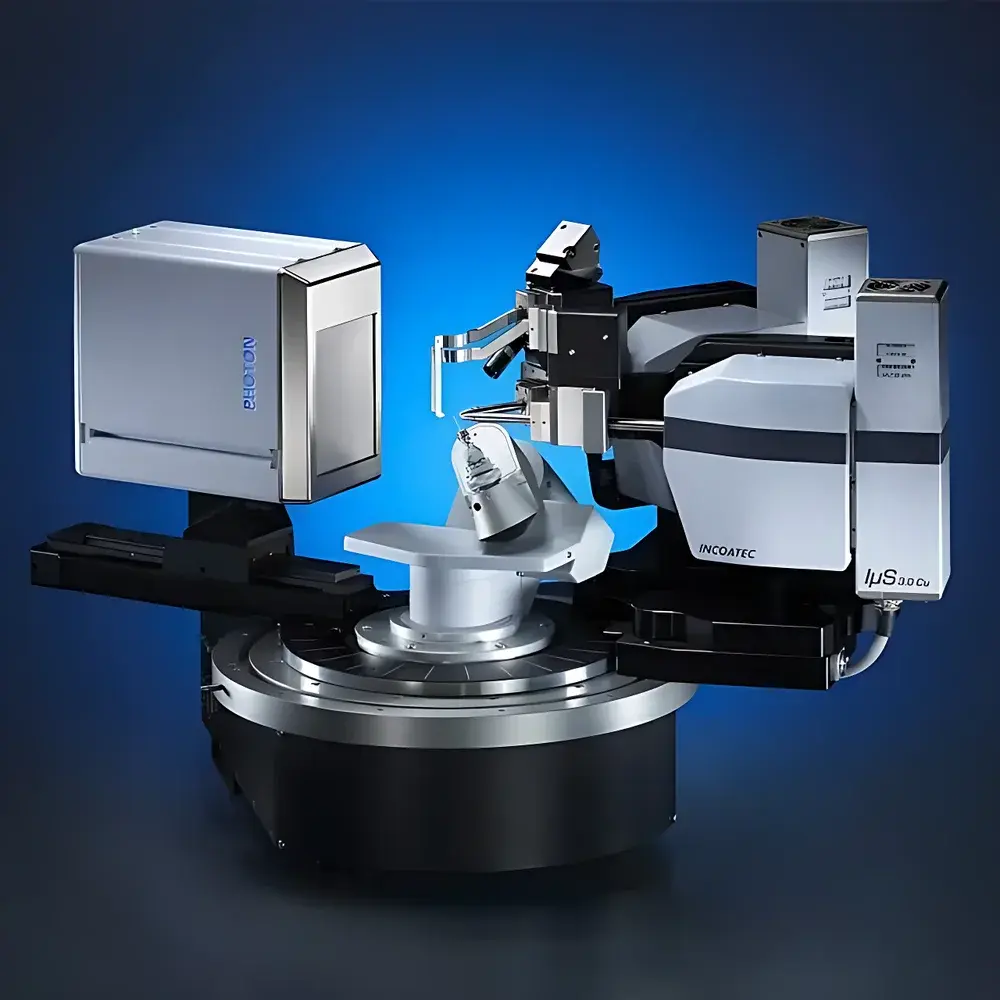
- Microfocus rotating anode source (Cu or Mo) with lus 3.0 optics—zero-maintenance, >10,000-hour lifetime, sub-20 µm focal spot size for optimal intensity and resolution.
- Liquid Metal Jet (MetalJet) Ga/In source option: delivers up to 10× higher brilliance than conventional microfocus tubes—enabling “lab-scale synchrotron-like” data collection for radiation-sensitive or weakly diffracting crystals.
- PHOTON III MMPAD detector: large-area (240 × 240 mm² active area), frame rates up to 1 kHz, true single-photon sensitivity, zero readout noise, and no point-spread function degradation—ideal for time-resolved and low-dose experiments.
- Dual-target configuration with automated source switching: seamless transition between Cu-Kα (for small molecules) and Mo-Kα (for heavy-atom structures or fast data collection) without manual intervention.
- Intelligent beamline management: real-time component recognition via RFID tags, automatic alignment calibration, and adaptive collimation optimized per sample geometry and crystal size.
- Rigid goniometer design with high-precision Eulerian cradle (±0.0005° angular reproducibility) and cryogenic compatibility (down to 10 K using closed-cycle coolers).
Sample Compatibility & Compliance
The D8 QUEST accommodates a broad spectrum of crystalline samples—from air-sensitive organometallics mounted under inert atmosphere to cryo-cooled protein crystals in nylon loops or MiTeGen micromounts. Sample stages support standard capillaries (0.1–1.0 mm), Hampton-style loops, and custom holders compatible with robotic sample changers (e.g., Bruker CATS). All hardware and software components are designed to support compliance with internationally recognized quality frameworks: data integrity features include electronic signatures, full audit trails, user-access controls, and timestamped metadata logging—all configurable to meet ISO/IEC 17025 laboratory accreditation requirements. Optional FDA 21 CFR Part 11 modules provide electronic record validation for regulated pharmaceutical environments, while PROTEUM3’s built-in validation reports facilitate GLP/GMP audits.
Software & Data Management
APEX3 and PROTEUM3 software suites provide an integrated environment for instrument control, data collection, integration, scaling, and structure solution (SHELXT, SHELXL, OLEX2, PHENIX). Real-time data visualization enables immediate assessment of completeness, redundancy, I/σ(I), and Rint. Automated processing pipelines support batch refinement and structure validation (PLATON, CheckCIF). Raw frames and processed .hkl files are stored in vendor-neutral formats (CBF, CIF) with embedded metadata (crystal system, space group, unit cell, exposure parameters). Data export supports direct submission to the Cambridge Structural Database (CSD) and Protein Data Bank (PDB). Network-deployable licensing allows centralized administration across multi-user facilities.
Applications
- De novo structure determination of novel organic, inorganic, and organometallic compounds.
- Polymorph screening and solid-form characterization for pharmaceutical development (ICH Q5A, Q6A).
- Time-resolved crystallography of photoactive materials and enzymatic intermediates.
- High-resolution structure analysis of membrane proteins, viral capsids, and large macromolecular complexes.
- Charge-density analysis and multipole modeling for electron distribution mapping.
- Residual electron density mapping in battery electrode materials and porous frameworks.
FAQ
What crystal size is required for successful data collection on the D8 QUEST?
Crystals ≥10 µm in minimum dimension are routinely measurable with MetalJet illumination; sub-5 µm crystals may be feasible using optimized beam focusing and long-exposure protocols.
Does the system support remote operation and unattended data collection?
Yes—APEX3 supports secure remote access via TLS-encrypted connections, scheduled runs, and email/SMS alerts upon job completion or error conditions.
Can the D8 QUEST be upgraded from a standard microfocus source to MetalJet?
Yes—Bruker offers field-installable MetalJet source modules with mechanical and software integration kits, preserving existing goniometer and detector infrastructure.
Is cryogenic data collection supported out-of-the-box?
Yes—the system ships with standard Oxford Instruments Cryostream 800+ integration, supporting nitrogen gas flow cooling from 80 K to 500 K with ±0.1 K stability.
How is detector calibration maintained over time?
PHOTON III employs factory-calibrated pixel gain maps and temperature-stabilized electronics; routine verification is performed automatically during startup using internal reference sources and dark-frame subtraction.





