
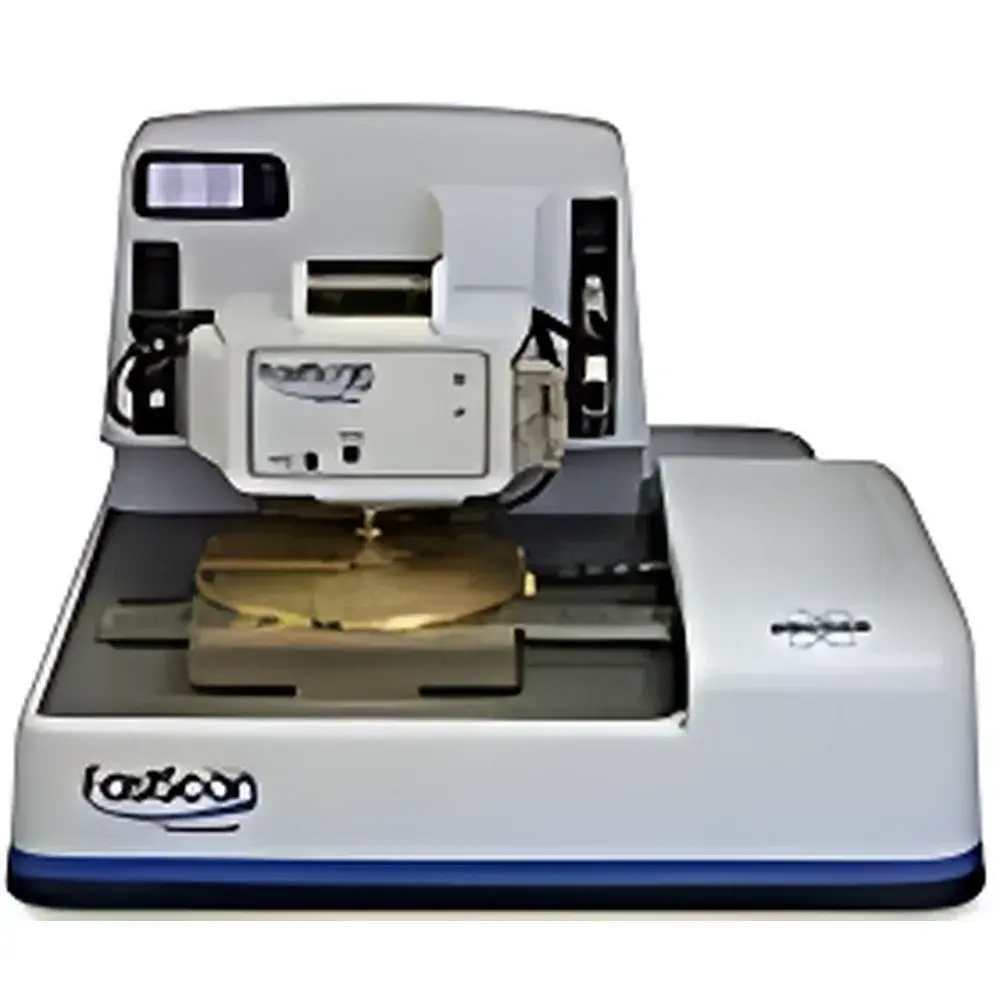
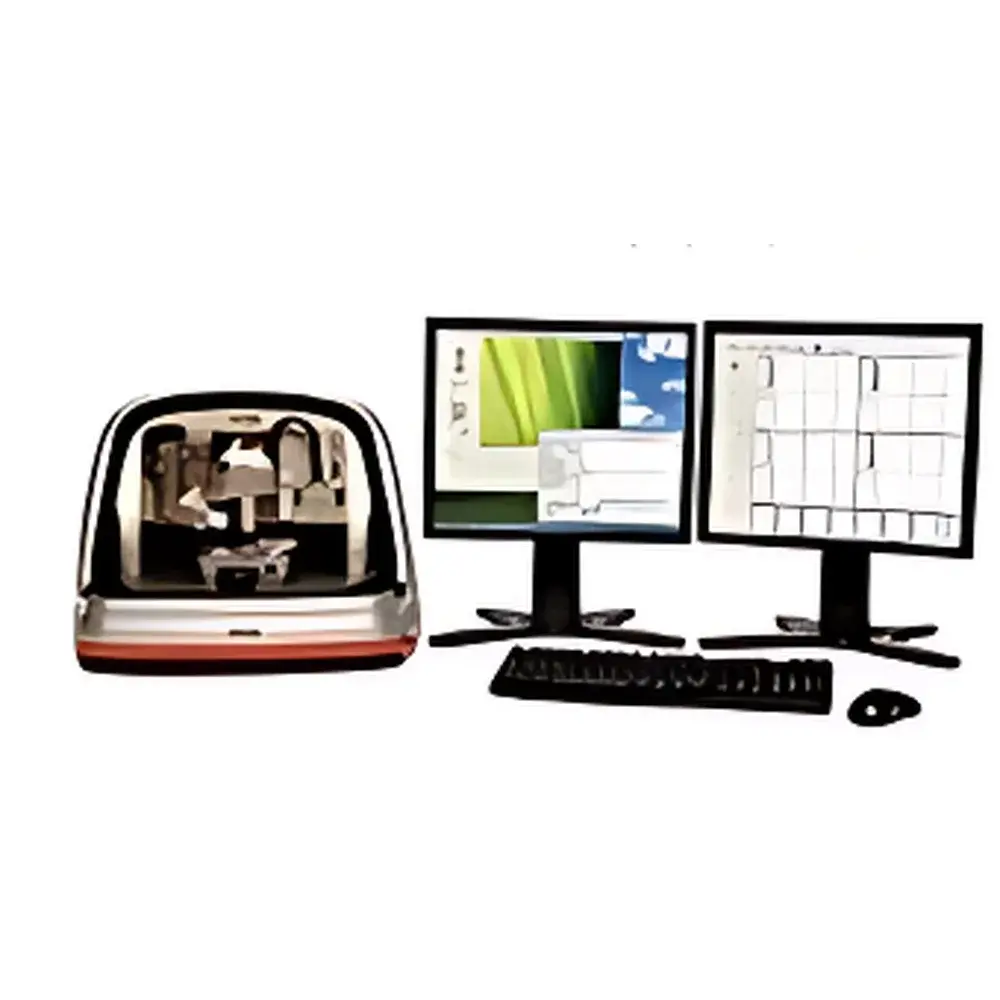
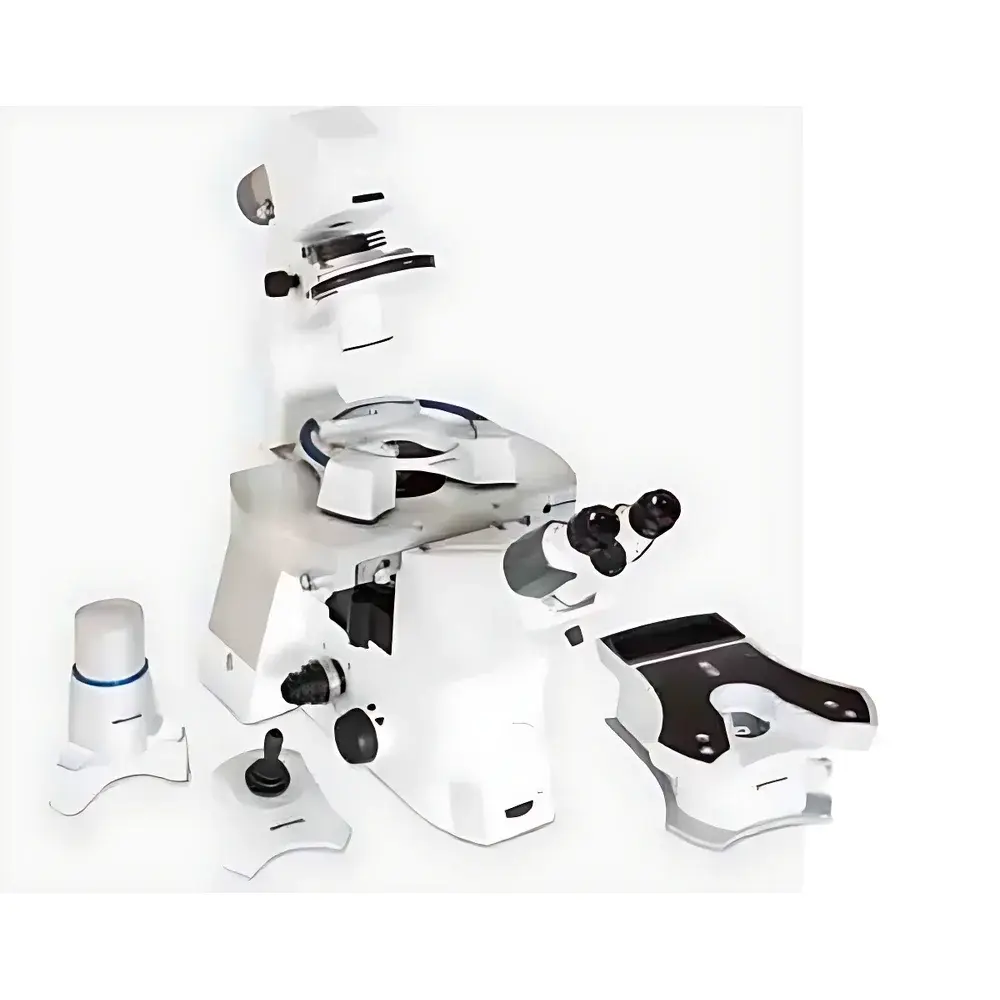
Bruker Dimension Icon Atomic Force Microscope
| Brand | Bruker |
|---|---|
| Origin | Malaysia |
| Manufacturer Type | Authorized Distributor |
| Origin Category | Imported |
| Model | Dimension Icon |
| Instrument Type | Atomic Force Microscope |
| X-Y Positioning Noise (Closed-Loop) | ≤0.15 nm RMS (Standard Imaging Bandwidth, up to 625 Hz) |
| Z Positioning Noise (Closed-Loop) | 35 pm RMS (Standard Imaging Bandwidth, up to 625 Hz) |
| Maximum Sample Diameter | 210 mm |
| Sample Stage Travel Range | 150 mm |
Overview
The Bruker Dimension Icon Atomic Force Microscope is a high-performance scanning probe microscope engineered for nanoscale surface topography, mechanical property mapping, and functional characterization under ambient, liquid, and controlled environmental conditions. Operating on the fundamental principle of atomic force detection—where interatomic forces between a sharp probe tip and sample surface are transduced via a compliant microcantilever—the Dimension Icon delivers quantitative, sub-angstrom resolution imaging through three primary operational modes: contact mode, tapping mode, and non-contact mode. Its closed-loop piezoelectric scanner architecture ensures real-time positional feedback across all axes, eliminating hysteresis and creep artifacts common in open-loop systems. Designed for rigorous scientific validation and industrial process monitoring, the system integrates seamlessly into GLP-compliant laboratories and supports traceable calibration protocols aligned with ISO/IEC 17025 requirements.
Key Features
- Sub-ångström Z-axis noise performance: 35 pm RMS (standard imaging bandwidth), enabling reliable detection of atomic-scale surface corrugations and monolayer thickness variations.
- Ultra-low X-Y drift and noise: ≤0.15 nm RMS (closed-loop, 625 Hz bandwidth), critical for long-duration force spectroscopy and time-lapse nanomechanical mapping.
- Integrated ScanAsyst™ automated imaging optimization: Reduces user dependency by dynamically adjusting setpoint, gain, and scan parameters based on real-time cantilever response and surface topography.
- Open-access XYZ closed-loop scanner with 150 mm travel range: Facilitates large-area stitching, multi-region correlation (e.g., AFM + optical microscopy), and custom in situ accessories (heating stages, electrochemical cells, humidity chambers).
- Dual-stage thermal compensation: Active temperature stabilization of both position sensors and scanner body minimizes thermal drift, maintaining <0.5 nm/h stability over 8-hour acquisitions.
- High-harmonic resonance imaging and TrueNonContact™ mode: Enables non-destructive, low-force (<50 pN) imaging of soft biological samples and polymer thin films without tip-induced deformation.
- Simultaneous tip–sample heating capability: Unique dual-zone thermal control eliminates thermal gradient-induced artifacts during elevated-temperature AFM, supporting studies from −30 °C to +250 °C with <0.1 °C stability.
Sample Compatibility & Compliance
The Dimension Icon accommodates standard wafers (up to 200 mm diameter), irregularly shaped specimens (max. 210 mm Ø × 15 mm thick), and fragile substrates including mica, HOPG, silicon nitride membranes, and live-cell cultures on glass-bottom dishes. Its modular stage design supports vacuum-compatible, liquid-cell, and electrochemical configurations per ASTM E2539-22 (Standard Guide for AFM Measurements). All hardware and software modules comply with FDA 21 CFR Part 11 for electronic records and signatures when deployed in regulated environments; audit trails, user access controls, and electronic signature workflows are fully configurable within NanoScope Analysis v2.0 software.
Software & Data Management
Controlled via Bruker’s NanoScope Analysis v2.0 platform, the system provides full scripting support (Python API), batch processing pipelines, and automated report generation compliant with ISO 25178-2 (Surface Texture — Areal). Raw force-distance curves, topographic maps, phase images, and modulus maps are stored in vendor-neutral HDF5 format with embedded metadata (timestamp, operator ID, calibration parameters, environmental logs). Data integrity is preserved through checksum validation, versioned file archiving, and optional integration with LIMS or ELN systems via RESTful API endpoints.
Applications
- Quantitative nanomechanical mapping of polymer blends, block copolymers, and hydrogels using PeakForce QNM® mode.
- In situ electrochemical AFM of battery electrode interfaces during charge/discharge cycling (Li-ion, solid-state).
- Mechanical property gradients in biomaterial scaffolds and tissue-engineered constructs.
- Defect analysis and strain mapping in semiconductor heterostructures and 2D materials (graphene, MoS₂, h-BN).
- Real-time self-assembly dynamics of supramolecular architectures at liquid–solid interfaces.
- Failure analysis of MEMS/NEMS devices including stiction, wear, and adhesion hysteresis quantification.
- Thin-film morphology and interfacial roughness assessment for OLED, perovskite photovoltaics, and anti-reflective coatings.
FAQ
What environmental conditions are supported for imaging?
The Dimension Icon operates in ambient air, inert gas (N₂, Ar), liquid (aqueous and organic solvents), and low-vacuum environments (down to 10⁻² mbar) with optional environmental enclosures.
Is the system compatible with third-party probes and cantilevers?
Yes—it accepts standard 125 µm × 500 µm rectangular and triangular cantilevers from major suppliers (BudgetSensors, Nanoworld, Olympus), with automatic probe recognition via integrated RFID tags.
How is calibration traceability ensured?
Bruker provides NIST-traceable calibration standards (gratings, step-height references) and documented procedures aligned with ISO/IEC 17025 and ASTM E2539-22 for lateral and vertical scale verification.
Can the system perform correlative microscopy?
Yes—open-stage geometry and programmable coordinate referencing enable precise registration with optical, fluorescence, Raman, and SEM modalities via fiducial markers or motorized stage synchronization.
What data security features are included for regulated use?
Role-based access control, encrypted database storage, electronic signatures, and full audit trail logging meet FDA 21 CFR Part 11 and EU Annex 11 requirements for GxP environments.



