
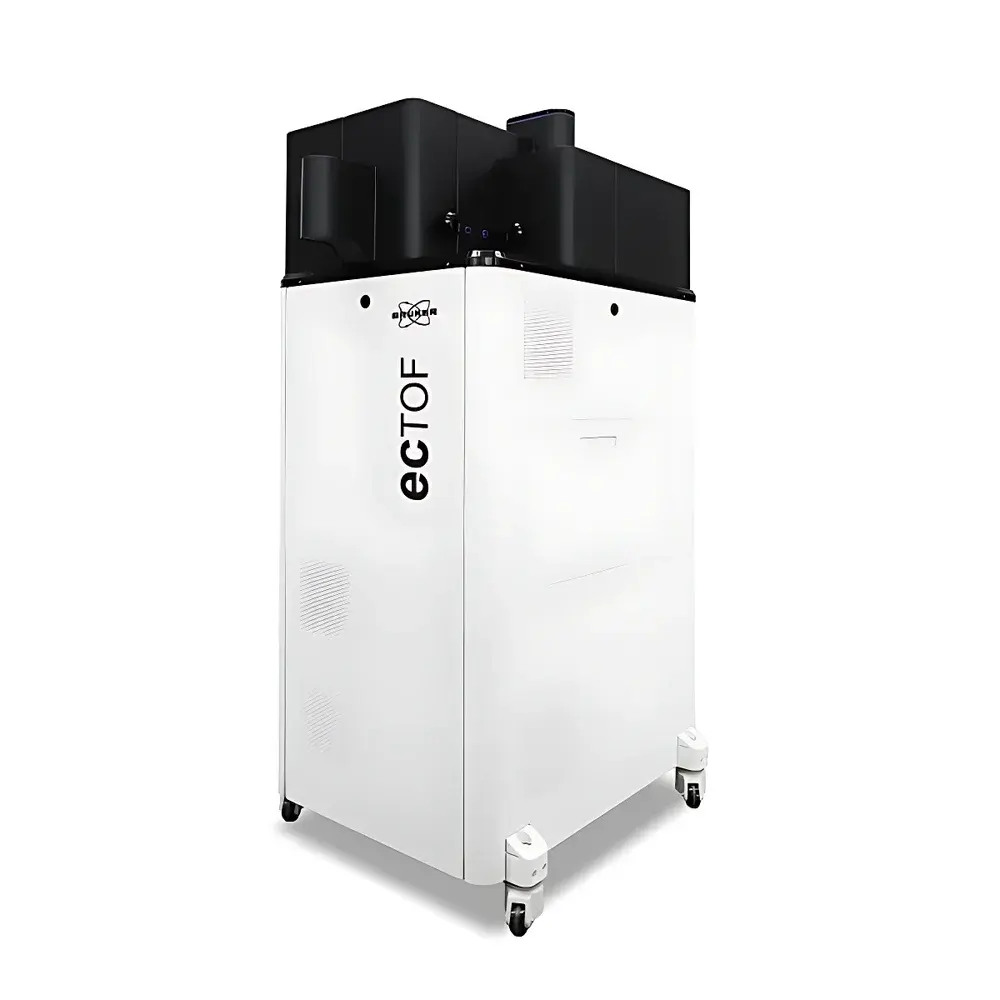
Bruker ecTOF High-Resolution Gas Chromatography Time-of-Flight Mass Spectrometer
| Brand | Bruker |
|---|---|
| Origin | Germany |
| Instrument Type | Time-of-Flight (TOF) |
| Configuration | Dual-Source GC-MS (EI + CI) |
| Ionization Modes | Electron Ionization (EI) and Chemical Ionization (CI) with Helical Resonant Plasma (HRP) source |
| Resolution | >40,000 FWHM (m/z 200) |
| Mass Accuracy | <1 ppm RMS (calibrated) |
| Scan Rate | Up to 50 spectra/sec (full-spectrum, high-res) |
| CI Reagent Gases | N₂H⁺, H₃O⁺, H(H₂O)ₙ⁺, NH₄⁺ (software-switchable, no hardware intervention) |
| Compliance | Fully compatible with GLP/GMP workflows |
Overview
The Bruker ecTOF is a high-resolution gas chromatography time-of-flight mass spectrometer engineered for untargeted and suspect-screening analysis of volatile and semi-volatile organic compounds. It uniquely integrates dual orthogonal ionization—simultaneous electron ionization (EI) and chemical ionization (CI)—within a single GC run, eliminating the need for sequential source swaps or repeated injections. Its time-of-flight mass analyzer delivers full-spectrum acquisition at up to 50 Hz with mass resolution exceeding 40,000 (FWHM at m/z 200) and sub-ppm mass accuracy under routine calibration conditions. This architecture enables concurrent generation of NIST-compatible EI fragment spectra and soft CI-derived molecular ion signals—critical for confident elemental composition assignment and structural elucidation. The system operates on a robust vacuum architecture optimized for long-term stability and minimal downtime, supporting hydrogen carrier gas operation in alignment with green analytical chemistry principles.
Key Features
- Dual-source ionization: Simultaneous EI and CI acquisition in one GC injection—no manual source exchange, no vacuum break, no chromatographic misalignment.
- Helical Resonant Plasma (HRP) CI source: Electrode-free, filament-free plasma generation enabling ultra-low maintenance, stable signal intensity over extended operation, and resistance to source contamination.
- Four software-selectable CI reagent ions: N₂H⁺, H₃O⁺, H(H₂O)ₙ⁺, and NH₄⁺ delivered via precision permeation tubes—switching requires no hardware modification or venting.
- High-fidelity spectral alignment: EI and CI peaks are intrinsically co-registered in retention time and m/z space, enabling direct comparative interpretation without post-acquisition alignment algorithms.
- Compass DataAnalysis platform: Native support for automated formula generation (SmartFormula), isotopic pattern matching (IsotopePattern), and library search integration (NIST, Wiley, custom libraries) with confidence scoring based on both fragment and molecular ion evidence.
- Hydrogen-compatible GC interface: Certified for H₂ carrier gas use—reducing operational costs, improving separation efficiency, and lowering carbon footprint without compromising sensitivity or resolution.
Sample Compatibility & Compliance
The ecTOF is validated for analysis of thermally labile and low-abundance analytes across environmental, food, pharmaceutical, and industrial matrices. It complies with ASTM D7622 (petroleum hydrocarbon profiling), ISO 17993 (environmental VOC analysis), and USP <1225> (method validation for identification). Its dual-ionization capability satisfies ICH M7 requirements for impurity identification in drug substances by providing orthogonal mass spectral evidence. Data integrity is maintained through Compass software’s 21 CFR Part 11–compliant electronic signatures, role-based access control, and immutable audit trails—including all CI gas selection events, calibration history, and peak integration parameters.
Software & Data Management
Compass DataAnalysis v5.x provides end-to-end workflow automation—from raw data import and baseline correction to deconvolution, formula prediction, and reporting. The SmartFormula engine leverages exact mass, isotope ratio fidelity (¹³C/¹²C, ³⁷Cl/³⁵Cl), and retention index correlation to rank candidate formulas with statistical confidence. All CI and EI spectra are stored in a unified .baf binary format, ensuring traceability and reproducibility. Batch processing supports multi-instrument comparison, QC monitoring via internal standard response tracking, and export to LIMS-compatible formats (e.g., mzML, ANDI-NetCDF). Raw data archives are fully searchable by compound class, retention time window, or elemental composition constraints.
Applications
- Environmental forensics: PFAS screening in wastewater and soil extracts; non-targeted identification of transformation products in air particulate filters.
- Food authenticity & safety: Detection of adulterants in essential oils; characterization of thermal degradation markers in roasted coffee; quantification of off-flavor compounds in dairy products.
- Pharmaceutical R&D: Metabolite identification in early-stage ADME studies; residual solvent profiling per ICH Q3C guidelines; extractables/leachables analysis from single-use bioprocessing systems.
- Industrial chemistry: Real-time monitoring of catalytic cracking byproducts; fingerprinting of bio-based solvents; compositional analysis of lithium-ion battery electrolyte decomposition products.
FAQ
How does the ecTOF achieve simultaneous EI and CI acquisition without signal interference?
The instrument employs spatially separated ion optics and time-gated detection, allowing independent pulsing and acceleration of EI and CI ion packets into the TOF analyzer without cross-talk or duty cycle loss.
Is method transfer possible from legacy quadrupole or triple-quadrupole GC-MS platforms?
Yes—Compass includes built-in method migration tools that convert existing SIM or MRM methods into full-scan TOF acquisition templates, preserving retention time windows and integrating them with new high-resolution deconvolution rules.
What level of training is required to operate the HRP CI source?
No specialized training is needed—the CI gas selection, plasma ignition, and source conditioning are fully automated via the Compass GUI; routine maintenance is limited to annual ion guide cleaning.
Can the ecTOF be integrated into an existing LIMS environment?
Yes—it supports ASTM E1578-compliant instrument interfacing protocols and exports structured metadata (including CI gas identity, calibration date, and instrument tuning parameters) alongside quantitative results.
Does the system support quantitative analysis in addition to identification?
Yes—its linear dynamic range exceeds 5 orders of magnitude (1–10⁶ cps), and internal standard normalization is supported for both EI and CI channels, enabling reliable semi-quantitative and validated quantitative workflows.
Related Products





