
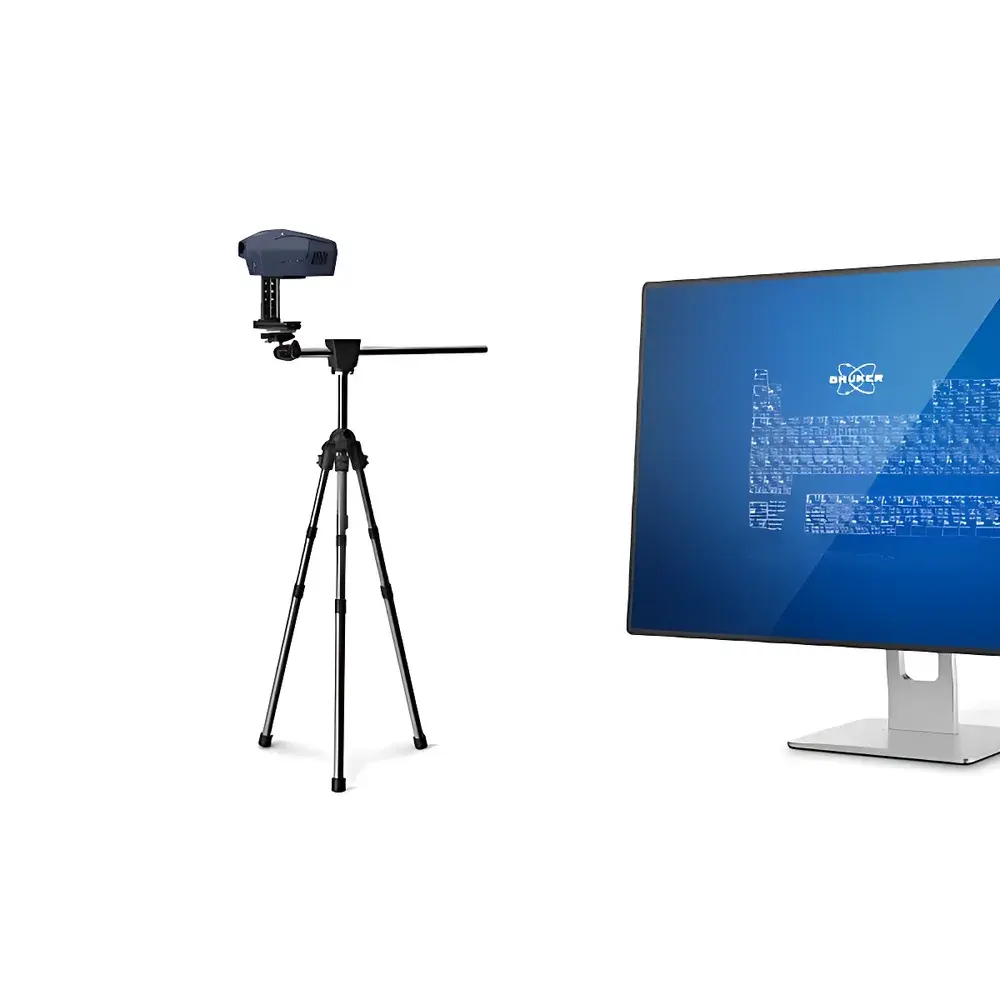
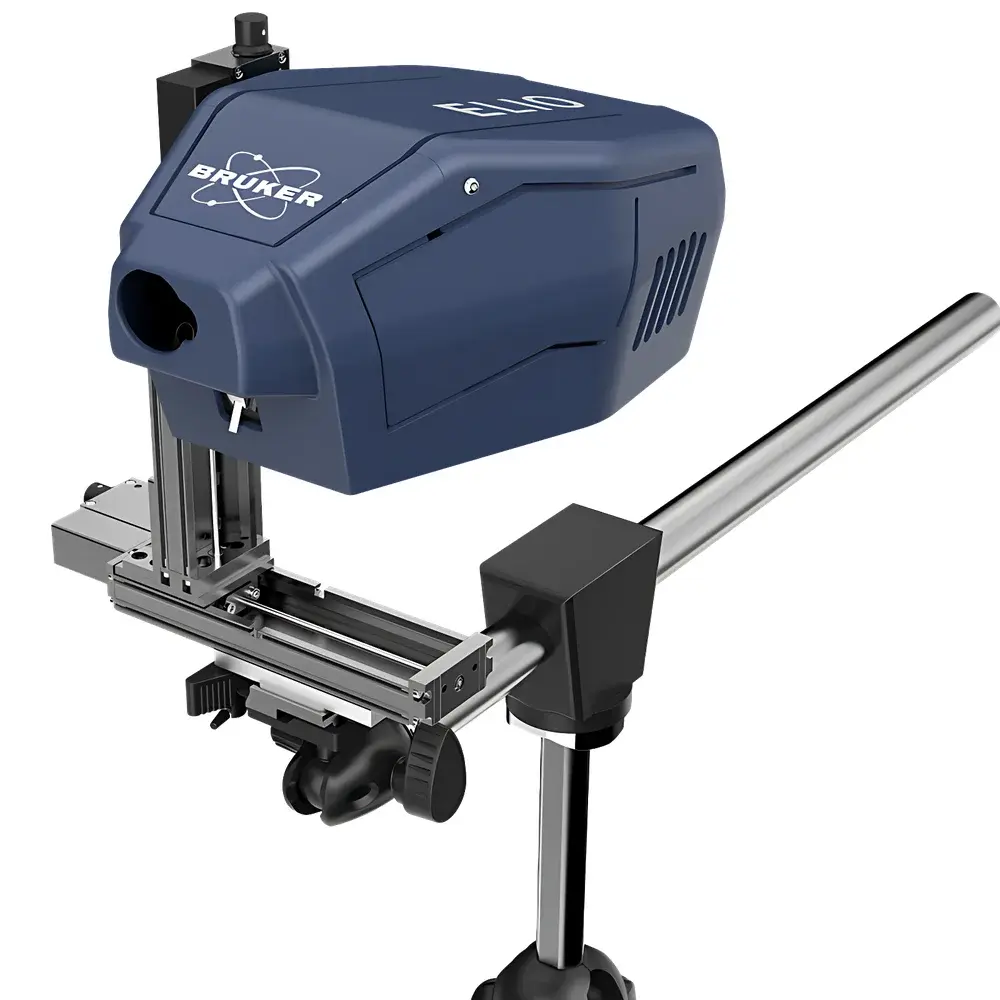
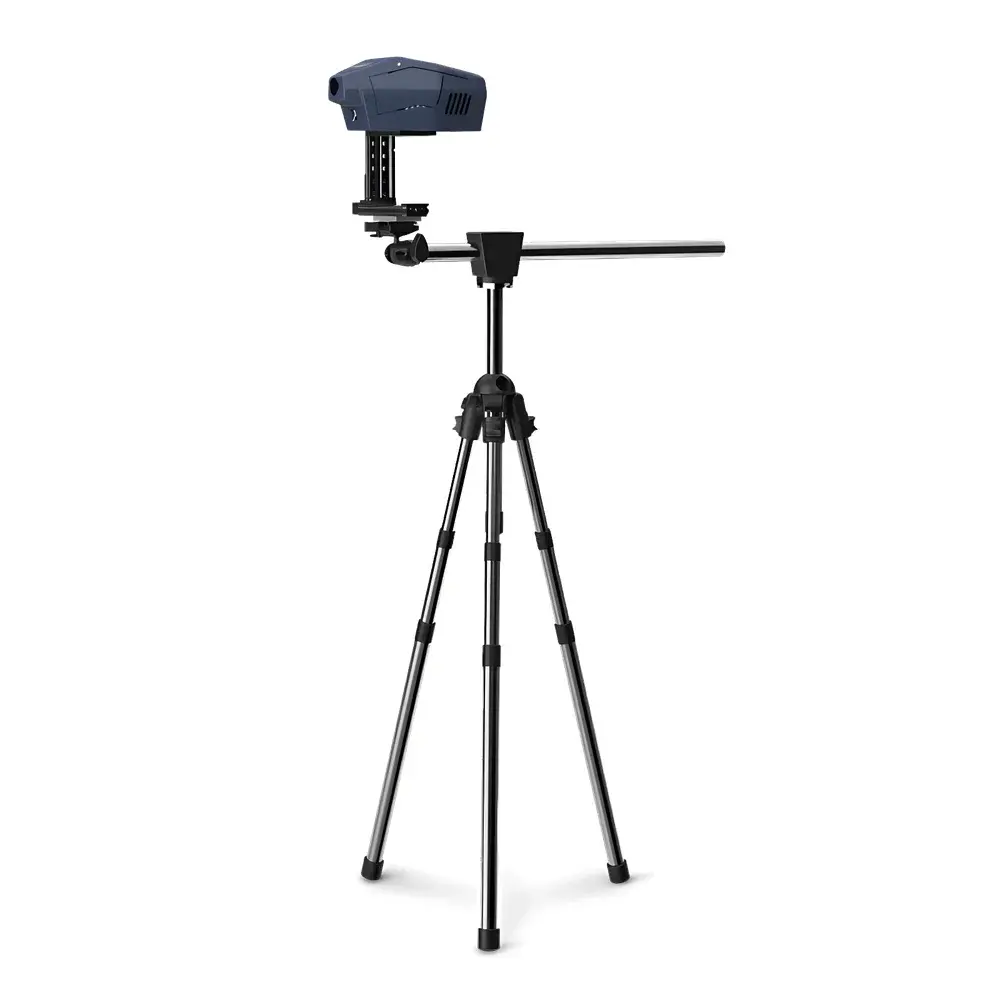
Bruker ELIO Portable Energy Dispersive X-Ray Fluorescence Micro-Spectrometer
| Brand | Bruker |
|---|---|
| Origin | Germany |
| Model | ELIO |
| Application | Portable/Field-Deployable |
| Element Range | Na–U |
| Detection Range | ppm to wt% |
| Energy Resolution | <140 eV (Mn Kα) |
| Detector | Large-Area Silicon Drift Detector (SDD) with CUBE Technology |
| Excitation Source | 50 kV Microfocus X-ray Tube |
| Spot Size | 1 mm (laser-guided) |
| Weight (Measurement Head) | 2.1 kg |
| Compliance | CE, RoHS, IEC 61000-6-3 |
Overview
The Bruker ELIO Portable Energy Dispersive X-Ray Fluorescence (ED-XRF) Micro-Spectrometer is an engineered solution for non-contact, non-destructive elemental microanalysis in situ and in the field. Operating on the fundamental principle of energy-dispersive X-ray fluorescence, the ELIO excites characteristic X-ray emission from sample atoms using a high-brightness 50 kV microfocus X-ray source. Emitted photons are resolved by a large-area silicon drift detector (SDD) integrated with Bruker’s proprietary CUBE technology—enabling simultaneous high spectral resolution (<140 eV at Mn Kα), high output count rate (OCR), and precise spatial registration. Unlike benchtop or vacuum-based systems, the ELIO is purpose-built for micro-scale mapping without sample preparation, making it ideal for applications where transport, preservation, or accessibility constrain conventional lab-based analysis.
Key Features
- Portable architecture: Measurement head weighs only 2.1 kg and mounts on lightweight aluminum tripods—including motorized XY stages for automated raster scanning.
- Laser-guided 1 mm analysis spot with integrated HD camera for real-time visual correlation between optical image and elemental signal location.
- Narrow-profile measurement nose enables access to confined geometries, curved surfaces, and recessed features—critical for cultural heritage objects and industrial components.
- CUBE-enabled SDD detector delivers high-resolution spectra with minimal peak overlap, supporting robust quantification across the Na–U element range (Z = 11 to 92).
- Modular excitation optics: Interchangeable X-ray tube anodes (e.g., Rh, Mo, Cr), primary beam filters, and collimators allow optimization for light-element sensitivity, heavy-metal detection, or matrix-specific suppression.
- Real-time acquisition control: Software-driven dwell time optimization and adaptive counting strategies reduce total mapping time without compromising statistical reliability or spectral fidelity.
Sample Compatibility & Compliance
The ELIO accommodates heterogeneous, irregular, and fragile samples—including archaeological artifacts, geological drill cores, painted canvases, semiconductor wafers, and botanical specimens—without requiring sectioning, coating, or vacuum environments. Its non-destructive workflow aligns with conservation ethics and regulatory requirements for irreplaceable materials. The system complies with CE marking directives (2014/30/EU EMC, 2014/35/EU LVD), RoHS 2011/65/EU, and IEC 61000-6-3 for electromagnetic compatibility. While not certified for GLP/GMP production environments, its data integrity features—including timestamped spectral logs, operator ID tagging, and raw spectrum archiving—support audit-ready documentation in research-grade laboratories adhering to ISO/IEC 17025 principles.
Software & Data Management
ELIO is operated via Bruker’s MSA (Micro XRF Spectral Analysis) software suite, which provides intuitive instrument control, live spectrum visualization, and quantitative mapping workflows. All acquired spectra are stored in standardized .spx format compliant with ASTM E1301 and ISO 18504 metadata conventions. Batch processing supports matrix-matched standardization, fundamental parameter (FP) modeling, and empirical calibration with NIST-traceable reference materials. Spectral deconvolution employs iterative least-squares fitting with user-adjustable background models and interference corrections. Export options include CSV, TIFF (for false-color maps), and PDF reports with embedded spectra, acquisition parameters, and uncertainty estimates per element. Audit trails record all processing steps, parameter changes, and user actions—meeting traceability expectations under FDA 21 CFR Part 11 for non-clinical research use.
Applications
- Archaeometry & Cultural Heritage: In situ elemental mapping of pigments, corrosion layers, and alloy compositions on statues, manuscripts, and ceramics—eliminating risks associated with sampling or transport.
- Geosciences: Rapid profiling of major, minor, and trace elements across drill core slabs or thin sections; identifying geochemical zoning, hydrothermal alteration halos, or mineral associations at sub-centimeter resolution.
- Materials Science: Characterizing dopant distribution in battery cathodes, interfacial segregation in multilayer coatings, or homogeneity in additive-manufactured alloys.
- Food & Agricultural Research: Visualizing micronutrient localization (e.g., Fe, Zn, Se) in grains, leaves, or fortified food matrices to evaluate bioavailability and processing effects.
- Education & Field Training: Used in undergraduate labs and outreach programs for hands-on instruction in atomic spectroscopy, radiation safety, and quantitative analytical methodology.
FAQ
Does the ELIO require vacuum or helium purge for light-element analysis?
No. The system operates in ambient air and achieves reliable detection down to sodium (Na) using optimized excitation geometry and SDD detector efficiency—no gas purging or vacuum pumping is needed.
Can ELIO data be integrated into laboratory information management systems (LIMS)?
Yes. Raw spectral files (.spx) and processed reports (CSV, PDF) support automated ingestion via configurable file watchers or REST API extensions developed under Bruker’s OpenMSA framework.
What is the typical measurement time per point for quantitative analysis?
At standard settings (50 kV, 1 µA, 30 s dwell), detection limits for mid-Z elements (e.g., Fe, Cu, Zn) are typically 10–50 ppm; acquisition time is adjustable from 1 s to >300 s depending on required precision and concentration level.
Is calibration transfer possible between different ELIO units?
Yes—using Bruker’s cross-instrument normalization protocol based on common reference standards and spectral response correction, enabling consistent quantification across multi-site deployments.
How is positional accuracy maintained during motorized mapping?
The integrated encoder feedback loop on both XY axes ensures repeatable stage positioning within ±2 µm; combined with laser spot alignment and camera-based coordinate registration, absolute spatial fidelity remains within ±10 µm over 10 × 10 cm scans.




