
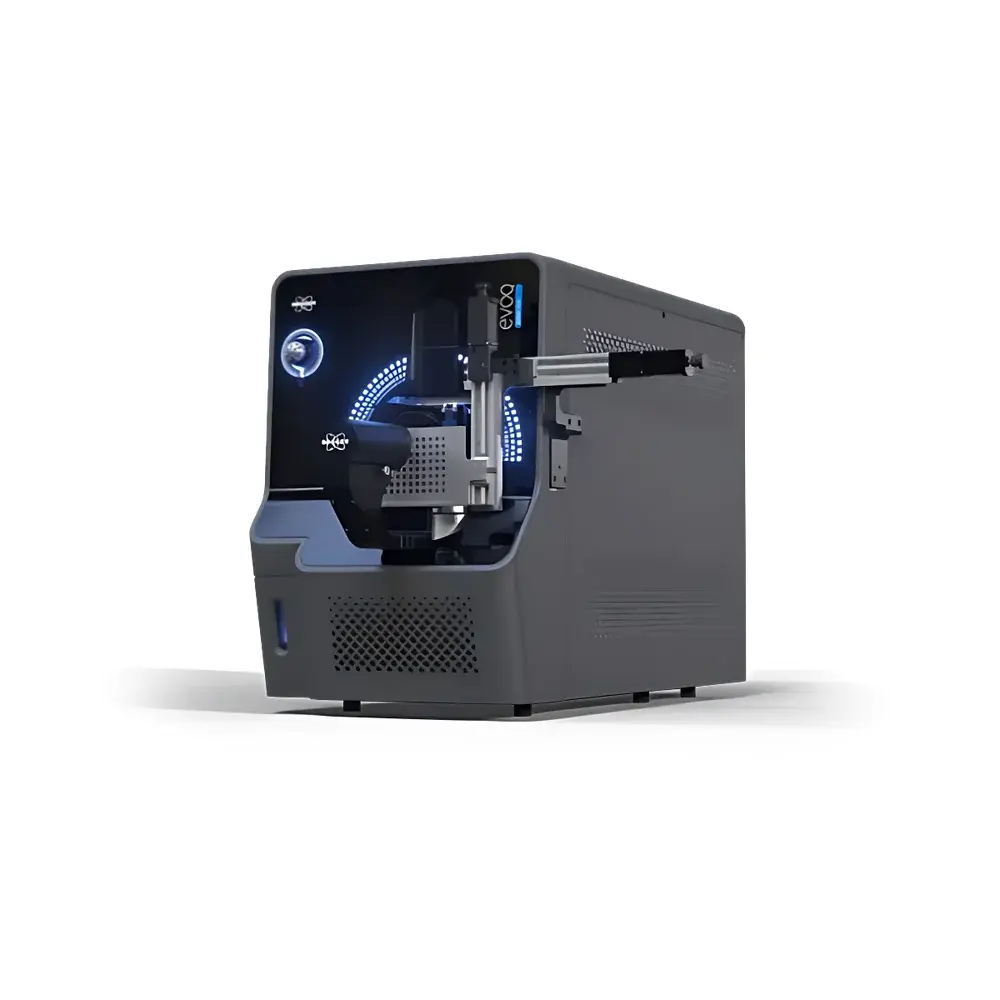
Bruker EVOQ® DART-TQ+ Triple Quadrupole Mass Spectrometer System
| Brand | Bruker |
|---|---|
| Origin | Germany |
| Instrument Type | Tandem Quadrupole (Triple Quad) |
| Model | EVOQ® DART-TQ+ |
| Application Scope | General-purpose small-molecule screening and quantitation |
| Ionization Modes | Fully integrated DART (Direct Analysis in Real Time), swappable with VIP-HESI (Heated Electrospray Ionization) and APCI sources |
| MRM Transition Rate | Up to 1,000 transitions/sec |
| Scan Speed | Up to 30,000 Da/sec |
| Detector | EDR™ Electron Multiplier with real-time gain optimization |
| Software Platform | tqControl™ with MRM Builder, automated tuning, daily performance verification, and rule-based data review |
Overview
The Bruker EVOQ® DART-TQ+ is a compact, benchtop triple quadrupole mass spectrometer engineered for high-throughput, high-sensitivity small-molecule analysis across diverse application domains—including forensic toxicology, clinical research, food safety, and environmental monitoring. Its defining innovation lies in the industry’s first fully integrated, internally housed DART (Direct Analysis in Real Time) ion source—designed for ambient, chromatography-free sample introduction. Unlike add-on or external DART configurations, the EVOQ® DART-TQ+ embeds the DART source’s electronics, gas delivery, and thermal control directly into the instrument architecture, enabling seamless switching between DART-MS and LC-MS workflows without hardware reconfiguration. The system operates on tandem quadrupole (QqQ) mass filtering principles: Q1 selects precursor ions, Q2 serves as a collision cell for controlled fragmentation (CID), and Q3 monitors specific product ions via multiple reaction monitoring (MRM). This architecture delivers exceptional specificity, reproducibility, and quantitative accuracy—particularly critical for regulated environments requiring compliance with ISO/IEC 17025, CLIA, or FDA 21 CFR Part 11–enabled data integrity.
Key Features
- Fully integrated DART source with internal gas regulation, temperature control, and electrical interface—enabling true plug-and-play operation and eliminating external cables or auxiliary controllers.
- Ultra-high-speed MRM acquisition: up to 1,000 transitions per second, supporting large-scale targeted panels (e.g., >500 analytes in a single run) without sacrificing dwell time or sensitivity.
- Scan speed of up to 30,000 Da/sec—optimized for narrow LC peaks or rapid DART desorption events, ensuring sufficient data points across transient signals.
- EDR™ (Extended Dynamic Range) electron multiplier detector with real-time gain adjustment—delivering linear response over five orders of magnitude and eliminating the need for multiple injections or dilutions.
- Lens-free ion transmission path: a robust, field-free ion channel minimizes space charge effects and ion losses, enhancing signal stability and reducing maintenance frequency.
- VIP-HESI source compatibility: tool-free, sub-60-second source exchange enables immediate transition from ambient DART screening to validated LC-MS/MS confirmation—ideal for tiered analytical strategies.
- Automated MRM method generation: the tqControl™ MRM Builder imports compound names or structures and auto-populates precursor/product ions, collision energies, and dwell times using an embedded library of >3,000 validated transitions.
Sample Compatibility & Compliance
The EVOQ® DART-TQ+ accommodates direct analysis of solids, liquids, and semi-solids—including untreated urine, whole blood, plasma, serum, saliva, plant tissues, food surfaces, and environmental wipe samples—without derivatization or extensive cleanup. Its cone-type interface and optimized ion optics maintain robustness in high-matrix-load applications, delivering consistent performance even with complex biological or environmental extracts. For regulated laboratories, the system supports full audit trails, electronic signatures, and user-access controls via tqControl™ software—meeting requirements for GLP, GMP, and 21 CFR Part 11 compliance when deployed with appropriate IT infrastructure and validation protocols. Method transferability between DART-MS and LC-MS modes has been demonstrated for compounds governed by ASTM D8119 (PFAS), EU SANTE/11312/2021 (pesticides), and SAMHSA guidelines (forensic toxicology).
Software & Data Management
tqControl™ is a purpose-built, modular software suite that unifies instrument control, method development, data acquisition, and post-run review. Key capabilities include:
- MRM Builder with intelligent collision energy optimization—leveraging empirical libraries and built-in predictive algorithms to minimize manual tuning.
- Automated daily performance verification: scheduled checks of mass accuracy, sensitivity, and peak shape—generating timestamped reports for quality assurance records.
- Rule-based data review engine: flags outliers based on user-defined criteria (e.g., CV >15%, response 0.1 min), streamlining QA/QC workflows.
- Secure, role-based data handling: encrypted raw data storage, version-controlled method archives, and configurable audit logs aligned with ALCOA+ principles.
- Export-ready reporting: generates PDF or Excel outputs compliant with LIMS integration standards (e.g., ASTM E1467, HL7).
Applications
The EVOQ® DART-TQ+ supports two complementary operational paradigms: rapid ambient screening and orthogonal LC-MS/MS confirmation. In forensic toxicology, it enables ToxBox®-enabled workflows—achieving full-panel drug-of-abuse screening in ≤15 seconds per urine or blood sample, with quantitative results traceable to reference standards. In food safety, it performs “dilute-and-shoot” pesticide residue analysis in fruit/vegetable homogenates or executes real-time surface screening of imported produce for unauthorized agrochemicals. For PFAS monitoring, DART-MS pre-screening identifies high-concentration samples prior to LC-MS/MS quantification—reducing column fouling and instrument downtime. Environmental labs apply it to rapid identification of flame retardants, plasticizers, or pharmaceutical residues in wastewater sludge or soil extracts—without solvent-intensive extraction protocols.
FAQ
Can the EVOQ® DART-TQ+ operate in both DART-MS and LC-MS modes within a single analytical session?
Yes—source switching between DART and VIP-HESI is accomplished in under 60 seconds with no tools required; both modes are fully controlled and calibrated within the same tqControl™ software environment.
Does the system support regulatory-compliant data handling for GLP or clinical laboratories?
Yes—when configured with network authentication, electronic signatures, and audit trail logging enabled, tqControl™ meets core requirements of 21 CFR Part 11 and ISO/IEC 17025 for data integrity and traceability.
How does the EDR™ detector improve quantitative performance compared to conventional electron multipliers?
The EDR™ detector dynamically adjusts gain during acquisition to maintain optimal signal-to-noise across wide concentration ranges—enabling accurate quantitation from sub-pg/mL to µg/mL levels in a single injection.
Is method development for new analytes time-consuming?
No—MRM Builder automates transition selection, collision energy optimization, and dwell time allocation using Bruker’s curated database or user-supplied structures; typical method setup requires <5 minutes for a 100-analyte panel.
What maintenance intervals are recommended for routine operation?
Daily performance verification is automated; source cleaning is typically required every 2–4 weeks depending on sample load, and quad calibration is recommended quarterly or after major maintenance events.
Related Products





