
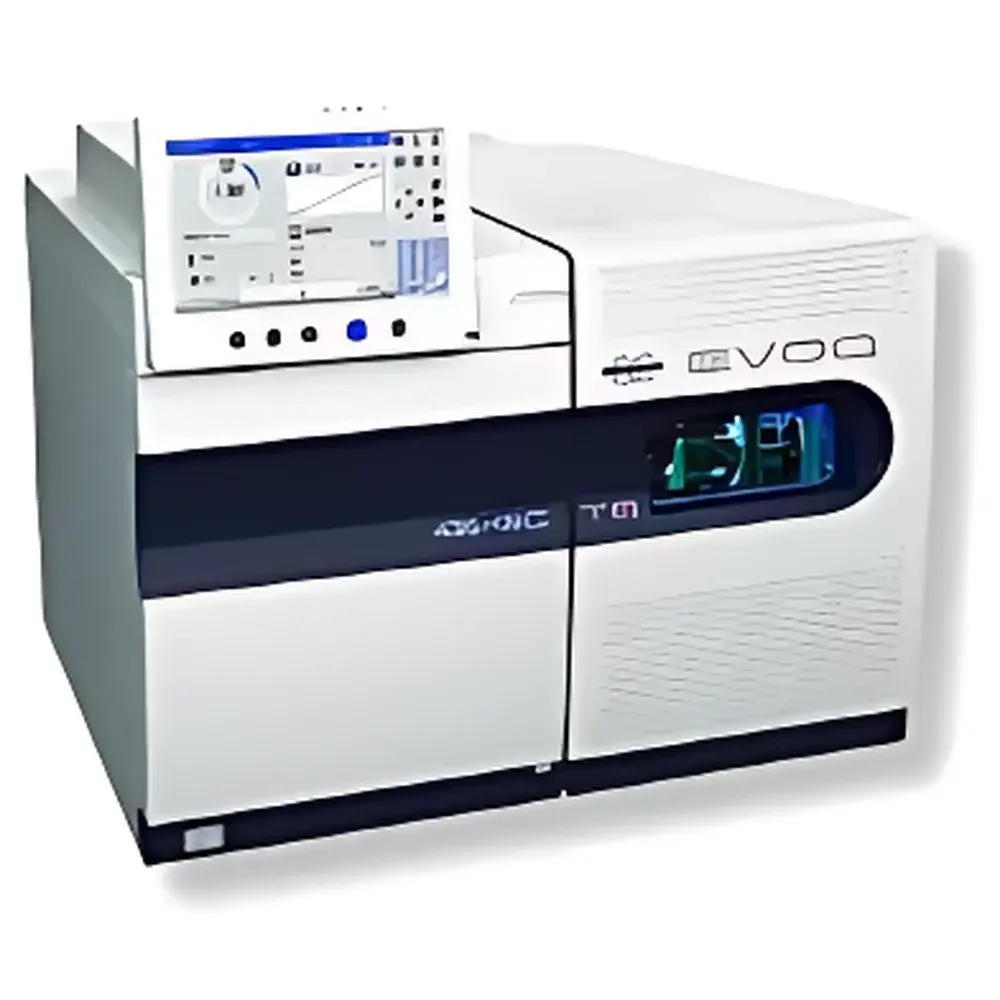
Bruker EVOQ GC-TQ Triple Quadrupole Gas Chromatography–Mass Spectrometry System
| Brand | Bruker |
|---|---|
| Origin | Germany |
| Model | EVOQ GC-TQ |
| Instrument Type | Triple Quadrupole Mass Spectrometer |
| Chromatography Configuration | Conventional Gas Chromatography–Mass Spectrometry (GC-MS/MS) |
| Ionization Modes | Electron Ionization (EI) and Negative Chemical Ionization (NCI) |
| Vacuum System | High-Capacity Turbo-Molecular Pump |
| Detector | Extended Dynamic Range (EDR) Detector Integrated with Quadrupole Assembly |
| Ion Optics | Lens-Free Ion Path |
| q0 Collision Cell | Helium-Gas-Assisted Active Ion Focusing |
| Ion Transmission Architecture | Elliptical Ion Channel |
| Method Setup | Automated MRM Transition Library Lookup by Compound Name |
| Compliance Readiness | Designed for GLP/GMP environments |
Overview
The Bruker EVOQ GC-TQ is a purpose-engineered triple quadrupole gas chromatography–mass spectrometry (GC-MS/MS) system optimized for high-sensitivity, high-selectivity quantitative analysis in regulated and research laboratories. Operating on the fundamental principle of tandem mass spectrometry—where precursor ions are selected in Q1, fragmented in a pressurized collision cell (q0), and product ions are analyzed in Q3—the EVOQ GC-TQ delivers robust performance for trace-level quantification across complex matrices. Its architecture integrates gas chromatographic separation with selective reaction monitoring (SRM) or multiple reaction monitoring (MRM) detection, enabling precise measurement of target analytes even in the presence of co-eluting interferences. The system is engineered for reproducibility in routine environmental, food safety, clinical toxicology, and pharmaceutical quality control applications where regulatory compliance and method ruggedness are critical.
Key Features
- Lens-Free Ion Path: Eliminates electrostatic lenses that degrade over time and introduce variability; enhances long-term signal stability and reduces maintenance frequency.
- q0 Active Ion Focusing with Helium Gas: Introduces controlled helium flow into the first quadrupole region to improve ion transmission efficiency and reduce scattering losses—particularly beneficial for low-abundance analytes.
- Elliptical Ion Channel Design: Physically excludes neutral species and uncharged background molecules from entering the mass analyzer, resulting in significantly improved signal-to-noise ratios and reduced chemical noise.
- Integrated Extended Dynamic Range (EDR) Detector: Coupled directly to the final quadrupole assembly, this detector enables linear response over six orders of magnitude without gain switching—minimizing need for repeated injections at different concentrations.
- Automated MRM Method Generation: Software-driven workflow allows entry of compound names only; the system retrieves retention times, precursor/product ion pairs, and optimal collision energies from an embedded spectral library—reducing method development time and operator dependency.
- High-Capacity Turbo-Molecular Pumping System: Ensures rapid vacuum recovery after injection and stable operating pressure throughout extended sequence runs, supporting high-throughput laboratory workflows.
- Dual Ionization Capability (EI/NCI): Switchable electron ionization and negative chemical ionization sources provide complementary selectivity—NCI mode delivers exceptional sensitivity for electronegative compounds such as halogenated pesticides and nitroaromatics.
Sample Compatibility & Compliance
The EVOQ GC-TQ accommodates standard GC inlet configurations—including split/splitless injectors, programmable temperature vaporizers (PTV), and cold on-column inlets—ensuring compatibility with legacy and modern GC methods. It supports all common GC column chemistries (e.g., 5% phenyl methylpolysiloxane, polyethylene glycol) and operates across conventional temperature programming ranges (40–320 °C). From a regulatory perspective, the system is architected to support Good Laboratory Practice (GLP) and Good Manufacturing Practice (GMP) requirements. When operated with Bruker’s Compass DataAnalysis and MethodBuilder software—configured with electronic signatures, audit trail logging, and user access controls—it meets foundational expectations for 21 CFR Part 11 compliance. Routine performance verification follows ASTM D7592 (for pesticide residue analysis) and ISO 17025–aligned instrument qualification protocols.
Software & Data Management
Data acquisition, processing, and reporting are managed through Bruker’s Compass software suite, which includes MethodBuilder for intuitive MRM method creation, DataAnalysis for peak integration and calibration curve fitting, and ReportBuilder for customizable output generation. All software modules maintain full traceability: every data point is linked to acquisition parameters, instrument state logs, and user actions. Raw data files adhere to open mzML format standards, ensuring interoperability with third-party quantitation tools and laboratory information management systems (LIMS). Audit trail functionality records timestamped entries for method modifications, result reprocessing, and report exports—supporting internal audits and external inspections.
Applications
The EVOQ GC-TQ is routinely deployed in laboratories performing multi-residue pesticide screening in fruits and vegetables (per EU SANTE/11312/2021 guidelines), mycotoxin quantification in cereals (AOAC 2012.05), residual solvent analysis in pharmaceuticals (ICH Q3C), and forensic toxicology screening for drugs of abuse (SAMHSA-certified cutoffs). Its NCI sensitivity enables detection of per- and polyfluoroalkyl substances (PFAS) at sub-ppt levels in drinking water extracts. Environmental labs apply it to EPA Methods 8270E (semivolatile organics) and 8082A (PCBs) with demonstrated precision (<5% RSD) across 100+ compound panels.
FAQ
Does the EVOQ GC-TQ support both EI and NCI ionization modes?
Yes—dual-source capability is standard, with automatic source switching and independent optimization parameters for each mode.
Is the elliptical ion channel design proprietary to Bruker?
Yes, it is a patented architecture designed to suppress neutral particle transmission while maintaining high ion throughput.
Can the system be integrated into an existing LIMS environment?
Yes, via ASCII export, ODBC connectivity, or direct API integration using Bruker’s OpenAccess framework.
What vacuum pumping configuration is used?
A high-speed, oil-free turbo-molecular pump with active cooling and real-time pressure monitoring ensures stable operation under variable load conditions.
How does the lens-free design impact calibration frequency?
It extends calibration intervals by minimizing ion optical drift; typical QC check frequency is once per 24-hour run sequence under routine use.
Related Products




