
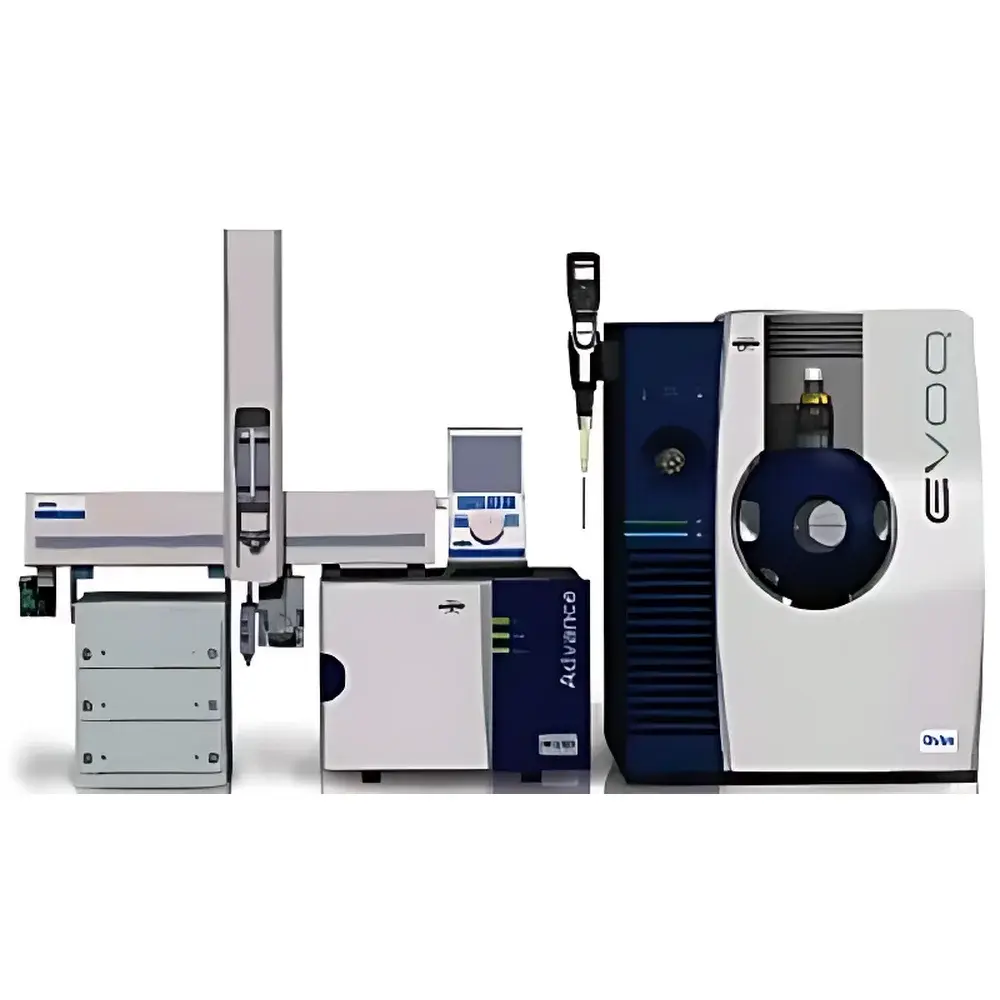
Bruker EVOQ Series Triple Quadrupole Liquid Chromatography-Mass Spectrometer
| Brand | Bruker |
|---|---|
| Origin | Germany |
| Instrument Type | Tandem Quadrupole (Triple Quad) |
| Configuration | LC-MS/MS |
| Application Scope | Universal Quantitative Analysis |
| Regulatory Compliance | Designed for GLP/GMP environments, compatible with 21 CFR Part 11 audit trail requirements |
Overview
The Bruker EVOQ Series triple quadrupole liquid chromatography–mass spectrometry (LC-MS/MS) system is engineered for high-throughput, robust quantitative analysis in regulated and research laboratories. Based on tandem quadrupole (QqQ) mass filtering architecture, the EVOQ platform employs collision-induced dissociation (CID) in the central quadrupole (q2) to generate product ions from selected precursors—enabling highly selective and sensitive multiple reaction monitoring (MRM) assays. Its design philosophy centers on minimizing ion transmission losses, maximizing duty cycle efficiency, and ensuring long-term signal stability across diverse sample matrices—from biological fluids and environmental extracts to food homogenates and pharmaceutical formulations. Unlike conventional LC-MS/MS platforms requiring frequent tuning or source cleaning, the EVOQ integrates hardware innovations—including the Interleaved Quadrupole (IQ) dual ion funnel, vacuum-insulated heated electrospray ionization (VIP-ESI), and conical API interface—to deliver reproducible quantitation without compromising operational simplicity.
Key Features
- Interleaved Quadrupole (IQ) Dual Ion Funnel: A patented RF-only ion optics architecture that replaces traditional stacked lens assemblies. Eliminates the need for compound-specific voltage optimization while improving ion transmission efficiency by >3× over legacy designs—particularly for low-abundance small molecules and labile biomolecules.
- Vacuum-Insulated Probe (VIP) ESI Source: Integrates ceramic heating elements with active temperature control, a pre-vaporization liquid cooling path, and vacuum thermal isolation to maintain stable desolvation conditions across UHPLC gradient elution. Enables reliable ionization of thermally fragile analytes—including glycosylated peptides, nucleosides, and N-heterocycles—at flow rates up to 1.0 mL/min.
- Conical Atmospheric Pressure Interface: Features a robust stainless-steel cone with integrated counter-flow drying gas (cone gas) to exclude neutral droplets and matrix particulates prior to differential pumping. Reduces source contamination frequency by up to 70% compared to standard capillary-based interfaces.
- Lens-Free Quadrupole Transmission Path: US Patent No. 6,576,897—eliminates intermediate electrostatic lenses between Q1 and q2, reducing scattering losses and enhancing MRM sensitivity by maintaining coherent ion beam geometry throughout mass filtering.
- Next-Generation Detector: US Patent No. 7,855,361—employs a hybrid electron multiplier/digital pulse-counting architecture that delivers uniform response for both positive- and negative-ion modes, supports sub-millisecond polarity switching, and extends dynamic range beyond 5 orders of magnitude.
Sample Compatibility & Compliance
The EVOQ series demonstrates exceptional tolerance toward complex, high-background matrices—including plasma, urine, soil extracts, and fortified food digests—without signal suppression or source fouling. Its conical API interface and IQ funnel architecture maintain consistent ion transmission even under variable solvent composition or high-salt loading. The system meets essential regulatory expectations for quantitative bioanalysis: it supports full audit trail logging, electronic signature enforcement, and method version control per FDA 21 CFR Part 11. Routine operation aligns with ISO/IEC 17025 quality management principles and is validated for use in GLP-compliant toxicokinetic studies and GMP-controlled stability testing protocols.
Software & Data Management
PACER™ software provides an integrated workflow engine for method development, acquisition control, peak integration, calibration curve fitting, and report generation—all within a single, auditable environment. Its “Anomaly Review” module automatically flags chromatograms deviating from predefined acceptance criteria (e.g., retention time shift >0.1 min, peak area RSD >15%, IS response drift >20%), enabling rapid root-cause assessment without manual data reprocessing. Raw data files are stored in open-format .baf containers compliant with mzML standards, facilitating third-party reprocessing and long-term archival. Software validation packages—including IQ/OQ documentation, test scripts, and traceable calibration logs—are available for regulated laboratory deployment.
Applications
- Food Safety Testing: Quantification of mycotoxins, pesticide residues, and veterinary drug contaminants at sub-ppb levels in cereals, dairy, and infant formula—achieving turnaround times under 4 hours from injection to final PDF report.
- Environmental Monitoring: Coupled with online solid-phase extraction (OLE)-UHPLC systems for automated, unattended analysis of PAHs, PCBs, and emerging contaminants (e.g., PFAS) in wastewater and sediment extracts.
- Toxicology & Forensic Screening: Simultaneous quantification of >100 drugs-of-abuse and metabolites in whole blood using scheduled MRM, with CVs <8% across 5-day runs.
- Pharmacokinetics (PK): High-volume plasma sample processing (>500 samples/day) with automated dilution, internal standard spiking, and batch-integrated calibration—validated for IND-enabling rat and monkey PK studies per ICH M10 guidelines.
FAQ
What distinguishes the EVOQ’s IQ dual ion funnel from conventional RF-only funnels?
It uses a geometrically optimized interleaved electrode array that improves ion focusing efficiency across a wider m/z range (50–2000 Da) without requiring compound-specific tuning voltages.
Can the VIP-ESI source operate reliably with acetonitrile/water gradients containing 0.1% formic acid?
Yes—the ceramic heater maintains stable tip temperature (±0.5°C) across 5–95% organic gradients, and the pre-desolvation cooling path prevents premature solvent boiling during high-flow elution.
Is PACER™ software compliant with 21 CFR Part 11 for electronic records and signatures?
Yes—full audit trail, role-based access control, electronic signature capture, and secure database encryption are enabled out-of-the-box and documented in the software validation package.
How often does the conical API interface require cleaning in routine bioanalytical workflows?
Typically every 200–300 injections when analyzing deproteinized plasma; extended intervals (≥500 injections) are achievable with online SPE coupling and optimized cone gas flow.
Does the EVOQ support retrospective data mining after acquisition?
Yes—raw .baf files retain full MS/MS spectral metadata, enabling post-acquisition extraction of additional transitions or reintegration with updated integration parameters.




