
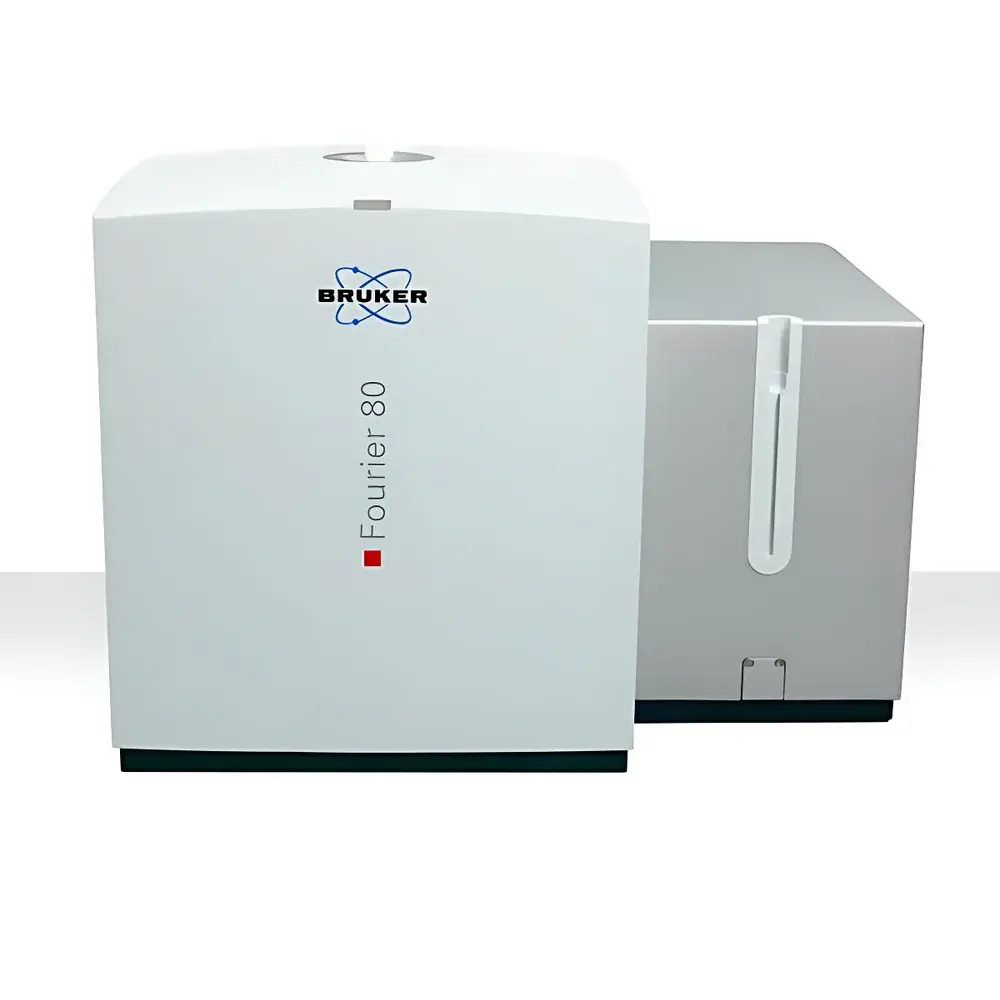
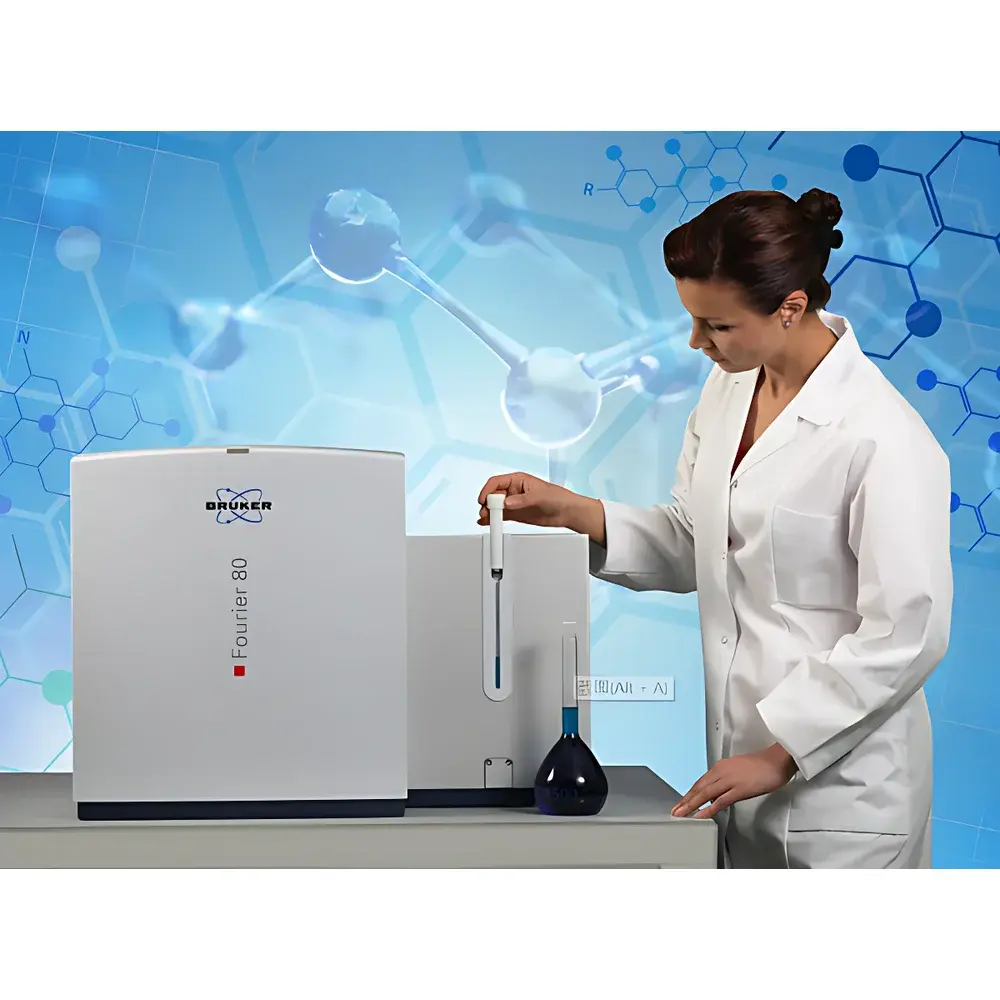
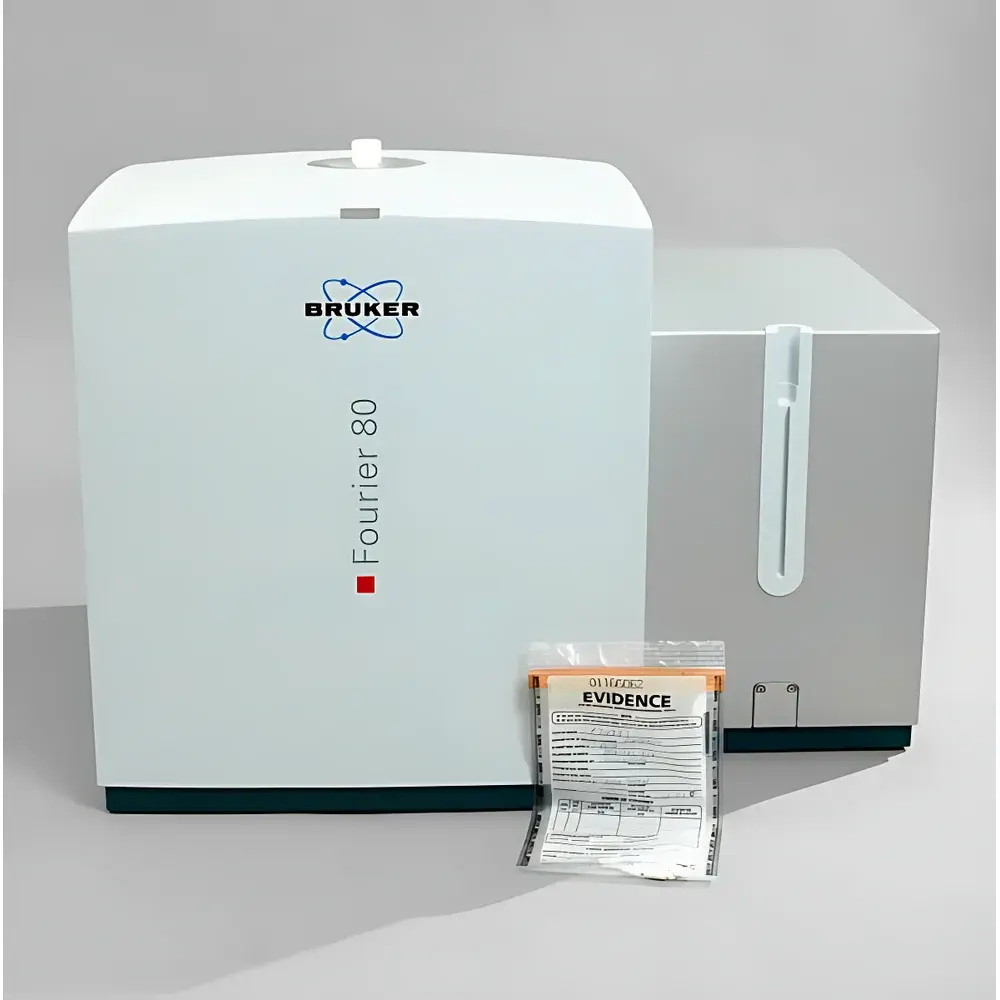
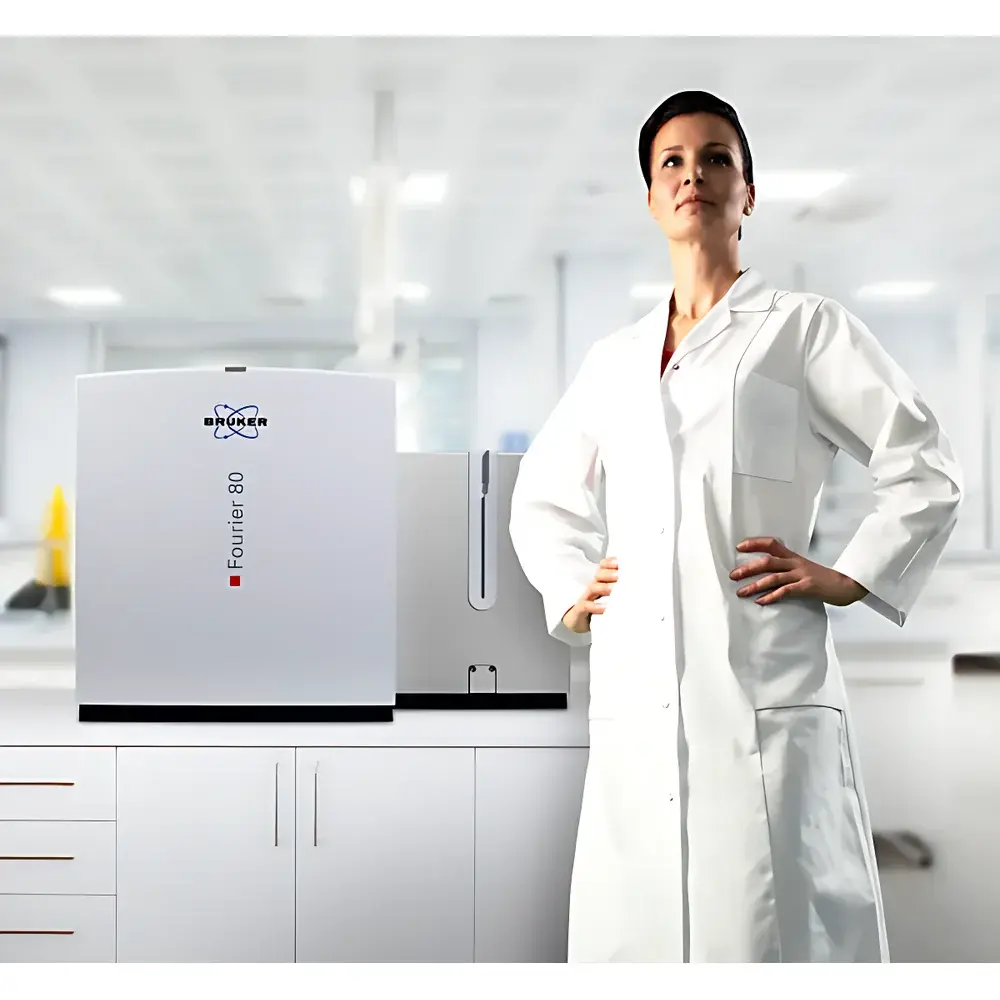
Bruker Fourier 80 Benchtop Nuclear Magnetic Resonance Spectrometer
| Brand | Bruker |
|---|---|
| Origin | France |
| Model | Fourier 80 |
| Instrument Type | Low-Field NMR Analyzer |
| Sample Type | Liquid |
| Operating Frequency | 80 MHz |
| Data Acquisition Method | Pulsed Fourier Transform |
| Software | GoScan (intuitive touch interface) & TopSpin™ (advanced processing) |
| Installation | Benchtop or fume hood—no dedicated shielding, cryogen, or RF room required |
| Compliance | Designed for GLP-compliant environments |
Overview
The Bruker Fourier 80 is a compact, high-stability benchtop nuclear magnetic resonance (NMR) spectrometer engineered for routine quantitative and qualitative analysis of liquid-phase samples in academic, industrial, and quality control laboratories. Operating at a proton resonance frequency of 80 MHz (corresponding to a 1.89 T static magnetic field), the system employs pulsed Fourier transform (PFT) methodology to acquire time-domain free induction decay (FID) signals, which are subsequently converted into frequency-domain spectra via fast Fourier transformation. Unlike high-field superconducting NMR systems requiring cryogenic infrastructure and RF-shielded rooms, the Fourier 80 integrates a permanent magnet with active temperature stabilization and a self-shielded RF probe—enabling robust, day-to-day operation on standard laboratory benches or inside chemical fume hoods. Its design reflects Bruker’s decades-long expertise in NMR hardware and pulse sequence engineering, delivering reproducible chemical shift resolution (≤ 0.3 ppm for CHCl₃ in CDCl₃), linewidths 100:1 (for 1% ethylbenzene in CDCl₃, 64 scans). The instrument is optimized for ¹H NMR but supports optional ¹⁹F and ³¹P capability via software-defined pulse calibration.
Key Features
- Compact footprint (W × D × H: 45 × 55 × 40 cm) with integrated magnet, console, and touchscreen interface—no external chillers, helium refills, or RF cages required.
- Dual-software architecture: GoScan for rapid one-button acquisition and basic spectral interpretation; TopSpin™ 4.2+ for advanced processing, phase correction, baseline optimization, peak integration, and custom scripting (TCL/Python).
- Automated shimming and tuning routines reduce operator dependency—calibration completed in under 90 seconds using built-in reference samples.
- Temperature-controlled sample handling (20–60 °C, ±0.1 °C stability) ensures reproducibility across kinetic or thermodynamic studies.
- Modular probe design accommodates 5 mm OD NMR tubes (standard) and optional 3 mm or capillary configurations for limited-sample applications.
- Embedded Ethernet and USB 3.0 connectivity enable secure data export, remote monitoring, and integration into LIMS or ELN platforms.
Sample Compatibility & Compliance
The Fourier 80 is validated for homogeneous liquid samples—including organic solvents, polymer solutions, pharmaceutical formulations, food extracts, and reaction mixtures—with viscosity ≤ 100 cP. It complies with IEC 61000-6-3 (EMC emission standards) and IEC 61000-6-2 (immunity). When operated with TopSpin™ in audit-mode configuration, the system supports 21 CFR Part 11 compliance through electronic signatures, role-based access control, and immutable audit trails for all acquisition and processing events. Routine performance verification follows ASTM E2821–22 (Standard Practice for Verification of Benchtop NMR Spectrometers), and spectral accuracy is traceable to NIST SRM 1961 (chloroform-d in CDCl₃). The instrument meets ISO/IEC 17025 requirements for testing laboratories when used within defined method validation protocols.
Software & Data Management
GoScan provides guided workflows for common applications—e.g., purity assessment, reaction monitoring, solvent identification, and excipient quantification—requiring no prior NMR training. TopSpin™ extends functionality with multidimensional pulse sequence libraries (including 1D NOESY, DOSY, and J-resolved), automated peak picking (with confidence scoring), and batch processing for multi-sample datasets. All raw FID data are stored in Bruker’s proprietary format (fid, acqus, procs), fully convertible to JCAMP-DX, NMR-ML, or CSV via open-source tools (nmrPipe, Mnova SDK). Data integrity is preserved via SHA-256 hashing of acquisition parameters and spectral metadata. Backups can be scheduled to network drives or cloud storage with AES-256 encryption.
Applications
- Pharmaceutical QC: Assay of active pharmaceutical ingredients (APIs), residual solvent quantification (per ICH Q3C), polymorph screening via relaxation time mapping (T₁/T₂).
- Chemical synthesis: Real-time reaction monitoring, endpoint determination, and byproduct identification without chromatographic separation.
- Materials science: Crosslink density analysis in elastomers, polymer branching ratio estimation, and hydrogel swelling kinetics.
- Food & agriculture: Fat/water content in dairy products, authenticity verification of edible oils, and ethanol concentration in beverages.
- Academic teaching: Hands-on NMR pedagogy with immediate spectral feedback—ideal for undergraduate chemistry labs where high-field access is limited.
FAQ
Does the Fourier 80 require liquid nitrogen or helium cooling?
No. It uses a passively stabilized permanent magnet—zero cryogens, zero boil-off, zero maintenance related to magnet cooling.
Can it analyze solid or semi-solid samples?
Not natively. The standard configuration is optimized for isotropic liquids. Solid-state capability requires external hardware (e.g., MAS probe) not supported by this platform.
Is method transfer possible from high-field NMR instruments?
Yes—chemical shifts are field-independent; peak patterns, coupling constants, and integration ratios remain consistent. Pulse sequences and processing parameters can be ported directly from TopSpin™ methods developed on 300–800 MHz systems.
What is the typical acquisition time for a routine ¹H spectrum?
Under standard conditions (64 transients, 4k points, 20 ppm sweep width), total experiment time is ≤ 2.5 minutes—including auto-tune, auto-shim, and Fourier transformation.
How is instrument performance verified over time?
Bruker supplies a quarterly performance test kit (PTK) with reference standards and automated QC scripts in TopSpin™, generating PDF reports compliant with ISO/IEC 17025 documentation requirements.
Related Products




