
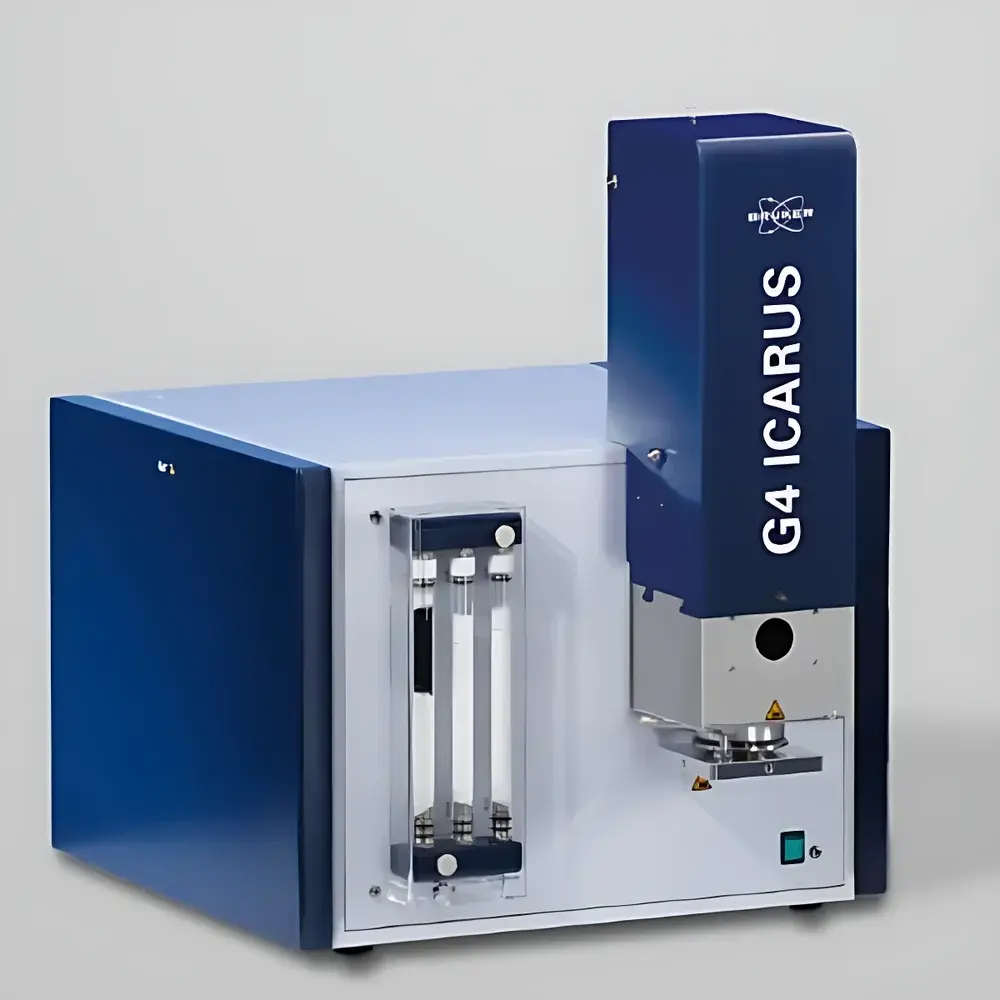
Bruker G4 ICARUS Series 2 High-Frequency Infrared Carbon-Sulfur Analyzer
| Brand | Bruker |
|---|---|
| Origin | Germany |
| Model | G4 ICARUS Series 2 |
| Detection Principle | High-frequency induction combustion coupled with UV absorption (SO₂) and infrared absorption (CO₂) |
| Analysis Time | < 60 s per cycle including auto-cleaning |
| Filter Pore Size | 3 µm |
| Signal-to-Noise Ratio (SO₂) | 10× improvement vs. conventional IR |
| Dynamic Range (SO₂) | 50-year linear calibration stability |
| Compliance | ASTM E1019, ISO 15350, DIN 51018, USP <231>, GLP/GMP-ready data integrity architecture |
Overview
The Bruker G4 ICARUS Series 2 is a high-frequency induction combustion analyzer engineered for precise, trace-level quantification of total carbon (C) and sulfur (S) in inorganic solid matrices—including metals, ores, ceramics, refractories, and geological samples. It operates on the fundamental principle of complete oxidative combustion: sample powder or chip is flash-heated to >2,000 °C in a high-purity oxygen atmosphere within a water-cooled HF induction furnace. Liberated CO and SO₂ gases are carried through a catalytic oxidation stage (to convert CO → CO₂ and COS → SO₂), dried, and then selectively measured—CO₂ via dual-beam non-dispersive infrared (NDIR) detection and SO₂ via high-sensitivity ultraviolet (UV) absorption spectroscopy (HighSense™). This hybrid optical detection architecture eliminates cross-sensitivity between C and S signals while delivering superior baseline stability, especially critical for low-concentration analysis (<10 ppm C/S) and heterogeneous materials such as gray cast iron or slag.
Key Features
- ZoneProtect™ combustion chamber design: Ensures reproducible, contamination-free thermal decomposition by isolating reaction zones and enabling fully automated post-combustion ash removal directly into the crucible—eliminating manual cleaning and reducing carryover risk.
- 3 µm high-efficiency particulate filter: Captures sub-micron combustion aerosols without flow restriction, maintaining long-term signal stability and protecting downstream optics and detectors from dust accumulation.
- HighSense™ UV absorption module: Dedicated SO₂ measurement with 10× higher signal-to-noise ratio versus conventional IR systems; immune to ambient temperature drift and offering ≥50-year linearity retention under routine calibration verification protocols.
- Integrated HF induction furnace: Delivers rapid, uniform heating up to 2,500 °C with programmable ramp profiles—optimized for refractory carbides, nitrides, and sulfide-rich alloys without pre-treatment.
- Full-cycle analysis time ≤60 seconds: Includes combustion, gas transfer, detection, and automatic chamber/crucible cleaning—enabling throughput of >60 samples per hour in routine QC environments.
Sample Compatibility & Compliance
The G4 ICARUS Series 2 accommodates solid samples ranging from 0.1 to 1.0 g, including ferrous and non-ferrous metals, cement clinker, fly ash, catalysts, and sintered powders. Its robust combustion protocol handles high-carbon steels (>5 wt% C), sulfur-rich pyrites, and graphite-containing composites—where XRF or LIBS fail due to matrix-induced spectral interference or incomplete volatilization. The system complies with ASTM E1019 (standard test methods for determination of carbon, sulfur, nitrogen, oxygen, and hydrogen in steel, iron, nickel, and cobalt alloys), ISO 15350 (determination of total carbon and sulfur in steels), and DIN 51018 (carbon/sulfur in metallic materials). Data acquisition and audit trails meet FDA 21 CFR Part 11 requirements when configured with Bruker’s optional ELSD software package, supporting electronic signatures, user access control, and immutable raw-data archiving for GLP and GMP-regulated laboratories.
Software & Data Management
Controlled via Bruker’s ICARUS Control Suite—a Windows-based application supporting method development, instrument diagnostics, real-time gas chromatogram visualization, and automated calibration curve generation using certified reference materials (CRMs). All measurement parameters (O₂ pressure, furnace power, carrier gas flow, integration time) are logged with timestamps and operator IDs. Raw absorbance spectra, peak area integrals, and drift-corrected concentration values are stored in vendor-neutral .csv and .xml formats. Optional integration with LIMS (e.g., LabVantage, Thermo SampleManager) enables seamless sample tracking, result reporting, and statistical process control (SPC) charting across multi-instrument networks.
Applications
- Metallurgical QC: Rapid certification of carbon equivalency (CE) and sulfur segregation in continuous-cast billets and automotive-grade AHSS.
- Materials R&D: Quantifying residual carbon in SiC ceramics and sulfur tolerance limits in Ni-based superalloys for turbine blade manufacturing.
- Environmental testing: Determination of total sulfur in coal ash and desulfurized flue gas residues per EPA Method 5D and ISO 14879-1.
- Geological surveying: Accurate C/S profiling in mantle xenoliths and hydrothermal ore deposits where graphite and pyrite coexist in micro-heterogeneous textures.
- Pharmaceutical excipients: Verification of elemental impurities (ICH Q3D Class 1) in calcium carbonate and magnesium stearate batches.
FAQ
What sample forms are compatible with the G4 ICARUS Series 2?
Solid samples must be homogeneous powders, chips, or drillings—typically ground to <100 µm particle size. No acid digestion or fusion required.
How does UV absorption for SO₂ improve accuracy over traditional IR detection?
UV absorption at 280–320 nm provides higher molar absorptivity and narrower spectral bandwidth than IR, resulting in reduced interferences from H₂O vapor, CO₂, and NOₓ—and eliminating the need for costly gas-phase scrubbers.
Is the system compliant with pharmaceutical regulatory standards?
Yes—when deployed with validated software configuration and 21 CFR Part 11 add-ons, it supports full audit trail, electronic signatures, and data integrity requirements for USP and ICH Q2(R2) method validation.
Can the instrument analyze nitrogen or oxygen simultaneously?
No—the G4 ICARUS Series 2 is dedicated to C/S only. For combined CS/ONH analysis, Bruker offers the G8 GALILEO platform with separate thermal conductivity and IR/UV modules.
What maintenance intervals are recommended for routine operation?
Daily: Crucible inspection and O-ring check. Weekly: Filter replacement and furnace liner visual inspection. Quarterly: Full optical path alignment and detector dark-current calibration using NIST-traceable standards.





