
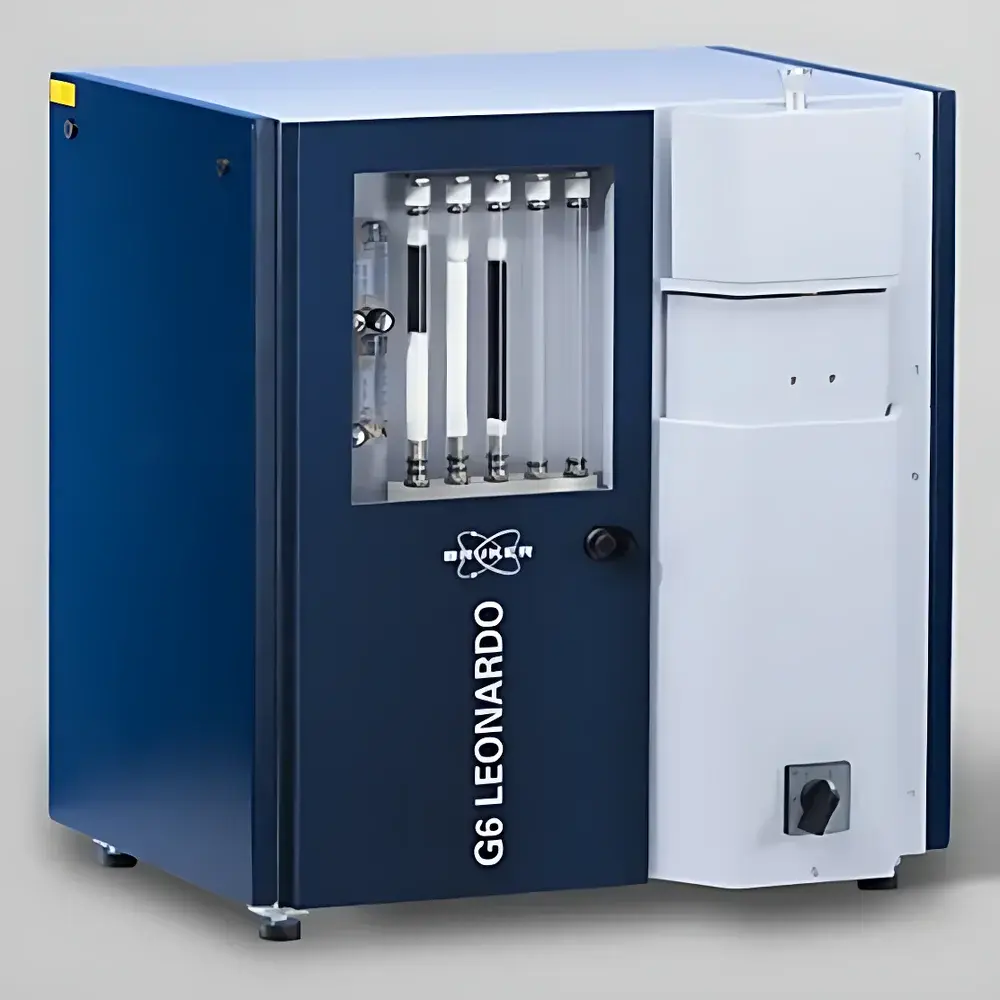
Bruker G6 LEONARDO Carbon-Sulfur and Oxygen-Nitrogen-Hydrogen Elemental Analyzer
| Brand | Bruker |
|---|---|
| Origin | Germany |
| Model | G6 LEONARDO |
| Technique | Inert Gas Fusion (IGF) with Thermal Conductivity Detection (TCD) for H/N |
| Detection Limits | < 0.1 ppm (ng/g) for H and N (1 g sample) |
| Maximum Furnace Temperature | > 3000 °C (water-cooled electrode furnace) |
| Carrier Gas | Argon (He-free operation) |
| Compressed Air Consumption | 0 L/min |
| Compliance | ASTM E1019, ISO 14284, ISO 15350, USP <233>, GLP/GMP-ready software architecture |
Overview
The Bruker G6 LEONARDO is a high-precision, dual-mode elemental analyzer engineered for the quantitative determination of carbon (C), sulfur (S), oxygen (O), nitrogen (N), and hydrogen (H) in metallic, ceramic, and refractory materials. It integrates two complementary analytical principles within a single platform: high-sensitivity infrared (IR) absorption spectroscopy for C and S quantification, and inert gas fusion (IGF) coupled with thermal conductivity detection (TCD) and IR detection for O, N, and H. The IGF method involves complete thermal decomposition of solid samples in a graphite crucible under ultra-pure argon flow at temperatures exceeding 3000 °C—enabled by a proprietary water-cooled electrode furnace. This ensures full liberation of interstitial and bound light elements into the carrier stream, where they are separated chromatographically and measured with trace-level sensitivity. Unlike wet-chemical or combustion-based alternatives, the G6 LEONARDO eliminates reagent consumption, helium dependency, and external calibration gases—reducing operational cost while maintaining metrological integrity across multi-element workflows.
Key Features
- FusionControl™: Non-contact, real-time pyrometric temperature monitoring during IGF analysis ensures precise thermal profiling and reproducible decomposition kinetics—critical for refractory metals (e.g., Nb, Ta, Zr) and oxide ceramics.
- SampleCare™: An integrated, maintenance-free sample handling system comprising an automated EZDrive lower electrode actuator, a sealed water-cooled crucible holder, and a high-capacity particulate trap followed by an inline sintered metal filter—minimizing contamination, extending component lifetime, and eliminating manual alignment.
- Smart Molecule Sequence™: A patented gas-phase signal processing architecture that applies time-resolved, reference-channel-compensated detection to isolate O₂, N₂, H₂, and CO/CO₂ peaks without chemical conversion or catalytic doping—delivering direct, stoichiometric quantification with 1:1 molar response fidelity.
- FUSION.ELEMENTS™ Software: Built on Bruker’s Alaska platform, this modular, audit-trail-enabled application supports 21 CFR Part 11 compliance, electronic signatures, method validation templates, and automated reporting aligned with ASTM E1019 and ISO 14284 requirements.
- Helium-Free Operation: Argon serves as both fusion atmosphere and carrier gas—reducing supply chain dependency, eliminating He-related baseline drift, and lowering total cost of ownership without compromising detection limits.
Sample Compatibility & Compliance
The G6 LEONARDO accommodates solid specimens up to 1.5 g—including ferrous and non-ferrous alloys, superalloys, titanium sponge, silicon carbide, tungsten carbide, and fused silica. Its robust IGF architecture meets ISO 15350 for oxygen/nitrogen/hydrogen in steel and ISO 14284 for carbon/sulfur in iron and steel. For regulated environments, FUSION.ELEMENTS™ provides configurable audit trails, user access control, electronic signature support, and raw data archiving compliant with FDA 21 CFR Part 11 and EU Annex 11. Method validation packages include linearity, precision (RSD < 1.5% at 10 ppm H), limit of detection (LOD ≤ 0.08 ppm H), and recovery testing per USP .
Software & Data Management
FUSION.ELEMENTS™ delivers intuitive workflow navigation, context-aware instrument diagnostics, and embedded QC tools—including real-time drift correction, automatic blank subtraction, and multi-point calibration curve management. All measurement data—including raw detector voltages, temperature logs, gas flow profiles, and peak integration parameters—are stored in vendor-neutral HDF5 format with embedded metadata (sample ID, operator, timestamp, method version). Export options include CSV, XML, and PDF reports pre-formatted for ISO/IEC 17025 laboratory accreditation. Remote monitoring via secure HTTPS interface enables centralized fleet management across multi-site QA/QC labs.
Applications
The G6 LEONARDO is deployed in primary metal production (e.g., EAF, AOD, VIM process control), powder metallurgy (pre-sintered Ti-6Al-4V, Ni-based AM powders), aerospace-grade superalloy certification (Inconel 718, Waspaloy), and advanced ceramics R&D (Si₃N₄, Al₂O₃ composites). Its ppb-level hydrogen detection supports hydrogen-induced cracking (HIC) risk assessment in pipeline steels; sub-ppm oxygen quantification validates vacuum arc remelting (VAR) efficiency; and simultaneous C/S/O/N/H profiling accelerates failure analysis of turbine disk forgings. In foundry environments, it replaces multiple legacy analyzers—reducing footprint, cross-contamination risk, and method transfer overhead.
FAQ
What standards does the G6 LEONARDO support for O/N/H analysis?
ASTM E1019, ISO 14284, ISO 15350, and JIS G 1211 are natively supported through pre-validated methods in FUSION.ELEMENTS™.
Can the system analyze coated or surface-treated samples?
Yes—provided the coating mass is ≤ 5% of total sample weight and does not contain volatile binders; optional laser ablation pre-treatment modules are available for depth-resolved analysis.
Is helium required for routine operation?
No—argon is the sole required gas; helium is neither used nor supported, eliminating supply constraints and associated cost volatility.
How is calibration maintained across long-term operation?
Calibration stability is ensured via internal reference standards, daily auto-zero routines, and drift-compensated TCD/IR detectors; annual verification against NIST-traceable CRM materials is recommended.
Does the software support automated report generation for ISO/IEC 17025 accreditation?
Yes—templates include uncertainty budgets, measurement traceability statements, equipment calibration status, and analyst identity—all exportable in PDF/A-2 compliant format.






