
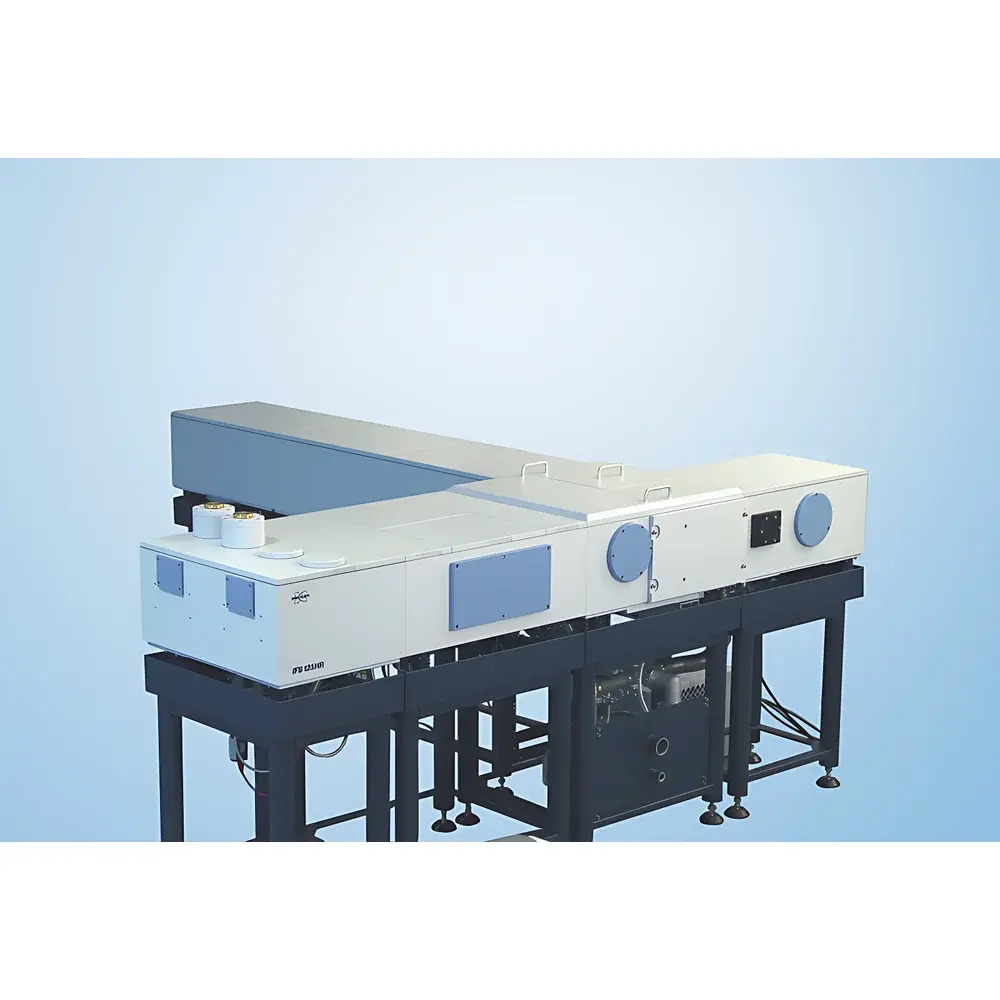
Bruker IFS 125HR High-Resolution Fourier Transform Infrared Spectrometer
| Brand | Bruker |
|---|---|
| Origin | Germany |
| Model | IFS 125HR |
| Instrument Type | Laboratory FTIR Spectrometer |
| Instrument Principle | Fourier Transform Infrared Spectroscopy |
| Configuration | Dual-Sample Chamber, Vacuum-Optimized |
| Optional Features | Dual-Sided Interferogram Acquisition, Hybrid Scanner Interferometer with Sliding Bearings, Integrated 24-bit Digitect™ ADC, Ethernet Data Interface |
| Spectral Range Extension Capability | Far-IR (down to 125 cm⁻¹) to UV (via optional sources/detectors) |
| Resolution Capability | < 0.0225 cm⁻¹ (at specified conditions) |
| Vacuum Compatibility | Yes |
| Compliance Context | Designed for GLP/GMP environments |
Overview
The Bruker IFS 125HR is a research-grade vacuum Fourier transform infrared (FTIR) spectrometer engineered for ultra-high-resolution spectroscopic investigations in academic, national laboratory, and industrial R&D settings. Operating on the Michelson interferometer principle, it acquires interferograms under high-vacuum conditions (typically < 10⁻² mbar) to eliminate atmospheric water vapor and CO₂ absorption—critical for achieving sub-0.025 cm⁻¹ resolution across broad spectral domains. Its core architecture centers on a thermally stabilized, dual-beam optical path with a hybrid-scanner interferometer featuring precision sliding bearings, enabling exceptional mechanical reproducibility and long-term phase stability. Unlike conventional benchtop FTIR systems, the IFS 125HR is purpose-built for fundamental molecular spectroscopy: resolving rotational-vibrational fine structure in gases, characterizing isotopic shifts, validating quantum chemical calculations, and supporting metrology-grade line position and intensity measurements traceable to NIST standards.
Key Features
- Vacuum-enclosed optical bench with active temperature stabilization (±0.01 °C) minimizes thermal drift and ensures interferogram fidelity over extended acquisition times.
- Dual independent sample compartments—each configurable with up to four light sources (e.g., globar, SiC, Hg arc, deuterium) and six detector options (including liquid-nitrogen-cooled MCT, InSb, DTGS, and bolometric far-IR detectors)—enabling rapid experimental reconfiguration without venting.
- Hybrid scanner interferometer with monolithic moving mirror and low-friction sliding bearings delivers superior velocity linearity and reduced vibration coupling, essential for high-SNR, high-resolution scans.
- Integrated Digitect™ electronics featuring synchronized 24-bit analog-to-digital conversion directly at the detector output, eliminating signal degradation from analog cabling and enabling true dynamic range > 1,000,000:1.
- Ethernet-native control architecture supports remote operation, time-stamped data logging, and seamless integration into centralized instrument management networks.
- Modular spectral extension capability: standard mid-IR coverage (7,800–350 cm⁻¹) extends continuously into the far-IR (125 cm⁻¹) using specialized beamsplitters and detectors, and optionally into the visible/UV (up to ~25,000 cm⁻¹) via interchangeable optics and light sources.
Sample Compatibility & Compliance
The IFS 125HR accommodates diverse sample forms—including gas cells (with path lengths from 0.1 m to 100 m), cryogenic sample holders (4–300 K), diamond anvil cells, reflection accessories (ATR, DRIFTS, specular reflectance), and beamline-coupled setups for synchrotron IR experiments. Its vacuum compatibility eliminates ambient interference, making it suitable for trace gas analysis, isotopic ratio measurements, and weak-absorption studies requiring >10⁶ scan co-additions. The system complies with ISO 17025 requirements for testing laboratories and, when operated with Bruker’s OPUS software configured for audit trail, electronic signatures, and data immutability, meets FDA 21 CFR Part 11 and EU Annex 11 expectations for regulated environments. All firmware and control logic are validated per GAMP 5 guidelines.
Software & Data Management
Controlled exclusively via Bruker’s OPUS software platform (v8.x or later), the IFS 125HR supports fully automated experiment sequencing, real-time interferogram quality monitoring, and advanced apodization and phase correction algorithms optimized for high-resolution work. Raw interferograms are stored in Bruker’s proprietary .0 format with embedded metadata (instrument configuration, environmental logs, user credentials, timestamped calibration records). OPUS provides built-in tools for line fitting (Voigt, Lorentzian, Gaussian), spectral subtraction, baseline correction using polynomial or rubberband methods, and export to standardized formats (JCAMP-DX, HDF5, ASCII) for third-party analysis (e.g., HITRAN database cross-referencing, quantum simulation pipelines). Audit trails record every parameter change, file access, and processing step—enabling full traceability during regulatory inspections.
Applications
- High-resolution gas-phase spectroscopy: rotational line assignment in planetary atmospheres, combustion intermediates, and interstellar molecule analogs.
- Fundamental constants determination: precise measurement of vibrational-rotational transition frequencies for refinement of molecular potential energy surfaces.
- Isotope effect studies: resolution of ¹²C/¹³C, ¹⁴N/¹⁵N, or D/H substitution shifts in small molecules and biomolecular fragments.
- Far-IR lattice mode analysis: phonon dispersion mapping in quantum materials, topological insulators, and MOFs under variable-temperature/vacuum conditions.
- Reference spectrum generation: NIST-traceable calibration standards for wavelength accuracy, line intensity, and instrumental line shape characterization.
- Synchrotron IR beamline end-station: leveraging high-brightness broadband IR from storage rings for microspectroscopy and time-resolved pump-probe experiments.
FAQ
What vacuum level is required to achieve the specified < 0.0225 cm⁻¹ resolution?
Typical operation requires a base pressure ≤ 5 × 10⁻³ mbar; optimal performance is achieved below 1 × 10⁻³ mbar, verified via integrated capacitance manometer and logged automatically in OPUS.
Can the IFS 125HR be used for time-resolved measurements?
Yes—when equipped with fast-scanning options and external trigger synchronization (TTL/PCIe), it supports step-scan and rapid-scan modes down to ~10 ms per scan for kinetic studies.
Is the system compatible with cryogenic sample stages?
Absolutely—the dual sample chambers accept standard Janis, Oxford, or custom cryostats with optical access; temperature control and feedback are fully integrated into OPUS.
How is calibration traceability maintained?
Wavelength calibration uses internal HeNe laser referencing (632.8 nm, ±0.0001 nm stability) and optional NIST-traceable gas cells (e.g., CO, N₂O, NH₃); intensity calibration employs certified blackbody sources.
Does Bruker provide application support for quantum chemistry validation projects?
Yes—Bruker’s Application Science team offers collaborative method development, including spectral simulation alignment (using programs like PGOPHER or Duo), line list generation, and uncertainty budgeting per ISO/IEC 17025 Annex A.3.




