
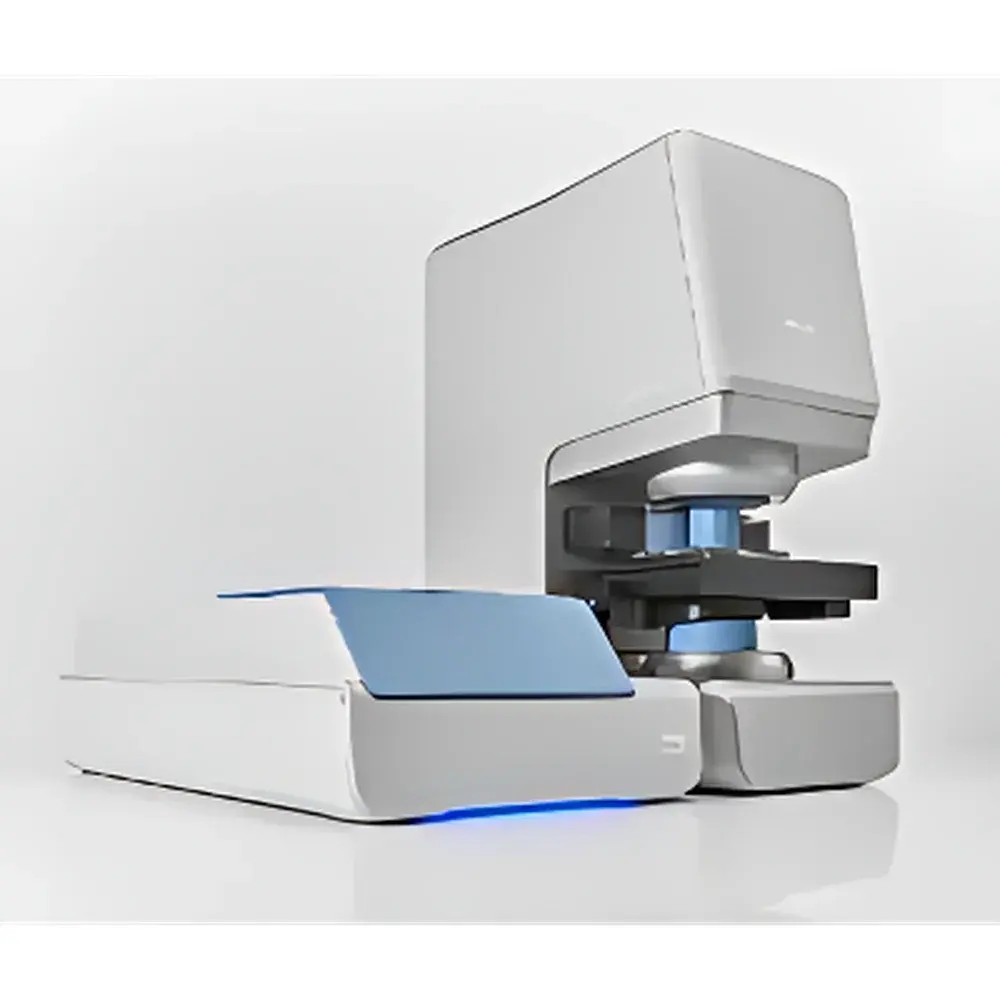
Bruker LUMOS II ILIM Laser Infrared Microscope
| Brand | Bruker |
|---|---|
| Origin | Germany |
| Model | LUMOS II ILIM |
| Instrument Type | Laboratory-based Laser IR Microscope |
| Instrument Category | FTIR Imaging Microscope with Integrated Laser Illumination Module |
| Application Domain | Chemical Imaging, Spatially Resolved Spectroscopy, Hyperspectral Mapping |
Overview
The Bruker LUMOS II ILIM is a high-performance, laboratory-grade laser infrared microscope engineered for rapid, spatially resolved chemical imaging and micro-spectroscopic analysis. Unlike conventional FTIR microscopes relying solely on thermal sources or globar illumination, the LUMOS II ILIM integrates a stabilized near-infrared (NIR) laser illumination module (ILIM) that enables diffraction-limited spatial resolution combined with high signal-to-noise ratio (SNR) spectral acquisition. Its core architecture leverages step-scan FTIR interferometry synchronized with precision motorized XYZ stages and real-time laser spot positioning—delivering sub-micrometer lateral resolution in transmission, reflection, and ATR modes. Designed for quantitative hyperspectral mapping of heterogeneous samples, it supports both point-and-shoot microanalysis and automated large-area mosaic imaging up to 100 mm × 100 mm without stage repositioning. The system operates across the mid-IR range (typically 4000–600 cm⁻¹), with optional extensions into the far-IR or NIR depending on detector and beamline configuration.
Key Features
- Laser-enhanced illumination module (ILIM) enabling high-brightness, collimated NIR excitation for improved contrast in reflection-mode imaging and reduced thermal background in sensitive biological specimens.
- Integrated motorized XYZ stage with 100 mm × 100 mm travel range and <1 µm repeatability, supporting seamless macro-to-micro transition and automated tiling of large-area chemical maps.
- Dual-detector capability: Mercury Cadmium Telluride (MCT) for high-speed focal plane array (FPA) imaging and liquid-nitrogen-cooled DTGS for high-dynamic-range single-point spectroscopy.
- Real-time spectral stitching and phase correction algorithms compliant with ASTM E1421 and ISO 18375 standards for FTIR imaging data integrity.
- Modular optical path design accommodating ATR, transmission, grazing-angle, and specular reflection accessories—all switchable under vacuum or purged environments.
- Robust mechanical architecture certified to ISO 14644-1 Class 5 cleanroom compatibility for controlled environment deployment in regulated labs.
Sample Compatibility & Compliance
The LUMOS II ILIM accommodates solid, semi-solid, and thin-film samples ranging from cryo-preserved tissue sections (5–20 µm thickness) to polymer-coated electronic substrates, mineral thin sections, pharmaceutical tablets, and aged cultural heritage artifacts. It supports non-destructive analysis under ambient, dry-air purged, or nitrogen-purged conditions—ensuring minimal oxidative degradation during extended acquisition. All spectral data acquisition workflows comply with GLP and GMP documentation requirements; audit trails, user authentication, and electronic signatures are fully enabled per FDA 21 CFR Part 11 when operated with OPUS 8.x software suite. System validation protocols align with USP , EP 2.2.24, and ISO/IEC 17025:2017 for analytical instrument qualification.
Software & Data Management
Controlled via Bruker’s OPUS 8.5 software platform, the LUMOS II ILIM provides unified access to acquisition, preprocessing, multivariate analysis (MVA), and reporting modules. Built-in chemometric tools—including PCA, HCA, PLS-DA, and cluster segmentation—support objective classification of spectral heterogeneity across imaging datasets. Raw interferograms are stored in Bruker’s proprietary .0 format with embedded metadata (sample ID, operator, date/time, instrument parameters, environmental conditions). Export options include ASCII, CSV, ENVI, and HDF5 formats compatible with third-party platforms such as MATLAB, Python (scikit-learn, HyperSpy), and Thermo Scientific OMNIC. Data archiving adheres to ISO 16363:2012 trustworthiness criteria for long-term digital preservation.
Applications
- Pharmaceutical Development: Quantitative distribution mapping of active pharmaceutical ingredients (APIs), excipients, and crystallinity gradients in intact tablets—enabling formulation optimization and generic product reverse engineering.
- Biomedical Research: Label-free metabolic profiling of tissue sections via lipid/protein/carbohydrate band ratios (e.g., 2800–3000 cm⁻¹, 1500–1700 cm⁻¹), supporting tumor margin delineation and cell-type classification in pathology workflows.
- Materials Failure Analysis: Identification of interfacial contaminants, oxidation products, or delamination signatures on semiconductor wafers and printed circuit boards using large-area reflection-mode hyperspectral mosaics.
- Environmental Monitoring: Detection and spectral characterization of microplastic particles (>5 µm) in environmental filter extracts, leveraging automated particle search and polymer library matching (e.g., PE, PP, PET, PS).
- Cultural Heritage Science: Non-invasive identification of pigments, binders, and degradation products in historical paintings and manuscripts through low-fluence reflection imaging—preserving surface integrity.
- Geosciences & Agri-Food: Mineral phase discrimination in rock thin sections and spatial quantification of starch, protein, and moisture distribution in feed pellets or cereal grains.
FAQ
What distinguishes the LUMOS II ILIM from standard FTIR microscopes?
It incorporates a dedicated laser illumination module that enhances SNR and spatial fidelity in reflection-mode imaging—particularly advantageous for opaque, reflective, or highly scattering samples where conventional thermal sources yield insufficient contrast.
Is vacuum operation supported?
Yes—the optical bench and sample chamber are designed for optional vacuum integration (<10⁻² mbar), reducing atmospheric water vapor interference and improving spectral quality in the 1800–1300 cm⁻¹ region.
Can the system perform real-time kinetic measurements?
While optimized for static hyperspectral mapping, time-resolved studies (down to ~1 s per spectrum) are feasible using rapid-scan mode with MCT detection—suitable for monitoring slow chemical transformations or hydration dynamics.
Does it support ATR imaging?
Yes—via interchangeable ATR objectives (e.g., Ge, diamond, or Si crystal tips) mounted on the same turret as reflective/transmission optics, enabling contact-mode chemical mapping with minimal sample preparation.
What level of spectral calibration traceability is provided?
Factory calibration is traceable to NIST SRM 1921b (polystyrene film) and SRM 2036 (silicon wafer), with annual recalibration recommended per ISO/IEC 17025 guidelines.






