
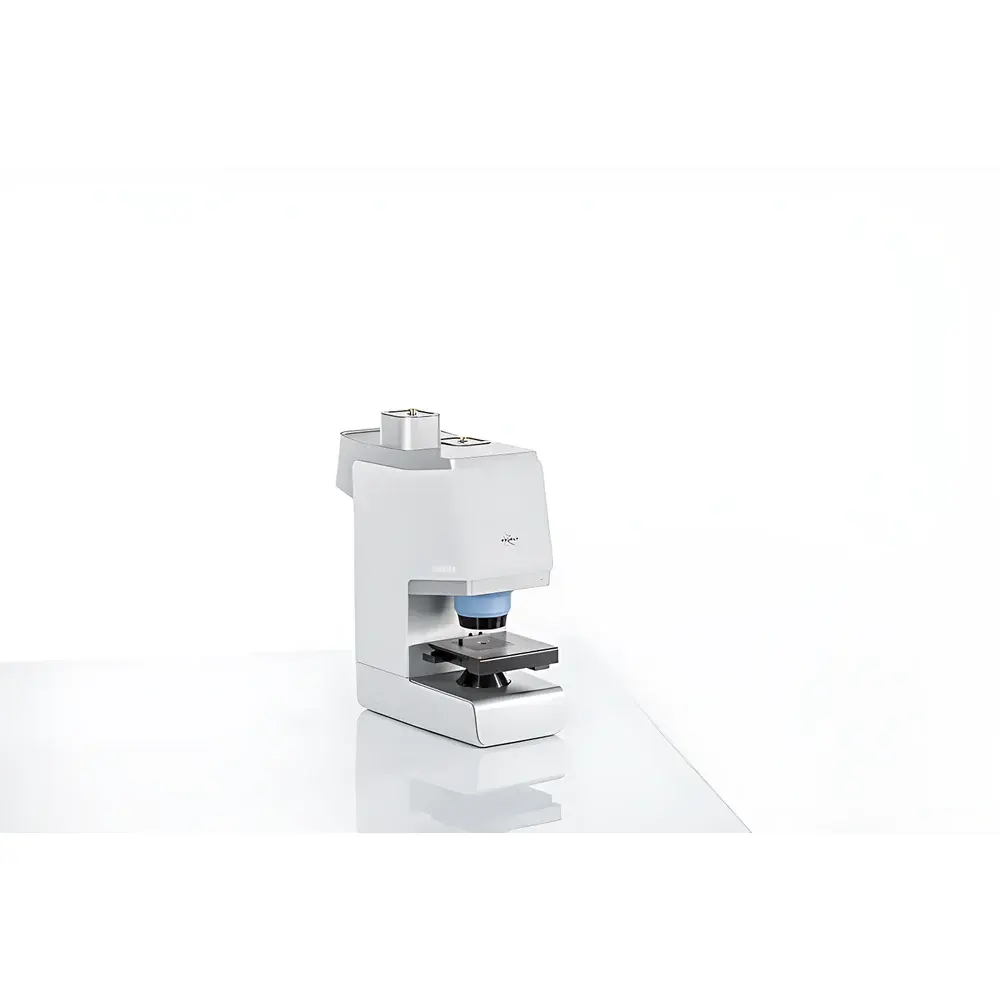
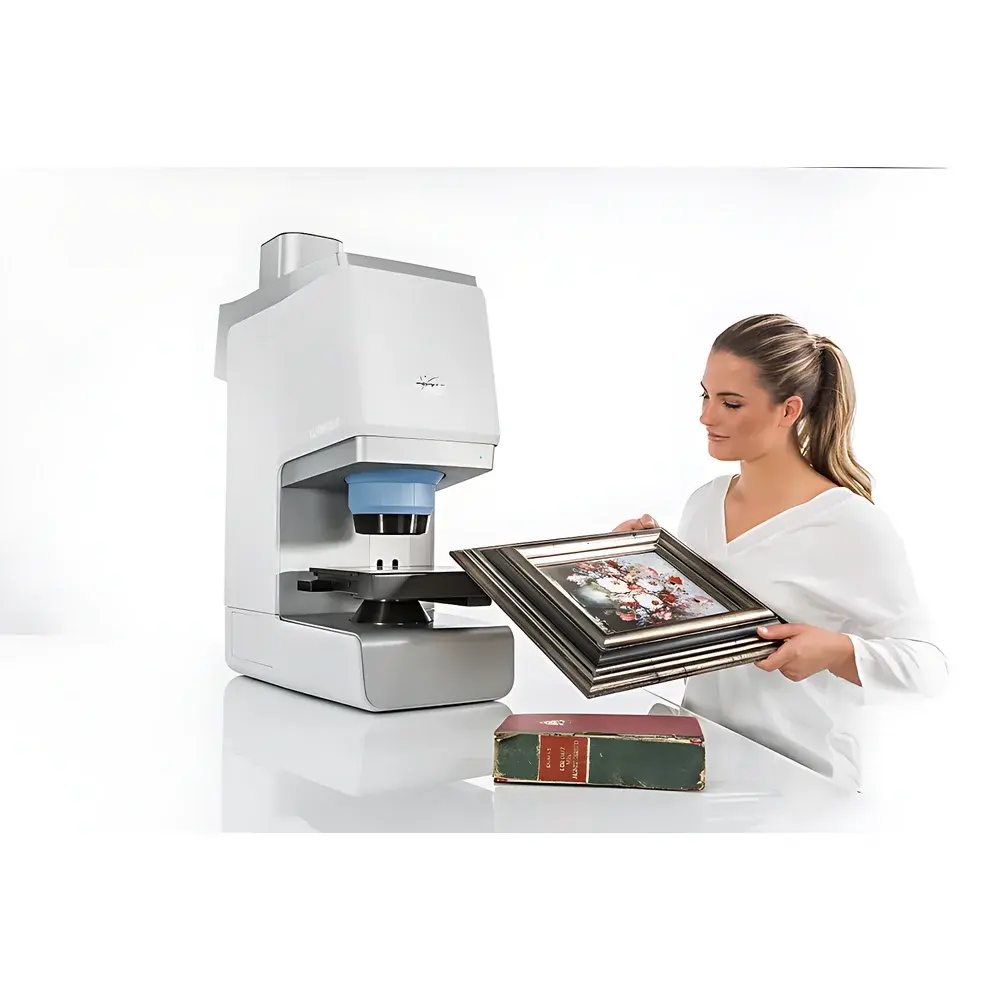
Bruker LUMOS II Standalone FTIR Microscope
| Brand | Bruker |
|---|---|
| Origin | Germany |
| Model | LUMOS II |
| Detector Options | TE-MCT (liquid-nitrogen-free), DTGS, LN2-cooled MCT |
| FPA Imaging Capability | Yes |
| Spatial Resolution | 0.6 µm/pixel |
| Field of View | 1490 × 1118 µm² |
| PermaSure+ Real-Time Calibration System | Yes |
| Sealed Optics (No Purge Required) | Yes |
| ZnSe Optical Components | Standard |
| Motorized Automation | Fully motorized aperture, detector, and technique switching |
| Sample Stage | Free-access, manual/optional motorized, max. 40 mm sample size |
| Compliance | FDA 21 CFR Part 11, cGMP, USP <1119>, EP 2.2.24, ALCOA+ data integrity principles |
Overview
The Bruker LUMOS II Standalone FTIR Microscope is a high-performance, fully integrated Fourier Transform Infrared (FTIR) microspectroscopy platform engineered for precision chemical imaging and microanalysis in regulated and research-intensive environments. Unlike conventional benchtop FTIR microscopes requiring external spectrometers or purge gas infrastructure, the LUMOS II integrates a robust Michelson interferometer, broadband IR source, and high-stability HeNe laser into a compact, self-contained optical enclosure. Its core measurement principle relies on spectral interferometry coupled with diffraction-limited infrared focusing optics, enabling spatially resolved molecular fingerprinting at sub-micrometer resolution. Designed for both routine QC laboratories and advanced materials research labs, the system delivers quantitative, reproducible spectral data across transmission, reflection, and attenuated total reflectance (ATR) modalities — all without compromising analytical fidelity or operational simplicity.
Key Features
- Focal Plane Array (FPA) Imaging Engine: Equipped with a high-sensitivity 64 × 64 or 128 × 128 pixel MCT FPA detector (configurable), the LUMOS II achieves rapid hyperspectral image acquisition — up to 100× faster than single-point mapping — while maintaining full spectral fidelity (4 cm⁻¹ resolution standard, optionally 2 cm⁻¹).
- PermaSure+ Real-Time Calibration: A proprietary hardware-software subsystem continuously monitors and corrects laser wavelength drift, mirror position error, and thermal expansion effects. Patented per-pixel wavenumber calibration ensures spectral accuracy across the entire field of view, critical for comparative analysis and multivariate modeling.
- Zero-Purge Optical Architecture: Hermetically sealed ZnSe-based optics eliminate dependence on dry air or nitrogen purge systems. This design enables stable operation in high-humidity environments (up to 85% RH) and reduces infrastructure dependencies — particularly valuable in shared lab spaces or mobile analytical units.
- Triple-Detector Flexibility: Three motorized detector positions support seamless switching between TE-MCT (thermoelectrically cooled, no liquid nitrogen required), DTGS (room-temperature, broad dynamic range), and LN₂-cooled MCT (highest sensitivity for trace analysis), ensuring optimal signal-to-noise ratio across diverse sample types and measurement conditions.
- Full Motorization & Software Control: All critical optical components — including apertures, beam splitters, objective lenses, and detector selection — are motorized and software-synchronized. One-click method execution guarantees repeatable alignment and eliminates manual reconfiguration errors between analyses.
- Low-Power, High-Reliability Electronics: Modern ASIC-based control electronics reduce power consumption by >40% versus prior-generation platforms. Critical subsystems — including the interferometer, laser, and IR source — are constructed from aerospace-grade materials and backed by extended warranty coverage (3–5 years, depending on configuration).
Sample Compatibility & Compliance
The LUMOS II accommodates a wide range of solid, thin-film, and heterogeneous samples — from pharmaceutical tablets and polymer laminates to forensic fibers and archaeological pigment layers. Its open-access stage accepts specimens up to 40 mm in diameter, with optional accessories including Ge ATR hemispheres (for viscous, fragile, or soft materials), polarizers, dark-field illumination modules, and specialized holders for IR-transparent windows, filters, and cross-sectioned devices. Regulatory compliance is embedded at the architecture level: the system and OPUS software meet FDA 21 CFR Part 11 requirements for electronic records and signatures, support audit trails with immutable timestamps, enforce role-based user access (administrator, analyst, reviewer), and maintain raw interferogram storage with full metadata provenance. It satisfies cGMP documentation standards, USP (Infrared Spectrophotometry), European Pharmacopoeia 2.2.24, and ALCOA+ data integrity principles — making it suitable for GxP-regulated environments including pharmaceutical development, medical device characterization, and contract laboratory services.
Software & Data Management
Controlled via Bruker’s OPUS 8.x software suite, the LUMOS II provides an intuitive, workflow-driven interface with context-sensitive guidance for beginners and scriptable automation for expert users. Integrated chemometric tools include hierarchical cluster analysis (HCA), principal component analysis (PCA), and classical least-squares (CLS) quantification. All spectral data — including interferograms, single-beam spectra, and hyperspectral cubes — are stored in vendor-neutral, timestamped .0 format files compliant with ASTM E1789-22. Raw data retention policies, electronic signature workflows, and secure database export (SQL-compatible) ensure long-term archival integrity and regulatory readiness. Optional integration with LIMS and ELN platforms is supported through standardized API protocols.
Applications
The LUMOS II serves as a primary analytical tool across multiple domains: failure analysis of microelectronic packaging delamination; identification of contaminants in semiconductor wafers; distribution mapping of active pharmaceutical ingredients (APIs) and excipients in solid dosage forms; compositional profiling of historical paint layers and conservation materials; micro-domain analysis in polymer blends and composites; and forensic fiber discrimination based on spectral heterogeneity. Its ability to combine high spatial resolution with full mid-IR spectral coverage (7500–375 cm⁻¹) enables unambiguous functional group assignment — even in complex, overlapping spectral regions — supporting root-cause investigations where molecular identity and localization are inseparable.
FAQ
Does the LUMOS II require liquid nitrogen for operation?
No — the standard TE-MCT detector operates without cryogenic cooling, significantly reducing operational overhead while maintaining superior sensitivity over DTGS for single-point measurements.
Can the system perform ATR imaging without sample preparation?
Yes — optional Ge ATR objectives enable direct contact imaging of soft, sticky, or thermally sensitive materials without sectioning or embedding.
Is spectral calibration traceable to NIST standards?
Yes — PermaSure+ incorporates NIST-traceable HeNe laser referencing and automated polystyrene film validation routines per ASTM E1421.
How is data integrity ensured during multi-user operation?
OPUS enforces strict user authentication, electronic signatures, and tamper-evident audit trails — all compliant with 21 CFR Part 11 Annex 11 and EU GMP Annex 11 requirements.
What is the maximum sample thickness compatible with transmission mode?
For optimal signal throughput, samples should be ≤20 µm thick in transmission; thicker specimens may be analyzed using reflection or ATR configurations.






