
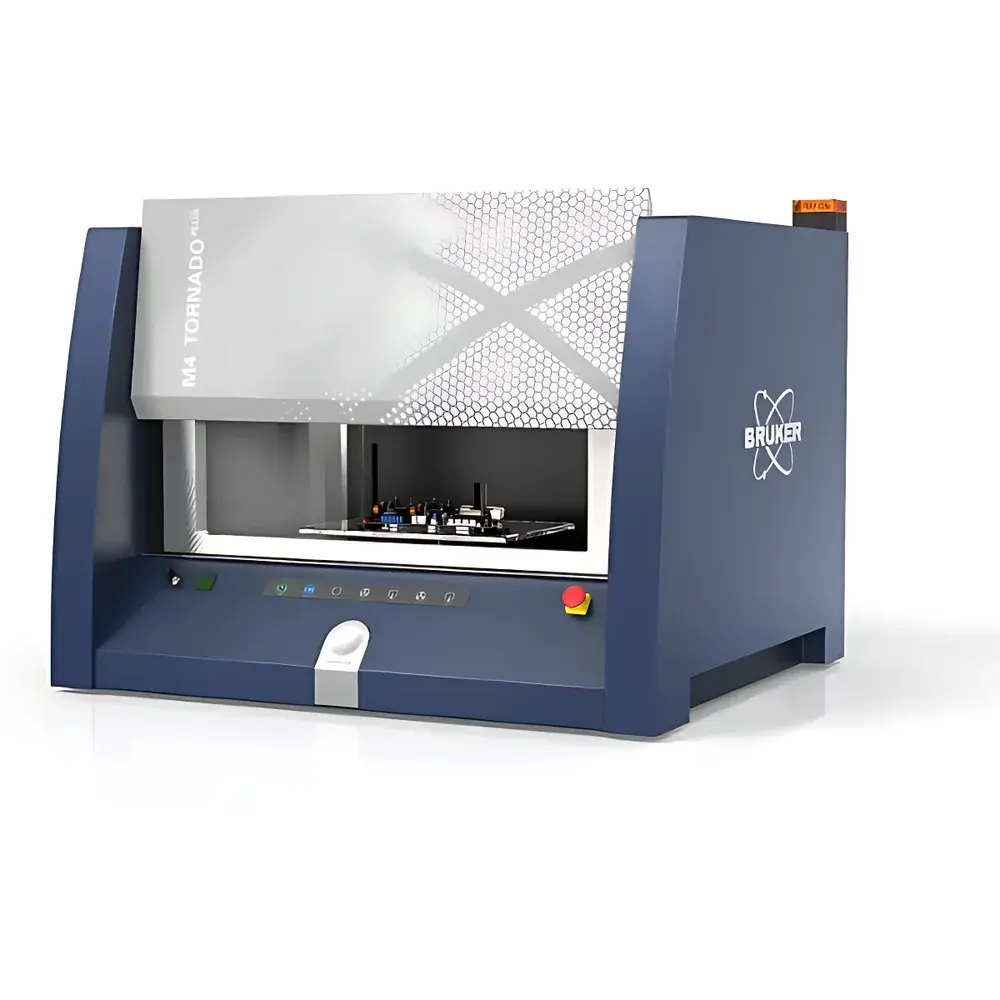
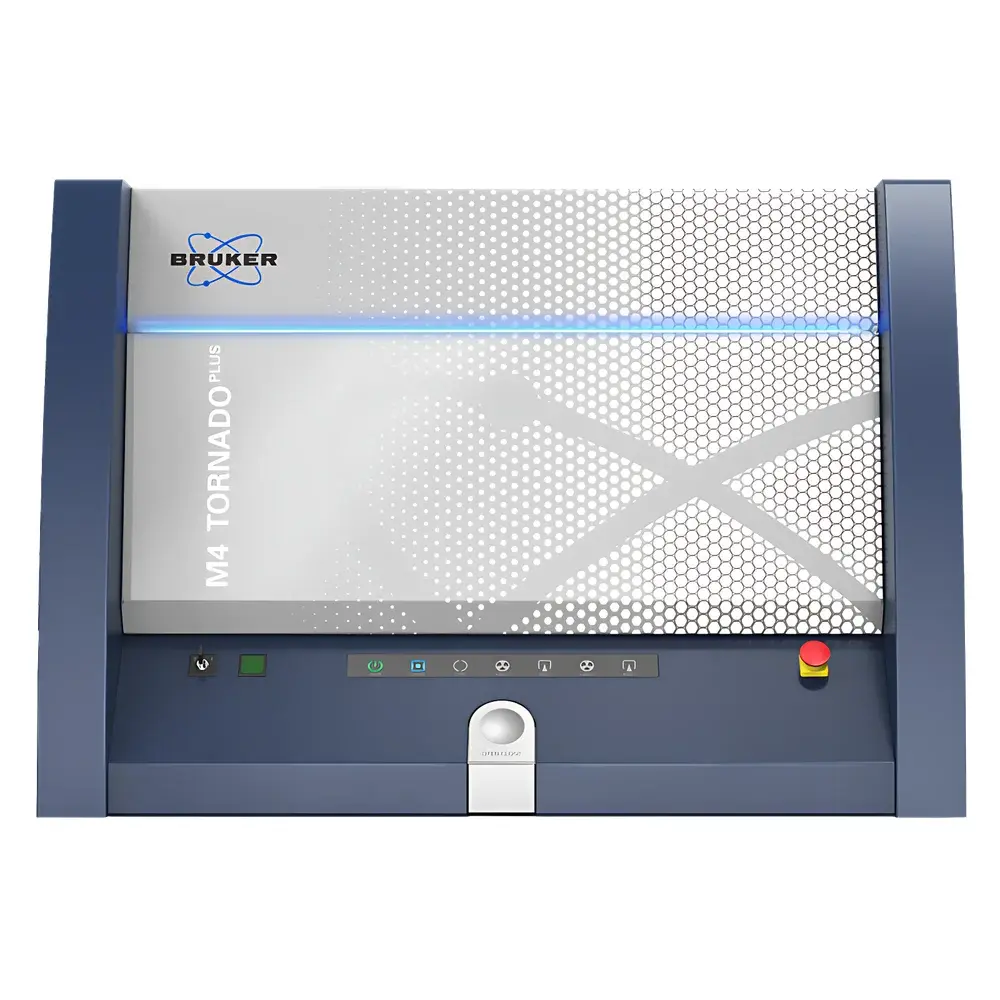
Bruker M4 TORNADO PLUS Benchtop Micro-XRF Imaging Spectrometer
| Brand | Bruker |
|---|---|
| Origin | Germany |
| Model | M4 TORNADO PLUS |
| Configuration | Benchtop |
| Element Range | C–U (Z = 6–92) |
| Energy Resolution | <140 eV |
| Detector | Dual Large-Area Silicon Drift Detectors (SDD) with Light-Element Windows |
| X-ray Source | Rh-target Microfocus Tube |
| Aperture Management System (AMS) | Integrated |
| Sample Compatibility | Flat & Topographically Irregular Surfaces |
| Compliance | ASTM E1598, ISO 22073, IEC 62471 (LED/X-ray Safety), GLP/GMP-Ready Data Audit Trail |
Overview
The Bruker M4 TORNADO PLUS is a high-performance benchtop micro-focus X-ray fluorescence (μ-XRF) imaging spectrometer engineered for spatially resolved elemental mapping and quantitative analysis at micrometer-scale resolution. Operating on the principle of energy-dispersive X-ray fluorescence (ED-XRF), the system excites sample surfaces using a finely focused Rh-target X-ray tube and collects emitted characteristic X-rays via dual large-area silicon drift detectors (SDDs) equipped with ultra-thin polymer windows optimized for light-element transmission. This architecture enables reliable detection and quantification of elements from carbon (Z = 6) through uranium (Z = 92), including critical low-Z elements—C, N, O, and F—that are inaccessible to conventional μ-XRF systems lacking optimized detector windows and high-flux pulse processing electronics. The instrument’s core innovation lies in its integrated Aperture Management System (AMS), which dynamically adjusts beam geometry to maintain focus across variable surface topographies—eliminating the need for Z-stacking or mechanical leveling in heterogeneous or rough samples.
Key Features
- Dual large-area SDD detectors with light-element-optimized windows, delivering high count-rate capability (>100 kcps per detector) and energy resolution <140 eV at Mn Kα (5.9 keV)
- Rh-target microfocus X-ray source with adjustable voltage (up to 50 kV) and current (up to 1 mA), enabling flexible excitation for both light- and heavy-element analysis
- Aperture Management System (AMS): A patented optical configuration that modulates beam divergence and working distance to achieve extended depth-of-field imaging—critical for PCBs, mineral sections, coated polymers, and biological tissue sections
- High-speed XYZ motorized stage with sub-micron repeatability and programmable raster scanning (up to 800 × 460 pixels per frame)
- Integrated real-time spectral acquisition and live elemental map rendering during scanning
- Robust mechanical design with vibration-damped granite base and EMI-shielded enclosure for stable long-duration acquisitions
Sample Compatibility & Compliance
The M4 TORNADO PLUS accommodates solid, non-volatile samples up to 200 × 200 mm in footprint and 100 mm in height—including polished thin sections, integrated circuit boards, geological slabs, polymer films, paint cross-sections, and biological specimens mounted on conductive substrates. Its AMS-enabled deep field-of-view ensures accurate elemental distribution data even on samples with >50 µm surface relief. From a regulatory standpoint, the system supports GLP and GMP workflows through built-in audit trail logging (user actions, parameter changes, calibration events), electronic signatures (21 CFR Part 11 compliant when deployed with Bruker’s ESPRIT software suite), and traceable calibration using certified reference materials (e.g., NIST SRM 2711a, BAM U-100). It conforms to ISO 22073:2019 (XRF instrumentation performance verification) and ASTM E1598-21 (standard test method for determination of elemental composition by μ-XRF).
Software & Data Management
Controlled by Bruker’s ESPRIT 3.0 software platform, the M4 TORNADO PLUS provides a unified interface for instrument operation, spectral deconvolution (using fundamental parameters and empirical calibration models), multivariate image analysis (PCA, cluster analysis), and report generation. All raw spectra, maps, and metadata are stored in vendor-neutral HDF5 format with embedded EXIF-like tags (acquisition time, detector bias, tube settings, stage coordinates). Batch processing supports automated ROI-based quantification across hundreds of scan frames, while Python API access enables integration into custom QA/QC pipelines or laboratory information management systems (LIMS). Data integrity is preserved via checksum validation, version-controlled method files, and optional network-attached storage (NAS) synchronization.
Applications
The M4 TORNADO PLUS serves as a primary tool in multidisciplinary research and industrial QA environments where spatial heterogeneity and light-element chemistry govern material behavior. In geosciences, it differentiates fluorite (CaF₂) from calcite (CaCO₃) by resolving F-Kα (0.677 keV), C-Kα (0.277 keV), and O-Kα (0.525 keV) signals—impossible with standard ED-XRF due to absorption losses in beryllium windows and insufficient detector resolution. In semiconductor manufacturing, it identifies solder mask contaminants (Cl, S, Br), intermetallic phase distributions (Cu–Sn–Ni), and under-bump metallization thickness gradients without destructive cross-sectioning. In polymer science, it maps flame retardant additives (Br, Cl, P) within multi-layer packaging films and detects carbon migration at polymer–filler interfaces. Additional validated use cases include forensic ink differentiation, cultural heritage pigment stratigraphy, and battery cathode homogeneity assessment (Ni–Co–Mn–O mapping at <5 µm resolution).
FAQ
Can the M4 TORNADO PLUS quantify carbon in organic matrices?
Yes—its dual SDDs with ultra-thin polymer windows and optimized Rh-tube spectrum yield sufficient counts at C-Kα (277 eV) for semi-quantitative mapping; quantification accuracy improves with matrix-matched standards and spectral deconvolution using escape peak correction.
Is vacuum or helium purge required for light-element analysis?
No—ambient air operation is sufficient for C, N, and O mapping due to the instrument’s optimized low-energy throughput and detector window transmission; helium purging may be optionally applied to enhance signal-to-noise below 200 eV.
How does AMS improve analysis of printed circuit boards?
AMS maintains consistent focus across component height variations (e.g., capacitors vs. flat traces) by adjusting effective focal length—eliminating defocus-induced intensity loss and enabling accurate Zn, Sn, and Pb quantification on solder joints without manual stage repositioning.
Does the system support automated multi-region scanning?
Yes—ESPRIT software allows definition of irregular ROIs via optical image overlay, with fully automated stage movement, auto-focus, and parameter switching between regions (e.g., high-resolution Cu mapping on traces + fast survey mode on substrate).
What calibration standards are recommended for geological samples?
Certified thin-section standards such as NIST SRM 2782 (basalt glass), BAM GSP-2 (granite), and USGS BCR-2g are routinely used; Bruker provides application-specific calibration packages with FP-based matrix correction for silicate, oxide, and sulfide matrices.





