
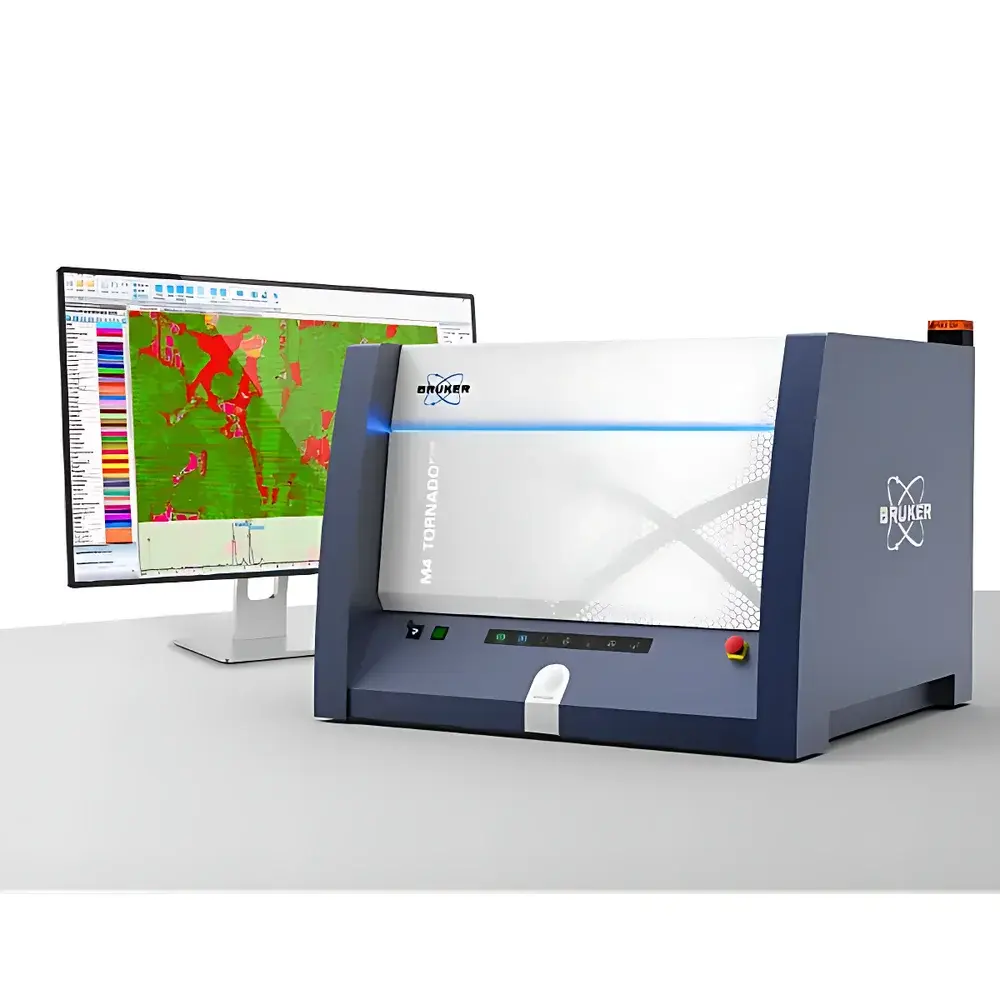
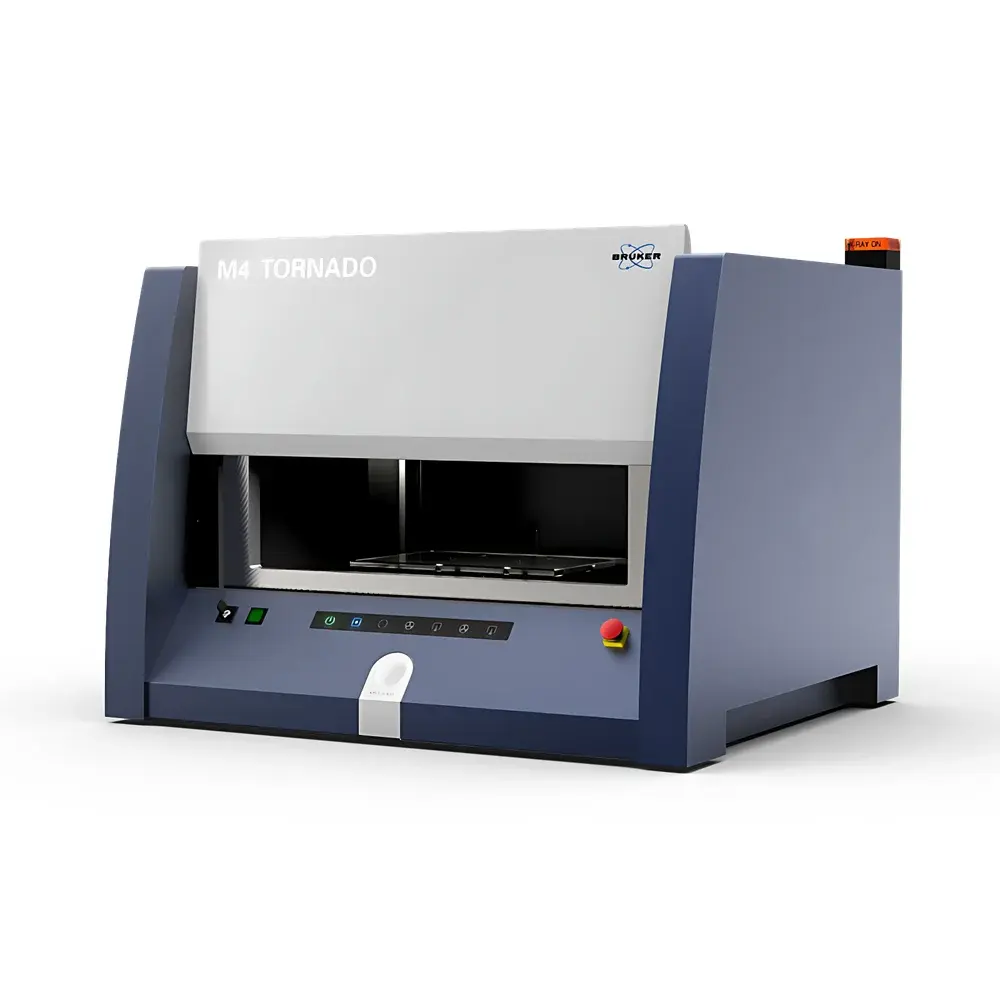
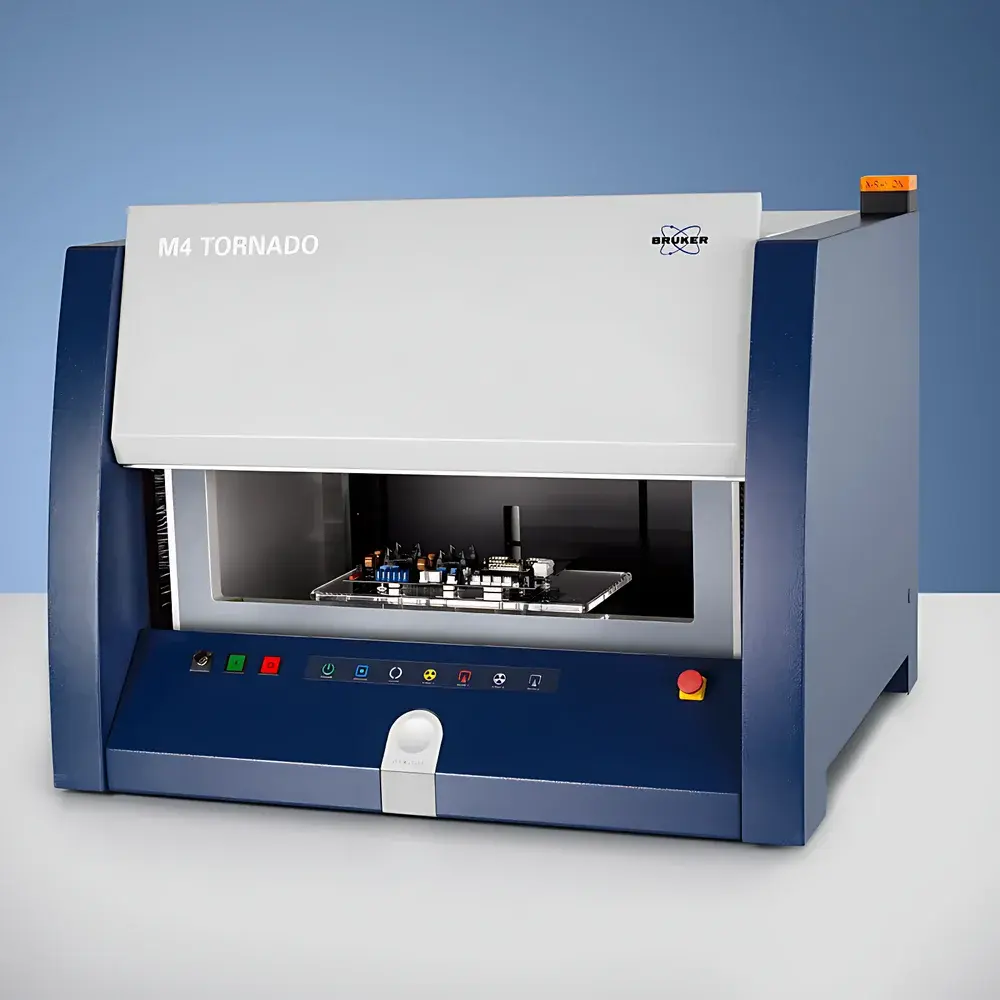
Bruker M4 TORNADO Micro-XRF Spectrometer
| Brand | Bruker |
|---|---|
| Origin | Germany |
| Model | M4 TORNADO |
| Form Factor | Benchtop/Floor-Standing |
| Application Sector | Geology & Mining |
| Elemental Range | Na–U |
| Detection Range | ppm to wt% |
| Energy Resolution | ≤130 eV at Mn Kα |
| Excitation | Dual X-ray Tube (Cr & Rh) + 6-Position Filter Wheel |
| Detector | Silicon Drift Detector (XFlash®) |
| Spatial Resolution | <25 µm (spot size) |
| Sample Chamber | Vacuum-Compatible, Motorized XYZ Stage with Zoom Camera Navigation |
| Quantification | Standardless Bulk & Multilayer Analysis |
| Compliance | CE, RoHS, ISO/IEC 17025-ready workflow support |
Overview
The Bruker M4 TORNADO is a high-performance benchtop/floor-standing micro-focus energy dispersive X-ray fluorescence (µ-XRF) spectrometer engineered for non-destructive, spatially resolved elemental mapping and quantitative analysis of heterogeneous, irregular, or small-volume samples. Operating on the principle of secondary X-ray emission induced by focused primary X-ray excitation, the system enables in situ elemental identification and distribution profiling without sample dissolution or coating. Its core architecture integrates a polycapillary optic that focuses the X-ray beam to a spot size below 25 µm—enabling true micro-scale analysis—and couples it with real-time imaging navigation via a motorized XYZ stage and variable-magnification optical camera. This configuration supports both point analysis and raster-based elemental mapping across mm² to cm² areas, delivering high reproducibility and trace-level sensitivity (ppm detection limits for many elements from Na to U) under ambient or vacuum conditions.
Key Features
- Multifocal excitation capability using dual X-ray tubes (Cr and Rh anodes) and a six-position automatic filter wheel, optimizing signal-to-background for light elements (Na–Ca) and heavy elements (Fe–U) in diverse matrices.
- High-throughput detection enabled by Bruker’s XFlash® silicon drift detector (SDD), offering energy resolution ≤130 eV at Mn Kα and count-rate stability up to 1 million cps.
- Vacuum-compatible sample chamber with automated pressure control, essential for enhancing sensitivity to low-Z elements (e.g., Na, Mg, Al, Si) and minimizing atmospheric absorption artifacts.
- Integrated zoom optical microscope with live video feed and crosshair overlay, allowing precise positioning and “on-the-fly” mapping—no pre-scanning required.
- Standardless quantification engine validated for bulk homogeneous materials and multilayer thin-film systems, reducing reliance on matrix-matched standards while maintaining traceable accuracy.
- Modular design supporting optional accessories including helium purge, cryo-stage, and motorized sample changer for unattended operation.
Sample Compatibility & Compliance
The M4 TORNADO accommodates a broad range of sample geometries—including polished sections, drill cores, thin sections, embedded particles, and irregular geological specimens—without requiring conductive coating or vacuum-compatible preparation. Its non-destructive nature preserves sample integrity for subsequent SEM-EDS, LA-ICP-MS, or petrographic analysis. The instrument meets CE marking requirements and adheres to electromagnetic compatibility (EMC) and low-voltage directives. While not certified as GMP/GLP hardware per se, its software architecture supports audit trails, user access levels, and electronic signatures—facilitating compliance with ISO/IEC 17025:2017 for testing laboratories and alignment with FDA 21 CFR Part 11 principles when deployed in regulated environments (e.g., cementitious material certification labs).
Software & Data Management
ESPRESSO software provides unified control of acquisition, real-time visualization, spectral deconvolution, and quantification. It includes built-in algorithms for matrix correction (Fundamental Parameters method), spectral background subtraction, and peak overlap resolution. Mapping data are stored in vendor-neutral HDF5 format, enabling export to third-party platforms such as Python (via h5py), MATLAB, or GIS tools for spatial statistics. Batch processing workflows support automated report generation compliant with ASTM E1598 (standard test method for elemental analysis of concrete by XRF) and NT Build 443/492 documentation requirements. All raw spectra and metadata are timestamped and logged with operator ID, instrument parameters, and environmental conditions—ensuring full traceability.
Applications
The M4 TORNADO is widely applied in geoscience for quantitative mineral zoning, sulfide ore characterization, and fluid inclusion chemistry; in construction materials science for chloride diffusion profiling in cement paste, interfacial transition zone (ITZ) analysis in reinforced concrete, and alkali–silica reaction (ASR) product identification; and in cultural heritage for pigment stratigraphy and corrosion layer composition on archaeological metals. In concrete durability studies, it enables direct measurement of Cl⁻ penetration depth profiles—complementing electrochemical methods like rapid chloride permeability tests (RCPT) and non-steady-state migration coefficient determination—by mapping chlorine distribution across polished cross-sections after exposure to chloride solutions or marine environments.
FAQ
Can the M4 TORNADO quantify chlorine in hardened concrete without digestion?
Yes—under vacuum or helium purge, it detects Cl Kα (2.62 keV) with ppm-level sensitivity in intact polished sections, avoiding acid digestion and preserving spatial context.
Does it require matrix-matched standards for accurate quantification?
No—standardless FP-based quantification is validated for common geological and cementitious matrices; however, empirical calibration improves accuracy for complex multi-phase binders.
Is vacuum operation mandatory for light element analysis?
Vacuum significantly enhances signal intensity and resolution for Na–P; helium purge offers a practical alternative for lab environments where vacuum cycling is impractical.
How does spatial resolution compare to SEM-EDS?
At <25 µm spot size, M4 TORNADO provides superior lateral resolution than conventional XRF but lower than SEM-EDS (~1 µm); however, it delivers deeper information depth (tens of µm) and requires no conductive coating.
Can it distinguish between bound chloride and free chloride?
No—µ-XRF measures total chlorine content only; speciation requires coupling with techniques such as ion chromatography or Raman spectroscopy.






