
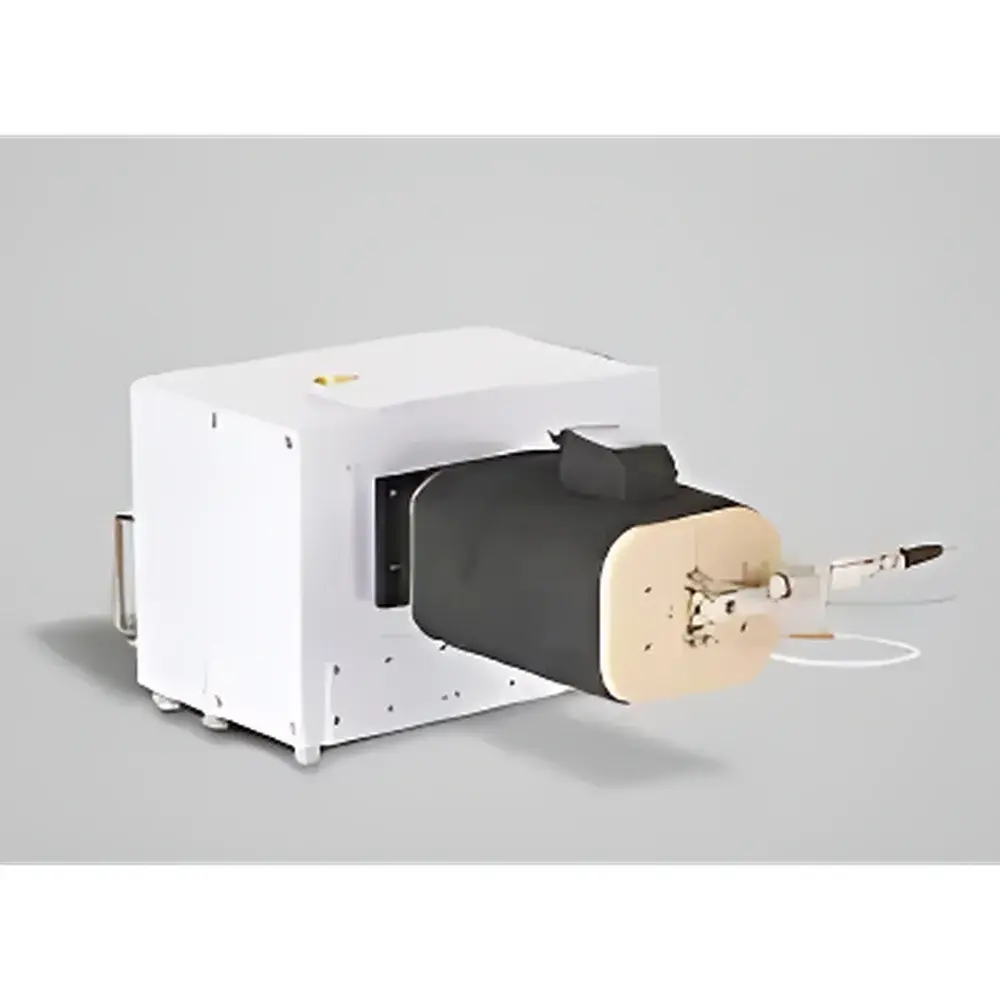
Bruker MATRIX II-MG Fourier Transform Infrared (FTIR) Gas Analyzer
| Brand | Bruker |
|---|---|
| Origin | Germany |
| Model | MATRIX II-MG |
| Detection Scope | Simultaneous Quantification of Major, Minor, and Trace Gaseous Impurities (ppb to % v/v) |
| Optical Path Length Options | 10 cm – 26 m (Heated Up to >180 °C for Condensable Gases) |
| Compliance | Designed for ISO 14644-8, ASTM D7538, IEC 62409, and GLP/GMP-Ready Data Integrity Architecture |
Overview
The Bruker MATRIX II-MG is a high-performance, benchtop Fourier Transform Infrared (FTIR) gas analyzer engineered for continuous, non-destructive, multi-component quantification of industrial, ultra-high-purity (UHP), and specialty gases. Leveraging Michelson interferometry with a thermally stabilized solid-state laser reference and a high-sensitivity DTGS or MCT detector, the system delivers laboratory-grade spectral resolution (down to 0.5 cm⁻¹) and long-term radiometric stability—critical for trace-level impurity monitoring in semiconductor fab environments, electronics-grade gas production, and hydrogen purity certification. Unlike single-wavelength NDIR or electrochemical sensors, FTIR enables simultaneous detection and quantification of dozens of infrared-active species—including CO, CO₂, CH₄, NH₃, H₂O, HF, HCl, SO₂, NOₓ, silanes, phosphines, arsines, and fluorinated compounds—within a single 30-second scan. Its modular optical path design supports application-specific configuration: short-path cells (10–20 cm) for high-concentration matrix gases (e.g., N₂, Ar, He) and extended-path multipass cells (up to 26 m effective pathlength) for sub-ppb detection of low-absorbing species such as H₂S or COS in carrier gases.
Key Features
- Compact, vibration-insensitive optical bench with integrated purge ports and sealed beam path—designed for integration into cleanroom utility cabinets or mobile analytical carts.
- Temperature-controlled gas cell options: standard unheated cells (10 cm–10 m), high-temperature heated cells (>180 °C, up to 5 m pathlength), and cryo-cooled cells for condensable analytes (e.g., ClF₃, WF₆).
- Real-time spectral acquisition at 10 scans/sec, enabling dynamic process monitoring and transient event capture (e.g., valve switching, purge breakthrough).
- Automated background correction and water/CO₂ compensation routines compliant with ASTM D7538 Annex A3 for UHP gas analysis.
- Ruggedized aluminum chassis with IP54-rated enclosure; CE, UKCA, and RoHS certified for industrial deployment.
Sample Compatibility & Compliance
The MATRIX II-MG accommodates gas streams from ambient to 5 bar absolute pressure, with flow rates ranging from 50 to 1000 mL/min. It interfaces seamlessly with standardized gas sampling systems—including heated stainless-steel lines, particle filters (0.1 µm), and pressure regulators—ensuring representative sampling without adsorption or catalytic decomposition. All calibration protocols adhere to ISO/IEC 17025 requirements, and spectral libraries include over 450 validated reference spectra traceable to NIST SRM standards. The system supports audit-ready compliance with ISO 14644-8 (cleanroom air monitoring), SEMI F57 (electronic specialty gases), and FDA 21 CFR Part 11 when deployed with Opus QA software and electronic signature modules.
Software & Data Management
Controlled via Bruker’s OPUS QA software (v8.5+), the MATRIX II-MG provides full method lifecycle management—from method creation and validation to routine operation and report generation. Spectral preprocessing includes atmospheric correction, baseline flattening, and peak deconvolution using constrained multivariate curve resolution (MCR). Quantitative analysis employs classical least-squares (CLS) fitting with optional partial least-squares (PLS) models for complex matrix interference. All raw interferograms, processed spectra, calibration logs, and user actions are stored in encrypted HDF5 archives with immutable timestamps. Audit trails meet ALCOA+ principles (Attributable, Legible, Contemporaneous, Original, Accurate, Complete, Consistent, Enduring, Available) and support automated export to LIMS via OPC UA or CSV/JSON APIs.
Applications
- Ultra-high-purity (UHP) bulk and cylinder gas certification for semiconductor manufacturing (e.g., Ar, N₂, O₂, H₂, NH₃, SiH₄).
- In-line monitoring of abatement system effluents for HF, HCl, Cl₂, and PFCs per EPA Method 320 and ISO 12039.
- Quality control of medical oxygen and nitrous oxide per USP and Ph. Eur. 2.2.43.
- Hydrogen fuel purity verification (ISO 8573-8, SAE J2719) including formic acid, formaldehyde, and total hydrocarbons.
- Research-grade gas-phase reaction kinetics studies requiring time-resolved speciation at ppm–ppb levels.
FAQ
Does the MATRIX II-MG require daily recalibration?
No. With internal laser wavelength stabilization and temperature-compensated detector electronics, drift is typically <0.005 cm⁻¹ over 72 hours. Weekly verification against NIST-traceable gas standards is recommended per ISO/IEC 17025.
Can it quantify non-IR-active gases like H₂ or He?
Not directly. However, indirect quantification is possible via stoichiometric correlation (e.g., H₂ consumption in catalytic reactors) or by coupling with a TCD module in hybrid configurations—subject to system integration review.
Is remote diagnostics supported?
Yes. Via secure TLS 1.3 VPN tunneling, Bruker Field Service Engineers can initiate diagnostic sessions with operator consent, accessing real-time hardware status, spectral SNR metrics, and optical alignment logs without compromising data sovereignty.
What is the minimum detectable concentration for CO in nitrogen?
Using a 20 m multipass cell and 100-scan co-addition, the instrument achieves a limit of detection (LOD) of 12 ppb (3σ) for CO in N₂ at ambient temperature and 1 atm—verified per ISO 11843-2.
How is spectral library validation performed?
Each library entry undergoes independent validation using certified reference materials (CRMs) across three concentration levels (LOQ, mid-range, upper limit), with recovery accuracy maintained within ±3% RSD per ISO 17034 guidelines.
Related Products







