
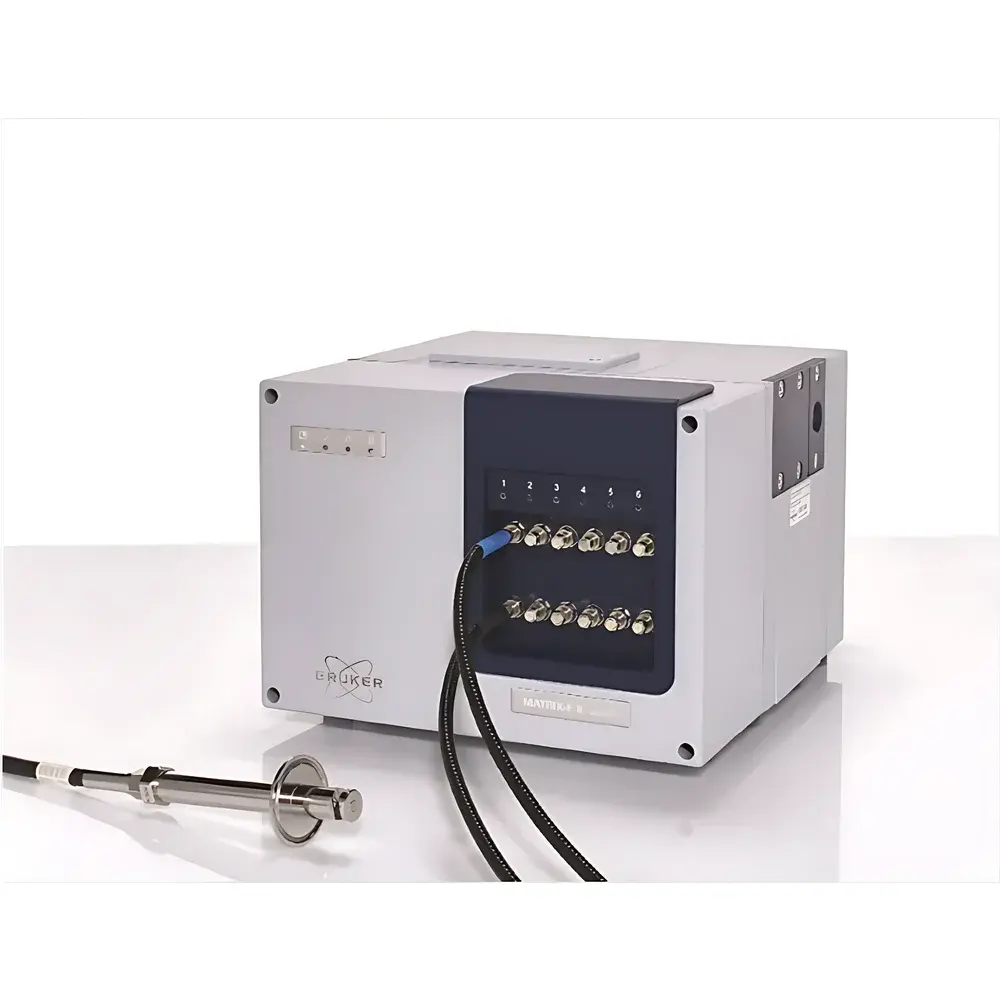
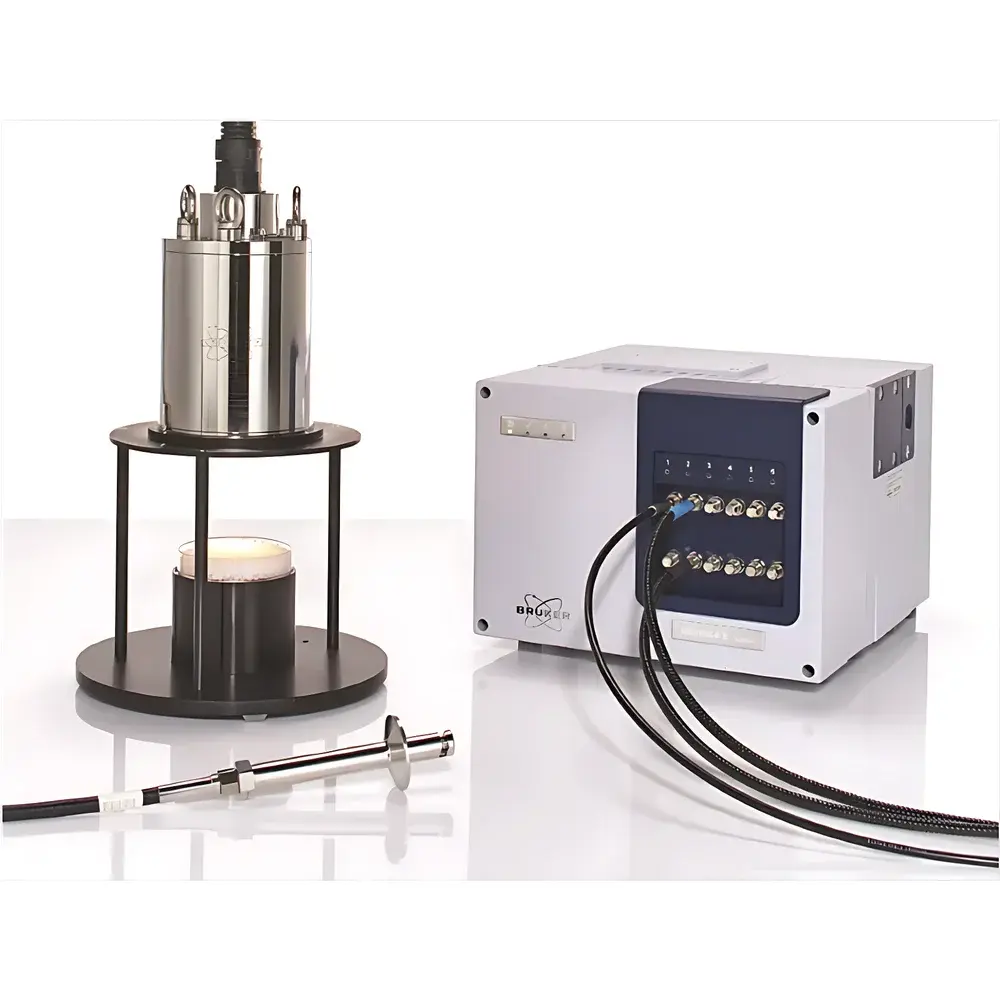
Bruker MATRIX-F II Online Process Analysis Fourier Transform Near-Infrared Spectrometer
| Brand | Bruker |
|---|---|
| Origin | Germany |
| Model | MATRIX-F II |
| Instrument Type | Online FT-NIR Spectrometer |
| Measurement Principle | Fourier Transform (FT) Interferometry |
| Sampling Modes | Diffuse Reflectance, Transflectance, Liquid Transmission (with variable-pathlength fiber-optic probes) |
| Chemometrics Software | OPUS |
| Compliance | Designed for industrial process environments per IEC 61508 SIL2-ready architecture |
| Connectivity | Ethernet with support for OPC UA, Modbus TCP, and Profibus DP |
Overview
The Bruker MATRIX-F II is an industrial-grade, online Fourier Transform Near-Infrared (FT-NIR) spectrometer engineered for real-time, non-destructive chemical analysis in continuous process environments. Based on Michelson interferometer architecture with a permanently aligned, sealed optical bench, the MATRIX-F II delivers high spectral resolution (up to 4 cm⁻¹ standard, optionally 2 cm⁻¹), exceptional signal-to-noise ratio (>15,000:1 at 100 scans), and long-term photometric stability—critical for unattended operation over months without recalibration. Its compact, ruggedized chassis meets IP65 enclosure rating and operates reliably across ambient temperatures from −10 °C to +50 °C, making it suitable for deployment directly on refinery platforms, polymer reactor skids, or pharmaceutical blending lines. Unlike dispersive NIR systems, the FT principle enables inherent wavelength accuracy via He–Ne laser referencing, ensuring traceability to international standards and enabling compliance with ASTM E1655 (standard practices for NIR quantitative analysis) and ISO 12099 (for feed and food analysis).
Key Features
- Single-instrument dual-mode sampling: Integrated capability for both contact-based (fiber-optic probe) and non-contact (standoff diffuse reflectance) measurements—eliminating need for separate analyzers in multi-point process monitoring.
- Modular fiber-optic interface: Supports up to six independent channels via optional internal multiplexer; compatible with stainless steel, Hastelloy®, and ceramic probe housings rated for pressures up to 200 bar and temperatures up to 250 °C.
- Variable-pathlength liquid transmission probes: Available in 0.1 mm to 50 mm optical path lengths, enabling optimized quantitation across wide concentration ranges—from low-absorbing hydrocarbons to highly attenuating aqueous solutions.
- Self-contained tungsten-halogen illumination in non-contact probe head: Ensures consistent irradiance and eliminates external light source drift; probe head includes active temperature stabilization for <±0.1 °C thermal control.
- Industrial communication stack: Native Ethernet interface with full implementation of OPC UA Information Model (Part 100), Modbus TCP register mapping, and optional Profibus DP slave firmware—enabling seamless integration into DCS, MES, and PAT (Process Analytical Technology) frameworks.
- Low-maintenance optical design: No moving mirrors or consumable components; interferometer core features monolithic flexure-mounted mirror assembly with solid-state vibration compensation.
Sample Compatibility & Compliance
The MATRIX-F II accommodates heterogeneous process streams including viscous hydrocarbons, suspended solids-laden slurries, emulsions, and vapor-phase gases—provided appropriate probe selection and mounting configuration. Probe materials comply with NACE MR0175/ISO 15156 for sour service; all wetted parts are certified per FDA 21 CFR Part 11 when used with validated OPUS software configurations. The system supports GLP/GMP audit trails, electronic signatures, and secure user role management. It conforms to electromagnetic compatibility requirements per EN 61326-1 (industrial environment) and functional safety guidelines per IEC 61508 (SIL2 capable with proper system-level architecture).
Software & Data Management
Controlled exclusively via Bruker’s OPUS spectroscopy platform (v9.0+), the MATRIX-F II supports full chemometric workflow execution—including preprocessing (SNV, MSC, derivatives), PLS and PCR model development, validation (cross-validation, test set prediction), and real-time inference with confidence limits. Models are deployed as encrypted *.mod files with version-controlled revision history. Data logging complies with 21 CFR Part 11 through integrated audit trail generation, immutable raw data archiving (HDF5 format), and time-synchronized event tagging. Remote diagnostics and firmware updates are supported over HTTPS-secured connections with TLS 1.2+ encryption.
Applications
- Petrochemical refining: Real-time monitoring of octane number, benzene content, sulfur species, and distillation endpoints in gasoline, diesel, and naphtha streams.
- Chemical manufacturing: In-line quantification of monomer conversion, catalyst activity, and residual solvent levels in polyolefin, polyurethane, and epoxy resin production.
- Pharmaceutical manufacturing: Blend uniformity assessment, API concentration verification, and moisture content tracking during fluid-bed drying and roller compaction.
- Food & agriculture: Fat/protein/moisture analysis in dairy powders, grain protein estimation, and ethanol concentration in fermentation broth—all without sample preparation or reagents.
FAQ
Is the MATRIX-F II suitable for hazardous area installation?
Yes—when equipped with ATEX/IECEx-certified probe housings and configured with intrinsically safe barriers, the system meets Zone 1/21 requirements for Group IIA–IIIC gas and dust environments.
Can existing calibration models from older Bruker FT-NIR instruments be migrated to MATRIX-F II?
Yes—OPUS ensures backward compatibility for *.mod and *.cal files generated on previous MATRIX series instruments, provided spectral resolution and wavenumber range are within defined tolerances.
What is the typical instrument warm-up time before stable operation?
Less than 15 minutes from cold start; photometric stability reaches ±0.0002 AU after 30 minutes under ambient conditions.
Does the system support automatic baseline correction during extended runs?
Yes—OPUS implements adaptive reference subtraction using built-in background acquisition routines triggered by process events or scheduled intervals.
How is spectral alignment maintained during thermal cycling?
The interferometer uses a thermally compensated monolithic beam splitter and He–Ne laser wavelength reference, ensuring wavenumber reproducibility better than ±0.02 cm⁻¹ over ±15 °C ambient variation.
Related Products






