
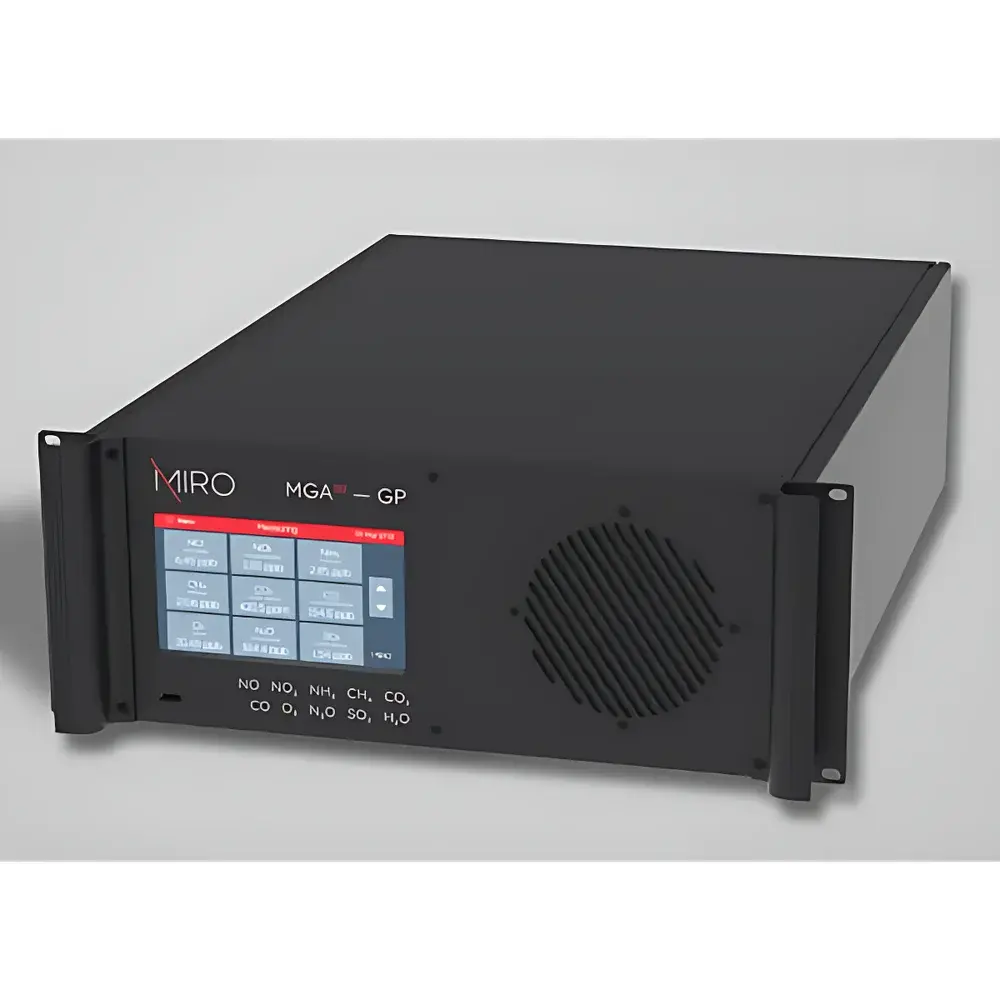
Bruker MGA10-GP Trace-Level Multicomponent Gas Analyzer
| Brand | Bruker |
|---|---|
| Origin | Germany |
| Model | MGA10-GP |
| Measurement Principle | Mid-Infrared Quantum Cascade Laser Absorption Spectroscopy (QCLAS) |
| Simultaneous Target Gases | CH₄, CO, CO₂, SO₂, NH₃, N₂O, NO, NO₂, H₂O, O₃, COS, HCHO, HONO |
| Measurement Frequency | 1 Hz or 10 Hz (user-selectable) |
| Detection Limit | Sub-ppb to low-ppb range for most analytes |
| Interference Resistance | High specificity due to narrow-linewidth QCL emission and spectral fingerprint matching |
| Operating Environments | Laboratory, mobile platforms (aircraft, vehicle, ship), and unattended ground stations |
| Compliance | Designed to support ISO 14064-1/2, EPA Method TO-15 & ASTM D6348, and GLP/GMP-aligned data integrity workflows |
Overview
The Bruker MGA10-GP Trace-Level Multicomponent Gas Analyzer is an advanced, field-deployable instrument engineered for high-fidelity, real-time quantification of up to 13 trace atmospheric gases in ambient air. It operates on the physical principle of mid-infrared quantum cascade laser absorption spectroscopy (QCLAS), leveraging tunable, narrow-linewidth quantum cascade lasers to probe fundamental vibrational-rotational absorption lines of target molecules in the 3–12 µm spectral region. Unlike filter-based or electrochemical sensors, QCLAS delivers inherent molecular specificity, eliminating cross-sensitivity from overlapping spectral features of interferents—critical for accurate NO₂, HCHO, and HONO detection in complex matrices. The analyzer achieves sub-part-per-trillion (sub-ppt) to low-part-per-trillion detection limits for key species such as N₂O and CH₄, and low-part-per-trillion to sub-part-per-billion sensitivity for reactive nitrogen compounds (NO, NO₂, HONO) and sulfur-containing species (SO₂, COS). Its optical path is optimized for stability across temperature gradients (−20 °C to +50 °C), enabling reliable operation without cryogenic cooling or frequent calibration drift correction.
Key Features
- Simultaneous, direct measurement of 13 regulated and climate-relevant gases—including NO₂, HONO, and HCHO—without chemical conversion or pre-concentration.
- User-selectable acquisition rates of 1 Hz or 10 Hz, supporting both long-term monitoring and high-temporal-resolution flux studies (e.g., eddy covariance).
- Integrated touchscreen interface with embedded Linux OS, enabling local configuration, real-time spectral visualization, and diagnostic logging.
- Ruggedized chassis rated IP54, designed for shock/vibration resistance per MIL-STD-810G, suitable for aircraft-mounted, vehicle-integrated, and remote ground station deployments.
- Zero-gas and span-gas validation routines compliant with EPA Performance Specification 17 (PS-17) and ISO 14644-3 protocols for instrument verification.
- Onboard memory (64 GB SSD) and dual Ethernet/RS-485/USB-C interfaces for seamless integration into SCADA, CR1000X, or IRGA networked measurement systems.
Sample Compatibility & Compliance
The MGA10-GP accepts standard 1/4″ OD stainless-steel or PFA sample lines with flow-controlled inlet (0.5–2.0 L/min). It accommodates humid samples up to 95% RH without condensation-induced signal attenuation, thanks to heated optical cell and Nafion™-based moisture management. All gas calibrations are traceable to NIST-certified standards, and measurement uncertainty budgets adhere to ISO/IEC 17025:2017 requirements. The system supports audit-ready data logging with timestamped metadata (pressure, temperature, flow, laser current, cavity alignment status), satisfying FDA 21 CFR Part 11 electronic record requirements when deployed in regulated environmental laboratories. It meets EN 14625:2021 for ambient air quality monitoring of NO₂ and SO₂, and its spectral resolution (<0.001 cm⁻¹) exceeds the minimum criteria defined in ASTM D6348–18 for trace gas analysis.
Software & Data Management
Bruker’s MGA Control Suite provides full instrument control via Windows/Linux desktop clients or web browser (HTTPS). Raw absorbance spectra are stored in HDF5 format with embedded calibration coefficients and line list references (HITRAN2020). Automated peak fitting uses constrained least-squares regression with Voigt line shape modeling and baseline correction via Legendre polynomial decomposition. Export options include CSV (time-series concentration), NetCDF-4 (CF-compliant for atmospheric science), and XML (for integration with ICOS, ACTRIS, or NOAA GML data pipelines). Audit trails log all parameter changes, user logins, and calibration events with SHA-256 hashing—enabling full GLP/GMP traceability.
Applications
- Long-term greenhouse gas monitoring networks (e.g., ICOS, TCCON, NOAA GLOBALVIEW)
- Eddy covariance flux measurements of CH₄, N₂O, and CO₂ over agricultural, wetland, and urban surfaces
- Mobile emissions mapping using vehicle- or drone-mounted configurations
- Indoor air quality assessment in controlled-environment facilities (cleanrooms, bioreactors)
- Validation of satellite-based retrievals (TROPOMI, OCO-3) through ground-truth campaigns
- Regulatory compliance testing for industrial stack emissions (SO₂, NOₓ, NH₃) under EU IED and US NSPS Subpart Ja
FAQ
Does the MGA10-GP require external calibration gases during routine operation?
No—it incorporates automated zero/span validation cycles using internal permeation tubes or external gas standards; daily zero checks are sufficient for most ambient monitoring applications.
Can it measure NO₂ without converting it to NO first?
Yes—direct, interference-free NO₂ quantification is enabled by targeting its unique ν₃ asymmetric stretch band near 6.2 µm, eliminating reliance on chemiluminescence or photolytic conversion methods.
Is the system compatible with existing eddy covariance data loggers?
Yes—native support for Campbell Scientific’s PakBus protocol and analog voltage outputs (0–10 VDC) ensure plug-and-play integration with CR6, CR1000X, and LI-COR EC systems.
What is the typical warm-up time before stable operation?
Less than 15 minutes from cold start; thermal stabilization algorithms maintain optical alignment within ±0.5 µrad over ambient temperature excursions.
How is data security ensured during remote operation?
All remote sessions use TLS 1.2+ encryption; firmware updates are cryptographically signed and verified prior to installation; local storage employs AES-256 full-disk encryption.
Related Products







