
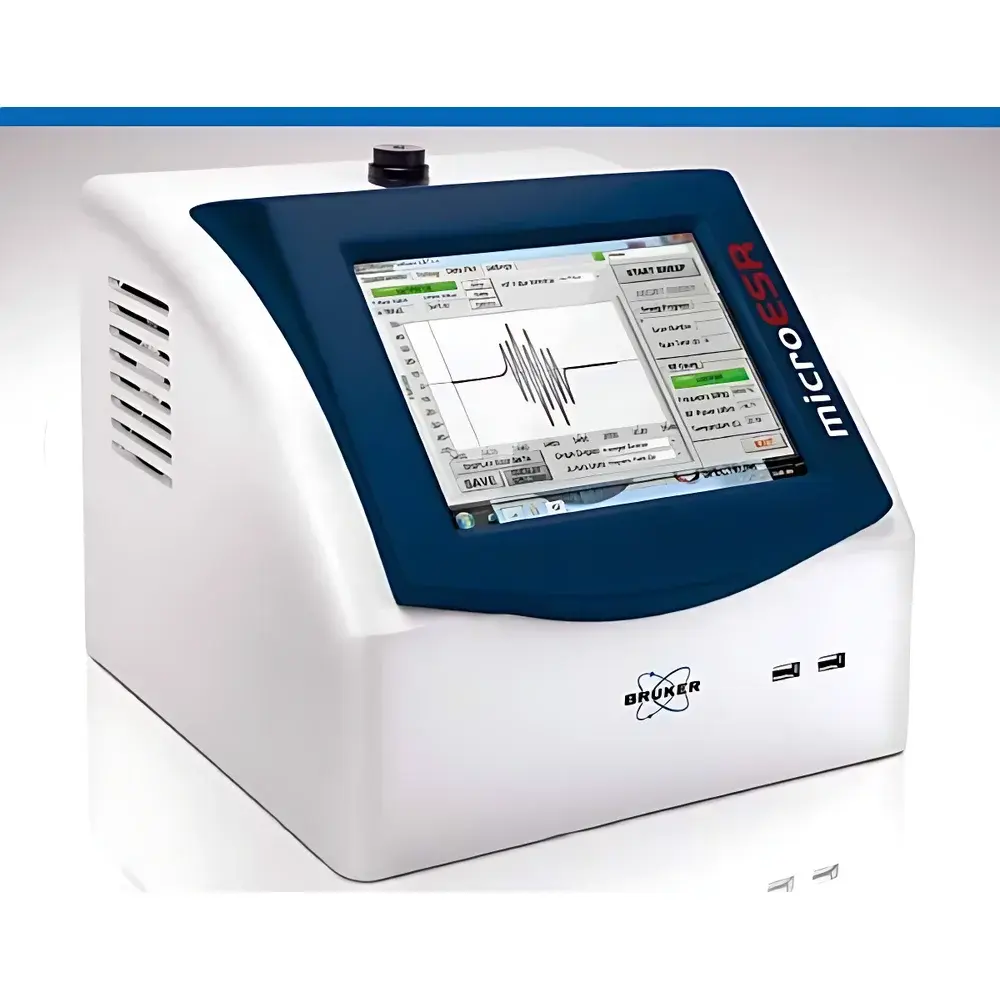
Bruker microESR Portable Electron Spin Resonance Spectrometer
| Brand | Bruker |
|---|---|
| Origin | Germany |
| Model | microESR |
| Instrument Type | Pulsed ESR |
| Magnet System | Permanent Rare-Earth Magnet with Low-Power Electromagnetic Core |
| Resonator | High-Q Cylindrical TE₀₁₁ Cavity |
| Microwave Frequency | X-band (~9.5 GHz) |
| Sensitivity | <1 × 10⁹ spins/Gauss (for DPPH, 1 s acquisition) |
| Dimensions | 32 × 24 × 18 cm |
| Weight | 8.5 kg |
| Power Consumption | <30 W |
| Operating Temperature | 15–30 °C |
| Compliance | CE, RoHS, IEC 61010-1 |
Overview
The Bruker microESR Portable Electron Spin Resonance Spectrometer is a compact, benchtop-grade pulsed ESR (Electron Spin Resonance) instrument engineered for quantitative detection and characterization of paramagnetic species—including free radicals, transition metal ions, and defect centers—in research, quality control, and field-deployable applications. Unlike conventional continuous-wave (CW) ESR spectrometers that rely on large water-cooled electromagnets (>200 kg, multi-kW operation), the microESR employs a precisely stabilized permanent rare-earth magnet combined with a low-power electromagnetic core for fine field modulation and sweep control. This architecture enables true portability without compromising fundamental spectroscopic performance. The system operates at X-band microwave frequency (~9.5 GHz) and utilizes a high-quality-factor (Q > 3,000) cylindrical TE₀₁₁ resonant cavity, delivering enhanced filling factor and signal-to-noise ratio—critical for trace-level radical detection in small-volume or heterogeneous samples. Its design reflects a paradigm shift in magnetic resonance instrumentation: from centralized, facility-bound systems to modular, lab-agnostic platforms compatible with ISO/IEC 17025 workflows and GLP-compliant environments.
Key Features
- True portable form factor: 8.5 kg mass, 32 × 24 × 18 cm footprint, and <30 W power draw enable operation in fume hoods, cleanrooms, gloveboxes, or remote field labs.
- Pulsed ESR capability with built-in arbitrary waveform generator (AWG) supporting standard pulse sequences (e.g., Hahn echo, inversion recovery, HYSCORE) for T₂, T₁, and hyperfine coupling analysis.
- Integrated digital microwave bridge using RF CMOS ICs—derived from modern wireless communication architectures—ensuring phase stability, amplitude linearity, and minimal thermal drift.
- Automated cavity tuning and matching via motorized plunger; real-time Q-factor monitoring ensures optimal microwave coupling across sample types.
- Modular software architecture supporting both guided workflows for routine QC and scriptable mode (Python API) for advanced pulse sequence development.
- Compliance-ready firmware with audit trail, electronic signatures, and configurable user roles aligned with FDA 21 CFR Part 11 and EU Annex 11 requirements.
Sample Compatibility & Compliance
The microESR accommodates standard 4 mm OD quartz ESR tubes (up to 100 µL volume), flat cells for thin films or catalytic surfaces, and custom holders for solid powders, polymers, or biological tissues. Its high filling factor improves sensitivity for low-concentration radicals (e.g., ROS in pharmaceutical stability studies or radiation-induced defects in semiconductors). All hardware and firmware comply with IEC 61010-1 (safety), CE marking directives, and RoHS 2011/65/EU. Data integrity protocols meet ISO/IEC 17025:2017 clause 7.5 (technical records) and support full traceability from raw FID to processed spectrum—including timestamped metadata, instrument configuration logs, and environmental sensor readings (temperature, humidity).
Software & Data Management
Bruker’s proprietary Xenos software provides unified control, acquisition, and processing for both CW and pulsed ESR experiments. It includes baseline correction, spectral simulation (using EasySpin-compatible spin Hamiltonian models), kinetic deconvolution tools, and batch processing for multi-sample stability assays. Raw data are stored in vendor-neutral HDF5 format with embedded metadata compliant with ISA-Tab standards. Integration with LIMS via RESTful API allows automated report generation and audit-ready export (PDF/A-2, CSV, MGF). All processing steps are logged with immutable timestamps and operator ID, satisfying GxP documentation requirements for regulated laboratories.
Applications
- Pharmaceutical R&D: Quantification of radical intermediates in photostability testing (ICH Q1B), oxidative degradation pathways, and excipient compatibility screening.
- Materials science: Characterization of point defects in SiC, GaN, and perovskite solar cell layers; doping profile analysis in graphene and carbon nanotubes.
- Food & agriculture: Detection of irradiated spices (cellulose radical signatures), lipid oxidation kinetics in edible oils, and pesticide residue identification via spin-trapping adducts.
- Environmental monitoring: In situ measurement of reactive oxygen species (ROS) in atmospheric particulate matter and soil redox-active iron/manganese complexes.
- Academic teaching: Hands-on ESR instruction with real-time parameter visualization—ideal for undergraduate physics, chemistry, and biophysics curricula.
FAQ
Is the microESR suitable for quantitative ESR analysis?
Yes. It delivers calibrated spin counting accuracy within ±15% (vs. standard DPPH reference) under ISO 13877:2013 guidelines when used with certified calibration samples and validated acquisition protocols.
Can it perform time-resolved ESR measurements?
Yes. With its integrated AWG and sub-microsecond timing resolution, it supports transient ESR experiments including light-induced radical pair formation and photochemical kinetics (down to 100 ns time resolution).
Does it require liquid nitrogen or external cryogenics?
No. The system operates at ambient temperature. Optional air-cooled variable-temperature accessory (-20 °C to +100 °C) is available for thermal activation studies.
How is data security and regulatory compliance ensured?
Firmware implements role-based access control, encrypted local storage, automatic backup to network drives, and full 21 CFR Part 11 audit trail generation—including all parameter changes, acquisition events, and manual annotations.
What training and support options are available?
Bruker offers on-site installation qualification (IQ), operational qualification (OQ), and user training aligned with ASTM E2879-22 practice for ESR instrument validation. Remote diagnostics and annual preventive maintenance contracts are globally supported.
Related Products





