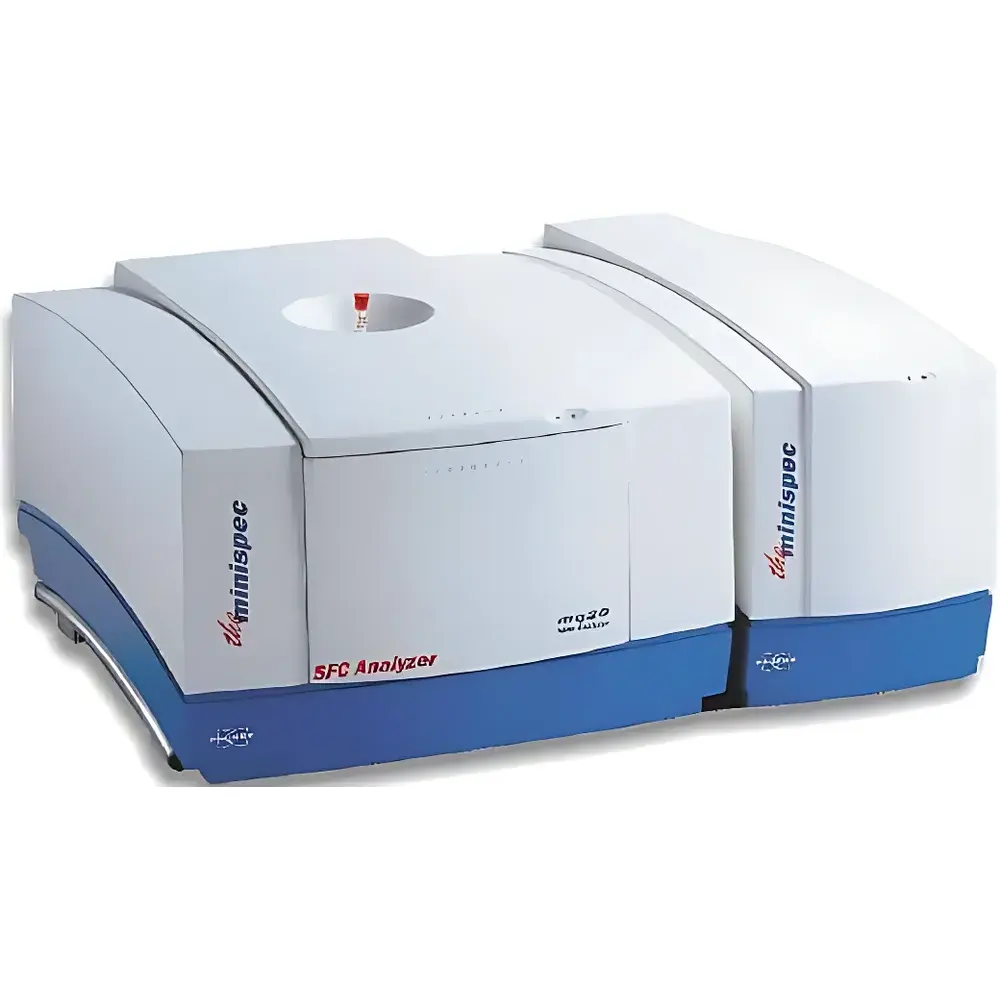
Bruker minispec LF50/LF90 Time-Domain Nuclear Magnetic Resonance (TD-NMR) Analyzer for In Vivo Body Composition Analysis in Rodents
| Brand | Bruker |
|---|---|
| Origin | France |
| Model | minispec LF50 / LF90 |
| Application | In vivo quantitative analysis of fat mass, lean body mass, and free fluid in live mice and rats |
| Measurement Principle | Pulsed low-field TD-NMR (1H) at 0.047 T (2 MHz) |
| Sample Orientation | Vertical or horizontal magnet configuration |
| Analysis Time | ≤ 120 s per animal |
| Animal Safety | Non-invasive, no ionizing radiation, no anesthesia required |
| Regulatory Context | Compliant with GLP-aligned data integrity requirements |
Overview
The Bruker minispec LF50 and LF90 are benchtop time-domain nuclear magnetic resonance (TD-NMR) analyzers engineered specifically for non-invasive, quantitative assessment of whole-body composition in live rodents. Operating at a static magnetic field strength of 0.047 Tesla (corresponding to a 1H Larmor frequency of 2 MHz), these instruments exploit the intrinsic differences in transverse (T2) and longitudinal (T1) relaxation times between adipose tissue, lean tissue, and free fluid compartments. Unlike destructive gravimetric methods or ionizing techniques such as DEXA, TD-NMR detects signal contributions from all mobile hydrogen protons—primarily those in triglycerides (fat), intracellular/extracellular water (lean mass), and unbound extracellular fluid—without perturbing physiological homeostasis. The system delivers absolute mass fractions (g) of fat, lean, and free fluid based on calibrated, multi-exponential T2 decay analysis, validated against chemical carcass analysis across multiple strain and diet models.
Key Features
- Two dedicated configurations: LF50 optimized for mice up to 85 g; LF90 extended-range system for mice, rats, and excised tissue samples
- Permanent NdFeB magnet architecture—zero cryogen consumption, no helium or liquid nitrogen required
- Modular RF probe design supporting both vertical and horizontal sample positioning to accommodate diverse caging and handling workflows
- Automated animal positioning via integrated laser-guided alignment and motorized lift stage (LF90)
- Temperature-stabilized magnet housing ensuring ±0.01 °C thermal control during sequential measurements
- Real-time signal-to-noise optimization via adaptive pulse sequence selection (CPMG, IR-CPMG, STIR variants)
- Compliance-ready firmware with configurable user roles, electronic signatures, and full audit trail logging
Sample Compatibility & Compliance
The minispec LF50/LF90 accommodates unrestrained, conscious rodents in standard ventilated cages or custom restraint tubes—no sedation, fasting, or surgical preparation is necessary. Each measurement preserves animal viability and permits longitudinal monitoring at intervals as short as 24 hours. Data output meets traceability requirements for preclinical metabolic studies under OECD GLP principles. Instrument validation protocols align with ISO/IEC 17025:2017 for testing laboratories, and software modules support FDA 21 CFR Part 11 compliance when deployed with Bruker’s minispec Software Suite v3.x—including secure login, change-controlled method templates, and immutable raw FID storage.
Software & Data Management
Acquisition and quantification are performed using Bruker’s proprietary minispec Software Suite, which implements standardized calibration curves derived from >10,000 reference carcass analyses. The software applies constrained non-linear least-squares fitting to multi-component T2 decay spectra, assigning signal amplitudes to three physiologically distinct pools: short-T2 (adipose lipid protons), intermediate-T2 (bound water in lean tissue), and long-T2 (free fluid). All raw free induction decay (FID) data, processed spectra, and metadata are stored in vendor-neutral HDF5 format. Batch processing, group statistics, ANOVA-ready export (CSV, Excel), and integration with third-party platforms (e.g., GraphPad Prism, MATLAB) are fully supported.
Applications
- Preclinical evaluation of anti-obesity therapeutics and insulin sensitizers in diet-induced obese (DIO) and genetically modified mouse models (e.g., ob/ob, db/db)
- Longitudinal monitoring of lean–fat partitioning during aging, caloric restriction, or exercise intervention studies
- Validation of imaging biomarkers against gold-standard NMR-derived composition metrics
- Metabolic phenotyping in high-throughput screening of transgenic colonies
- Supporting regulatory submissions where precise, repeatable body composition endpoints are required (e.g., ICH S5(R3), FDA Guidance on Diabetes Drug Development)
- Quality control of breeding colonies by detecting subtle shifts in baseline adiposity
FAQ
How does TD-NMR differ from DEXA for rodent body composition analysis?
TD-NMR directly quantifies hydrogen-bearing molecular environments based on relaxation physics, providing superior discrimination between lean mass and free fluid—whereas DEXA estimates soft-tissue composition indirectly via X-ray attenuation, with known overestimation of lean mass in hydrated or edematous animals.
Can the system be used for longitudinal studies without affecting animal welfare?
Yes. The absence of ionizing radiation, anesthesia, or physical restraint enables repeated measurements throughout an animal’s life cycle, with documented reproducibility CVs < 2.1% for fat mass across 10 consecutive scans.
Is calibration required between species or strains?
No species-specific recalibration is needed. The instrument uses a universal calibration model trained on chemically analyzed tissues from C57BL/6, BALB/c, Sprague-Dawley, and Wistar strains, with cross-validation R² > 0.995 for fat and lean mass prediction.
What maintenance is required for the permanent magnet system?
Zero consumables or cryogens. Annual verification of field homogeneity (< 10 ppm over 30 mm DSV) and RF coil Q-factor is recommended using Bruker’s certified service protocol.
Does the system comply with FDA 21 CFR Part 11 for regulated studies?
When configured with minispec Software Suite v3.x and validated system access controls, full electronic record and signature functionality—including audit trail generation, user authentication, and data integrity checks—is available per Part 11 Annex A requirements.