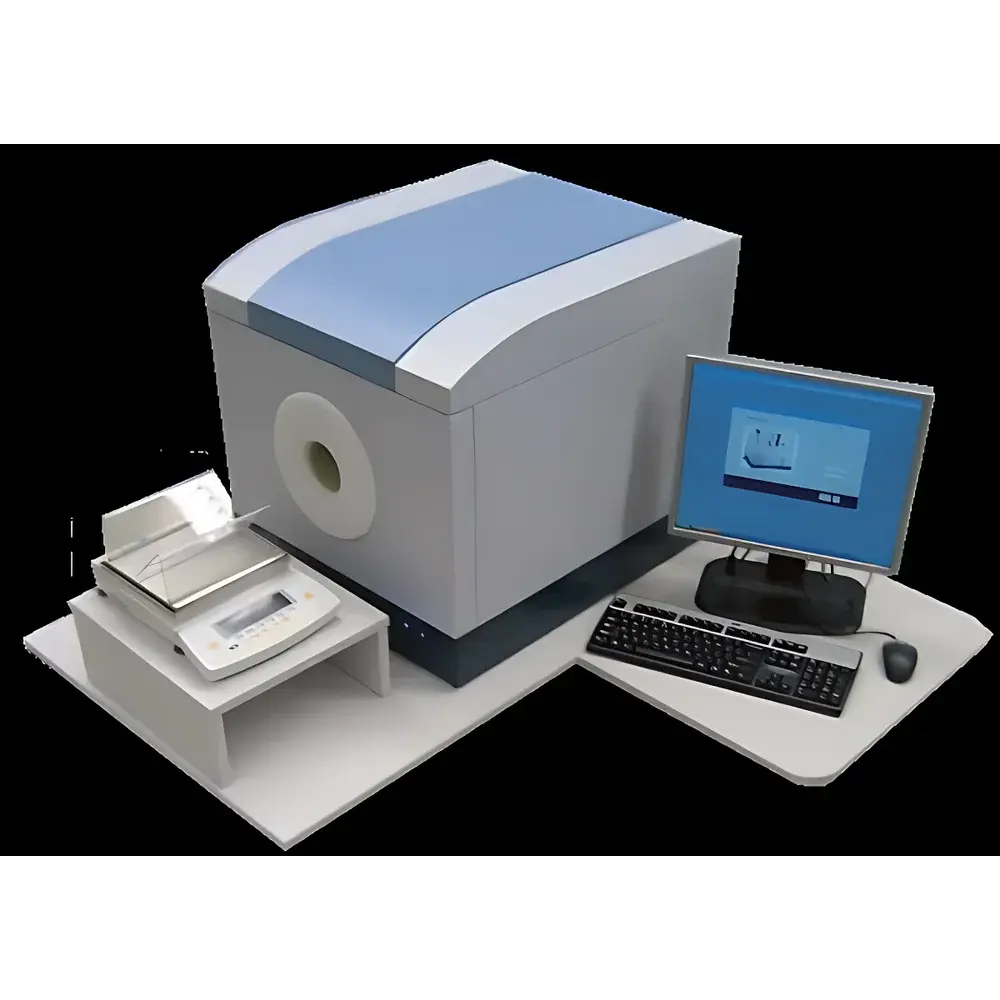
Bruker minispec LF90II Time-Domain NMR Body Composition Analyzer for Live Rodents
| Brand | Bruker |
|---|---|
| Origin | France |
| Model | minispec LF90II |
| Instrument Type | In Vivo Rodent (Mouse/Rat) Body Composition Analyzer |
| Operating Frequency | 6.2 MHz |
| Measurement Time | < 120 s per animal |
| Sample Handling | Non-invasive, anesthesia-free, restraint-only in dedicated cylindrical holder |
| Compliance | Designed for GLP-compliant preclinical research environments |
Overview
The Bruker minispec LF90II is a benchtop time-domain nuclear magnetic resonance (TD-NMR) analyzer engineered for rapid, non-invasive, and quantitative assessment of whole-body composition in live rodents—primarily mice and rats—without requiring euthanasia, anesthesia, or tissue extraction. Unlike destructive methods (e.g., chemical extraction, dual-energy X-ray absorptiometry with radiation exposure), the LF90II leverages the intrinsic magnetic properties of hydrogen nuclei (1H) in water and lipid protons to differentiate fat mass, lean body mass (predominantly muscle and organ tissue), and free fluid compartments based on their distinct transverse relaxation times (T2). The system operates at a fixed Larmor frequency of 6.2 MHz, optimized to balance signal-to-noise ratio, penetration depth, and safety for repeated in vivo measurements. Its compact footprint and integrated workflow enable deployment directly within animal housing facilities or core phenotyping labs, supporting longitudinal studies with high temporal resolution and minimal physiological perturbation.
Key Features
- Non-destructive, anesthesia-free analysis: Animals remain conscious and physiologically intact before, during, and after measurement—critical for chronic metabolic, pharmacological, or genetic intervention studies.
- Sub-2-minute acquisition per subject: Enables high-throughput screening of cohorts (e.g., >30 mice/day) without compromising data integrity or animal welfare.
- No consumables or reagents required: Eliminates recurring operational costs and inter-batch variability associated with enzymatic assays or extraction solvents.
- Benchtop mobility: Integrated chassis with casters allows relocation between vivarium rooms, imaging suites, or metabolic cages without recalibration or infrastructure modification.
- Self-contained electronics and gradient assembly: No external cryogens, RF shielding rooms, or dedicated power conditioning—operates on standard 110/220 V AC supply.
- Standardized rodent positioning: Precision-machined cylindrical holders ensure reproducible animal orientation and coil coupling, minimizing operator-dependent variance.
Sample Compatibility & Compliance
The LF90II is validated for use with live C57BL/6, BALB/c, CD-1, and other common inbred/outbred mouse strains, as well as Sprague-Dawley and Wistar rats (body weight range: 15–500 g). Tissue-level validation includes excised adipose depots, skeletal muscle biopsies, and liver homogenates. All protocols adhere to OECD Test Guidelines 407 (Repeated Dose 28-Day Oral Toxicity) and NIH Guide for the Care and Use of Laboratory Animals standards. Data output supports audit trails compliant with 21 CFR Part 11 when paired with Bruker’s optional LabSolutions software module, enabling electronic signatures, user access controls, and immutable raw FID storage—essential for regulatory submissions and GLP-certified contract research organizations (CROs).
Software & Data Management
Controlled via Bruker’s proprietary minispec Analysis Suite (v5.x), the system provides automated calibration, pulse sequence selection (CPMG, inversion recovery), baseline correction, and multi-component T2 decay fitting using constrained non-linear least-squares algorithms. Quantitative outputs include absolute fat mass (g), lean mass (g), free fluid volume (mL), and derived ratios (e.g., fat/lean ratio, % body fat). Raw time-domain signals (FIDs) and processed spectra are stored in Bruker’s proprietary format (.DSC/.JDX) and exportable to CSV, MATLAB (.mat), or HDF5 for integration into institutional data lakes or statistical platforms (R, Python, SAS). Audit logs record operator ID, timestamp, instrument configuration, and calibration status per measurement—fully traceable for IACUC review or FDA inspection.
Applications
- Preclinical obesity and diabetes research: Monitoring dynamic changes in adiposity and lean mass during dietary interventions or anti-obesity drug trials.
- Metabolic phenotyping of genetically modified models: Rapid stratification of knockouts/knock-ins (e.g., leptin-deficient ob/ob, PPARγ mutants) prior to terminal endpoints.
- Oncology cachexia studies: Tracking progressive lean mass loss independent of tumor volume metrics.
- Aging and sarcopenia models: Longitudinal quantification of age-related muscle atrophy with weekly or biweekly repeatability (CV < 2.1% for fat mass in stable cohorts).
- Toxicology and safety pharmacology: Detecting early-onset hepatomegaly or edema via fluid compartment shifts before histopathological manifestation.
- Validation of alternative imaging modalities: Cross-calibration against micro-CT or MRI-derived body composition metrics under controlled conditions.
FAQ
Does the LF90II require animal sedation or anesthesia?
No. The system uses mild physical restraint only; animals are fully conscious and exhibit normal respiratory and cardiac activity throughout measurement.
Can the same animal be scanned repeatedly over time?
Yes—up to daily scanning is supported with no observed thermal, acoustic, or physiological stress effects, as confirmed by corticosterone assays and behavioral monitoring.
How does TD-NMR compare to DEXA for rodent body composition?
Unlike DEXA, TD-NMR does not involve ionizing radiation and provides superior soft-tissue differentiation (e.g., distinguishing intramuscular fat from subcutaneous fat) without bone mineral density interference.
Is method validation documentation available?
Bruker provides IQ/OQ/PQ protocols, ASTM E2970-14-aligned precision studies, and ISO/IEC 17025-compliant uncertainty budgets upon request for regulatory submissions.
What maintenance is required?
Annual calibration verification and magnet shimming; no routine cryogen refills, vacuum pump servicing, or RF coil replacement—typical mean time between failures exceeds 15,000 operating hours.