
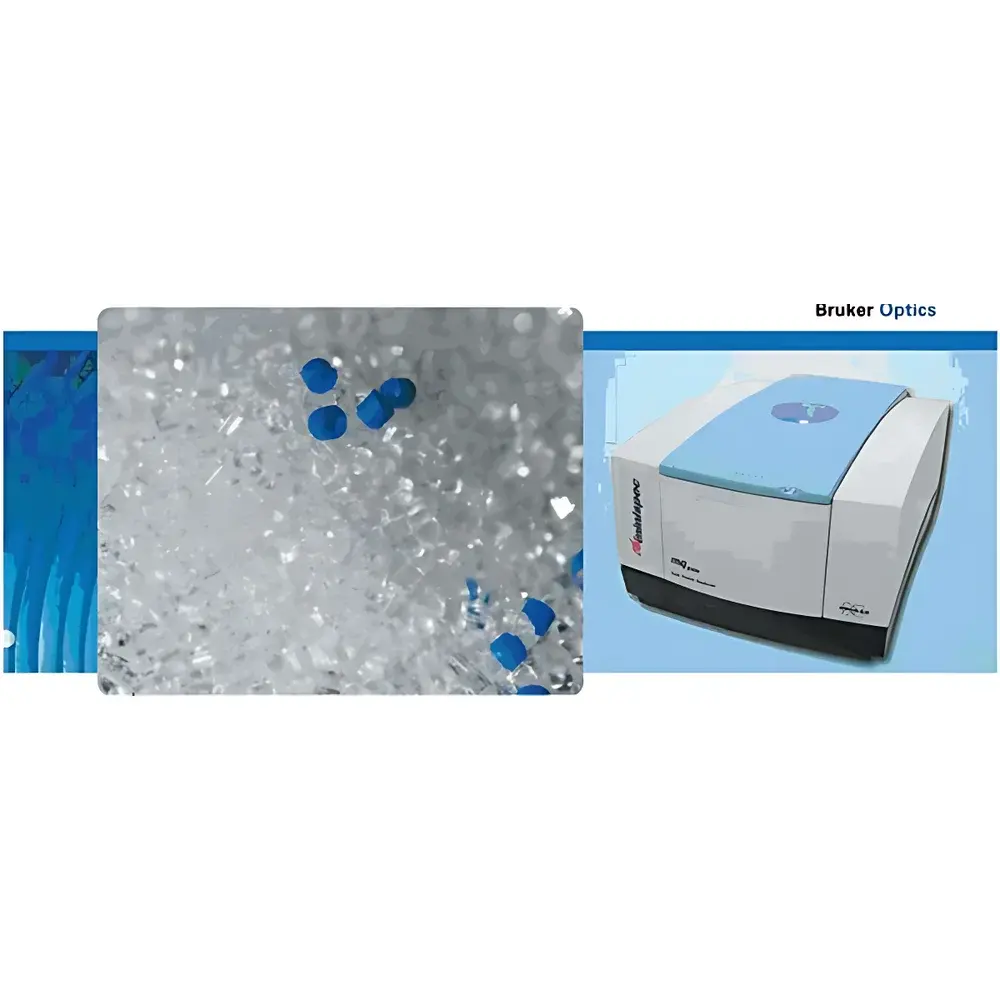
Bruker minispec mq-Series Polymer Analyzer (Compact NMR)
| Brand | Bruker |
|---|---|
| Origin | Germany |
| Manufacturer Type | Authorized Distributor (China Region) |
| Product Category | Imported Instrument |
| Model | minispec mq-Series Polymer Analyzer |
| Pricing | Upon Request |
| Temperature Control Options | Fixed (35–45 °C), Variable (–5 to 65 °C via water bath/heater), Extended Range (–100 to 200 °C via gas-flow system) |
| Pulse Configurations | T₁, T₂, diffusion-weighted (PGSE), gradient-enabled |
| Sample Forms | Liquids, powders, films, tablets, bulk solids |
| Analysis Principle | Time-domain nuclear magnetic resonance (TD-NMR) |
Overview
The Bruker minispec mq-Series Polymer Analyzer is a benchtop time-domain nuclear magnetic resonance (TD-NMR) instrument engineered for quantitative and qualitative characterization of polymeric materials in textile, polymer manufacturing, and R&D laboratories. Unlike conventional high-field NMR spectrometers, this compact system operates at low magnetic field strengths (e.g., 0.47 T for mq20, corresponding to 20 MHz ¹H Larmor frequency), enabling robust, maintenance-free operation with minimal infrastructure requirements. It measures spin–lattice (T₁) and spin–spin (T₂) relaxation times, free induction decay (FID) signals, and diffusion coefficients—parameters directly correlated with molecular mobility, crosslink density, crystallinity, phase separation, and solvent content in fibers, spun yarns, nonwovens, and finished textiles. Its core application domain includes quality assurance of synthetic fibers (e.g., PET, nylon, acrylic), moisture uptake studies in natural and blended fabrics, and real-time monitoring of polymer curing or aging processes—all without sample destruction or chemical reagents.
Key Features
- Non-invasive, non-destructive analysis: preserves sample integrity for repeat measurements or downstream testing.
- Multi-form compatibility: accommodates liquids, granules, pressed pellets, thin films (≥0.5 mm), and irregular solid specimens up to 18 mm OD without homogenization or dissolution.
- Flexible temperature control architecture: fixed-temperature mode (35–45 °C) for routine QA; variable-temperature probe (–5 to 65 °C) for thermal transition profiling; extended-range gas-flow system (–100 to 200 °C) for glass transition (Tg) mapping and high-temperature degradation kinetics.
- Configurable pulse sequences: standard inversion-recovery (T₁), CPMG (T₂), stimulated echo (T₁ρ), and pulsed gradient spin-echo (PGSE) for diffusion coefficient determination—enabling structure–dynamics correlation in heterogeneous polymer systems.
- Low calibration burden: requires only 3–5 reference samples per parameter; supports both classical univariate calibration and multivariate PLS regression models for complex matrices.
- Automated workflow execution: method-driven acquisition, real-time signal processing (curve fitting of exponential decays), and auto-report generation compliant with internal SOPs.
Sample Compatibility & Compliance
The minispec mq-Series accepts samples irrespective of optical properties—color, opacity, or geometric asymmetry do not interfere with signal acquisition. This eliminates preprocessing steps required by FTIR or UV-Vis methods. In textile QC labs, it routinely quantifies oil content on polyester filament yarns (ASTM D2257), moisture regain in cotton blends (ISO 6741-1), and plasticizer migration in PVC-coated fabrics. The system supports audit-ready data handling per GLP and GMP frameworks: electronic signatures, user access levels, full audit trail (including parameter changes and manual interventions), and raw FID export for independent validation. Software complies with FDA 21 CFR Part 11 requirements when deployed with enabled security modules.
Software & Data Management
The minispec software suite (version 3.x or later) provides a multilingual GUI—including English, German, Chinese, and Japanese—with context-sensitive help and customizable report templates. All spectral processing—including mono-/bi-exponential T₂ fitting, diffusion coefficient calculation via Stejskal–Tanner equation, and peak deconvolution of multi-phase decay components—is performed within the native environment. Raw time-domain data (FID) and processed parameters are stored in vendor-neutral ASCII formats (.txt, .csv) alongside metadata (pulse sequence, temperature, coil tuning status). Integration with LIMS is supported via OPC UA or direct database connectors (ODBC/JDBC), facilitating automated result transfer into enterprise QA databases.
Applications
- Quantification of residual monomer and solvent in acrylic fiber production batches.
- Determination of crosslink density in vulcanized rubber textiles using T₂ distribution analysis.
- Monitoring hydration dynamics in smart hydrogel-based fabrics during cyclic swelling/deswelling.
- Discrimination of polymer blend ratios (e.g., PLA/PBAT) in biodegradable nonwovens via T₁–T₂ correlation maps.
- Assessment of thermal history effects on polypropylene melt-blown web morphology through relaxation time shifts.
- Validation of coating uniformity on technical textiles via spatially resolved surface coil measurements.
FAQ
What sample volume is required for reliable TD-NMR measurement?
Standard 10 mm or 18 mm diameter sample tubes are used; minimum fill height is 20 mm. For solids, mass equivalence to ~0.5–2.0 g is typical depending on density and proton concentration.
Can the system distinguish between amorphous and crystalline phases in semi-crystalline polymers?
Yes—via T₂ distribution analysis: rigid crystalline domains exhibit short T₂ components (<100 µs), while mobile amorphous regions yield longer T₂ values (1–100 ms), enabling semi-quantitative phase fraction estimation.
Is method transfer possible between different mq-Series instruments (e.g., mq20 to mq10)?
Method portability is achievable within the same magnetic field strength class; cross-field transfer requires re-validation due to inherent differences in signal-to-noise ratio and relaxation weighting.
Does the analyzer require liquid cryogens or permanent magnet shimming?
No—permanent magnet design eliminates helium consumption; passive shimming is factory-set and stable over years under normal lab conditions.
How is compliance with ISO/IEC 17025 addressed during instrument qualification?
Bruker provides IQ/OQ documentation packages, including field homogeneity mapping, temperature calibration certificates traceable to NIST standards, and repeatability/reproducibility test protocols aligned with ISO 5725.






