
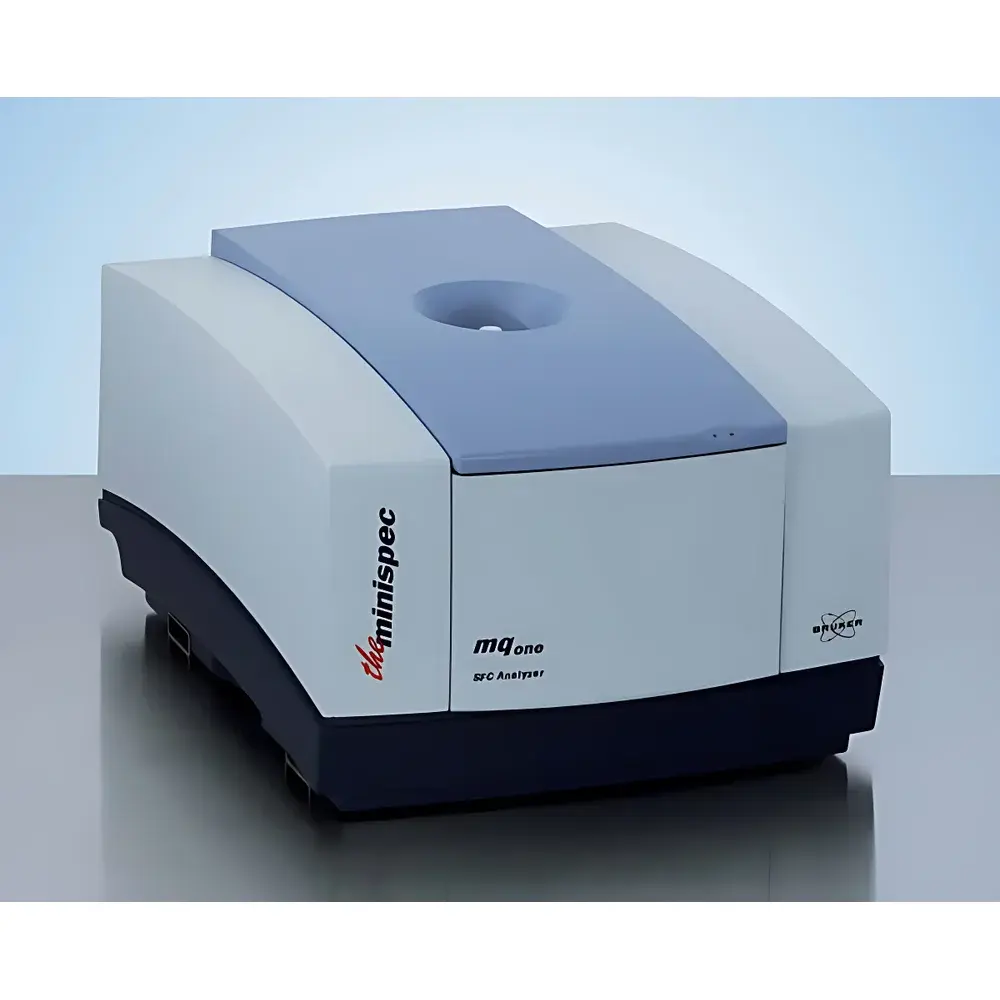
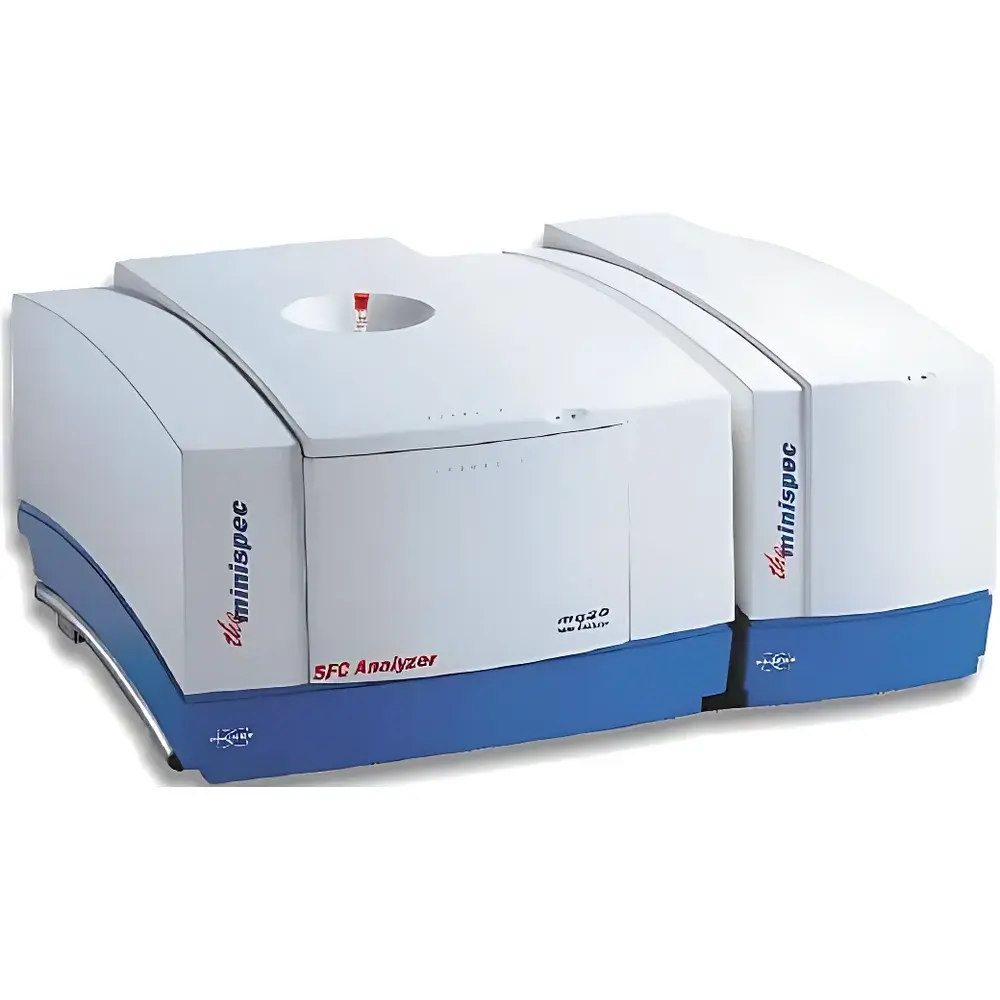
Bruker minispec mq one Solid Fat Content Analyzer
| Brand | Bruker |
|---|---|
| Origin | France |
| Manufacturer Type | Authorized Distributor |
| Origin Category | Imported |
| Model | minispec mq one |
| Pricing | Available Upon Request |
Overview
The Bruker minispec mq one Solid Fat Content (SFC) Analyzer is a benchtop, low-field nuclear magnetic resonance (NMR) instrument engineered for precise, non-destructive quantification of solid fat content in edible oils, shortenings, margarines, cocoa butter, and other lipid-based food products. Based on the fundamental principle of pulsed NMR relaxation time discrimination—specifically the differential transverse relaxation behavior (T2) between solid-phase and liquid-phase triglyceride molecules—the system delivers rapid, reproducible SFC measurements across standardized temperature profiles. Since its introduction in the early 1970s, Bruker’s minispec platform has evolved through six generations to become the global reference standard for routine SFC analysis in QC/QA laboratories, R&D centers, and contract testing facilities serving the fats and oils industry. The mq one represents the latest iteration, validated for compliance with AOCS Official Methods Cd 16b-93 (direct measurement) and Cd 16-81 (indirect measurement), and recognized twice with the R&D 100 Award for technical excellence in analytical instrumentation.
Key Features
- Compact, self-shielded 20 MHz permanent magnet system optimized for high signal-to-noise ratio in routine SFC workflows
- Integrated Peltier-based temperature control unit enabling precise, programmable thermal ramping from –40 °C to +80 °C (±0.1 °C stability)
- Dual-pulse NMR methodology support: direct measurement (simultaneous solid + liquid signal acquisition) and indirect measurement (liquid-signal-only relative to fully melted reference)
- Pre-calibrated, traceable SFC reference standards supplied by Bruker Spectrospin (Rheinstetten, Germany), certified per ISO/IEC 17025-accredited protocols
- Automated three-point calibration routine using certified standards (0%, 50%, 100% SFC) prior to each analytical session
- Robust mechanical design with vibration-damped sample holder and field homogeneity optimization for long-term measurement stability
Sample Compatibility & Compliance
The minispec mq one accepts standard 10 mm or 18 mm glass NMR tubes (depending on configuration), accommodating both bulk and emulsified lipid samples without chemical pretreatment or solvent extraction. Sample preparation follows AOCS Cd 16b-93 guidelines—including defined tempering cycles, equilibration times, and thermal history protocols—to ensure method comparability across laboratories. Instrument validation documentation supports audit readiness for GLP (Good Laboratory Practice) and GMP (Good Manufacturing Practice) environments. Full traceability is maintained via electronic calibration logs, user-accessible audit trails, and secure data storage compliant with FDA 21 CFR Part 11 requirements when configured with appropriate software permissions and network authentication.
Software & Data Management
The system operates under Windows-compatible SFC software (v6.x or later), featuring an intuitive, role-based interface designed specifically for food quality analysts. Core capabilities include: automated instrument self-diagnosis; guided sample registration with customizable metadata fields (batch ID, operator, date/time stamp); real-time statistical processing (mean, SD, CV%, trend charts); GLP-compliant raw data archiving with immutable timestamps; and export-ready reports in PDF, CSV, and XML formats. All calibration events, measurement sequences, and parameter changes are recorded in a tamper-evident audit trail. Remote diagnostics and firmware updates are supported via Ethernet connectivity (RJ-45 port), enabling centralized IT management in multi-instrument lab networks.
Applications
- Quality control of cocoa butter equivalents and substitutes during confectionery manufacturing
- Crystallization behavior profiling of palm oil fractions and interesterified fats
- Stability assessment of margarines and spreads under accelerated storage conditions
- Validation of fat replacers and structured lipids in low-calorie food formulations
- Regulatory compliance testing per AOCS, ISO 8588-1, and national standards (e.g., GB/T 22460–2008, JIS Z 8807)
- Research into polymorphic transitions (β’, β) and nucleation kinetics in triacylglycerol systems
FAQ
What temperature programs are supported for SFC profiling?
The mq one supports both sequential (stepwise tempering) and parallel (direct immersion) thermal protocols as defined in AOCS Cd 16b-93. Users may configure up to 12 temperature points per run, with dwell times ranging from 10 to 120 minutes per step.
Is method transfer possible between older minispec models and the mq one?
Yes—Bruker provides documented equivalence protocols and cross-calibration tools to ensure continuity with legacy minispec II–IV instruments, including pulse sequence mapping and relaxation time normalization tables.
How often must the instrument be recalibrated?
A full three-point calibration using certified standards is required before each daily analytical session. Optional intermediate verification checks can be scheduled at user-defined intervals (e.g., every 4 hours) using a single 50% SFC standard.
Does the system comply with international regulatory data integrity requirements?
When deployed with enabled audit-trail logging, electronic signatures, and secure user access controls, the mq one meets the core technical requirements of FDA 21 CFR Part 11, EU Annex 11, and ISO/IEC 17025 for regulated environments.





