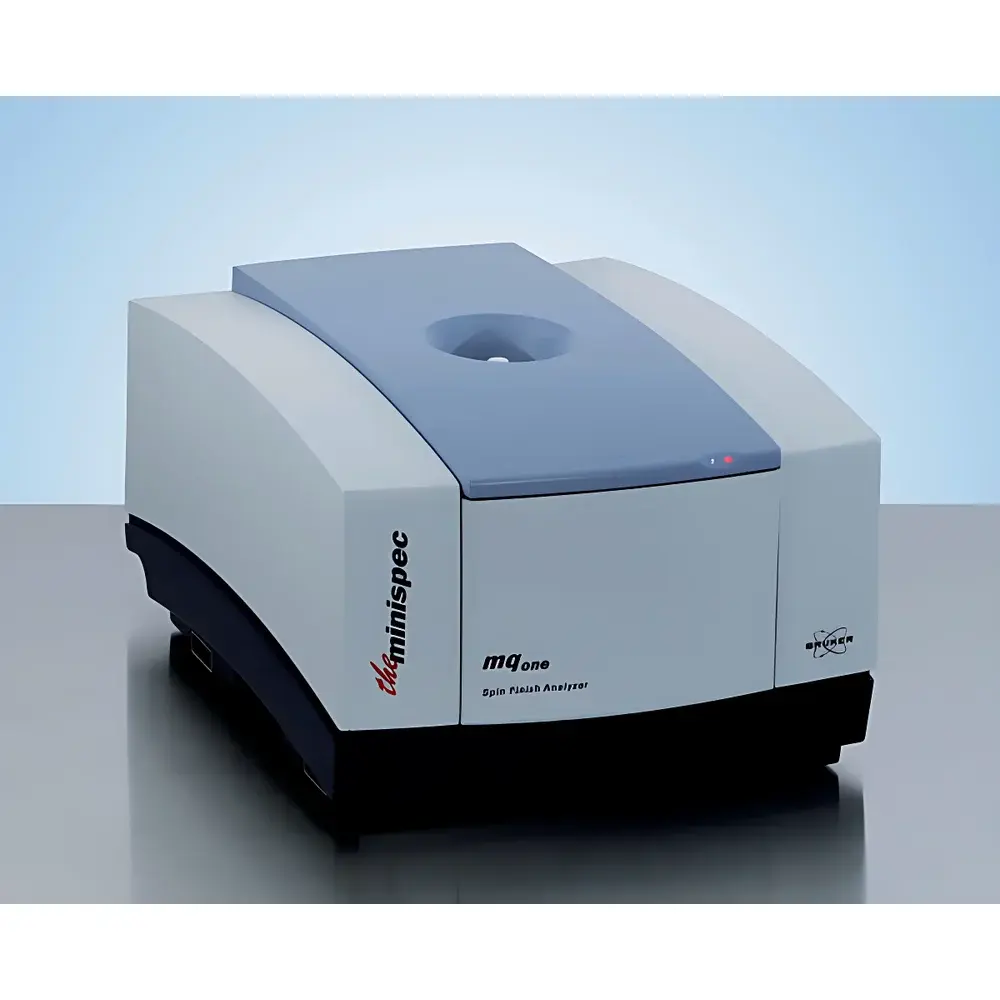
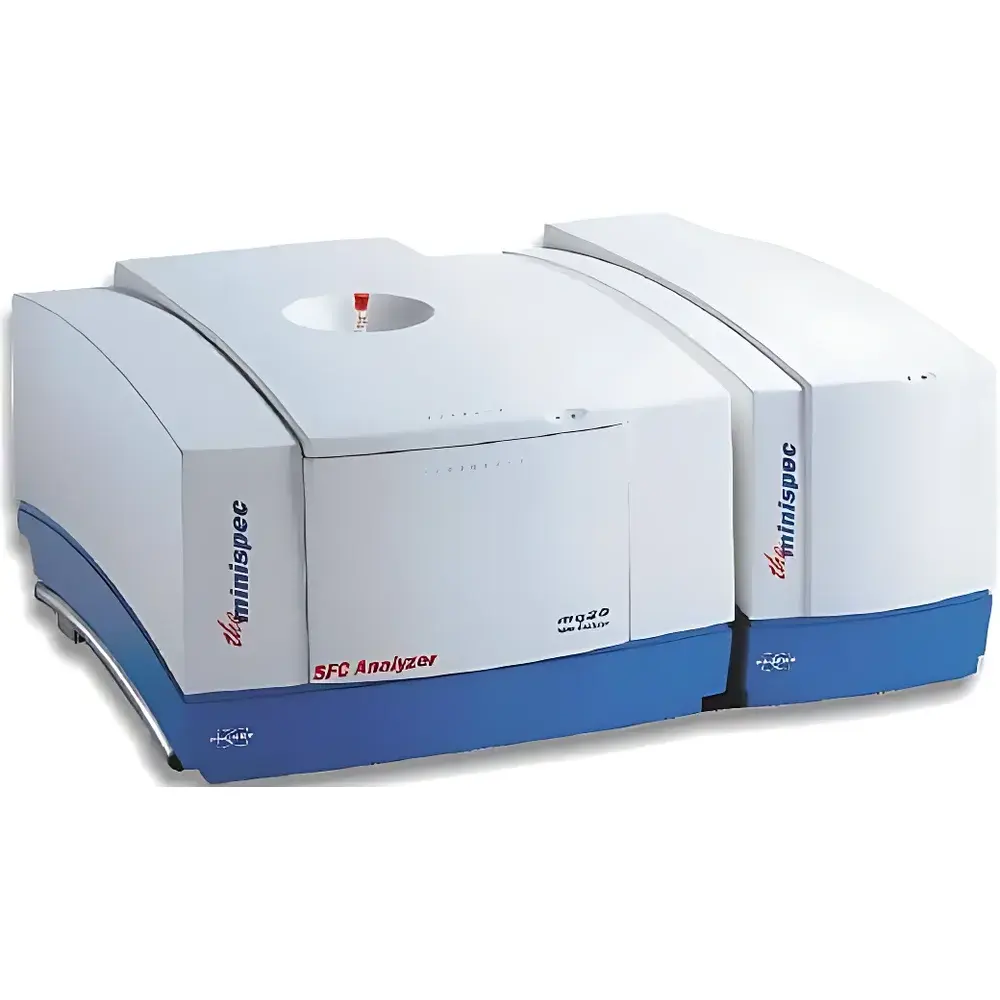
Bruker Minispec mqone Spin Finish Analyzer
| Brand | Bruker |
|---|---|
| Origin | France |
| Manufacturer Type | Authorized Distributor |
| Import Status | Imported |
| Model | Minispec mqone Spin Finish Analyzer |
| Pricing | Available Upon Request |
Overview
The Bruker Minispec mqone Spin Finish Analyzer is a benchtop time-domain nuclear magnetic resonance (TD-NMR) instrument engineered for rapid, non-destructive, and solvent-free quantification of spin finish (oil content) on synthetic fibers and yarns. Unlike conventional wet-chemical methods—such as Soxhlet extraction or gravimetric analysis—which require sample dissolution, solvent handling, and multi-hour processing, the mqone leverages the intrinsic magnetic relaxation properties of hydrogen nuclei (¹H) in oil versus polymer matrix and moisture. In TD-NMR, the transverse relaxation decay (T₂) profile of the sample is acquired following a 90°–180° pulse sequence. Spin finish exhibits a distinct, relatively long T₂ component due to its high molecular mobility, while the solid polymer backbone yields a very short, rapidly decaying signal, and residual moisture displays an intermediate relaxation behavior. By mathematically deconvoluting these overlapping relaxation components—typically via multi-exponential fitting or pre-calibrated partial least squares (PLS) models—the instrument isolates and quantifies the oil fraction with high reproducibility. This principle enables direct measurement of Oil Pick-Up (OPU), Fiber Oil Finish (FOF), and Yarn Oil Finish (FOY) in under 60 seconds per sample, without physical alteration or consumables.
Key Features
- Single-button operation with intuitive touchscreen interface—designed for routine use by production floor personnel without NMR expertise
- Benchtop footprint (W × D × H: 35 × 40 × 25 cm) optimized for near-line deployment in spinning or texturing facilities
- Permanent 0.5 T permanent magnet system—no cryogens, no shimming, minimal maintenance
- Pre-configured calibration libraries for major fiber chemistries: polyester (PET), polyamide (PA6/PA66), polypropylene (PP), polyethylene (PE), and polyacrylonitrile (PAN)
- Robust architecture compliant with industrial environmental conditions (IEC 60529 IP20, operating temperature 15–35 °C, relative humidity ≤70 % non-condensing)
- Integrated thermal stabilization ensures signal stability across ambient fluctuations
Sample Compatibility & Compliance
The mqone accommodates a broad range of textile morphologies: monofilaments, multifilament yarns, staple fibers, and finished fabrics—including nonwovens. Sample presentation is standardized using Bruker-supplied cylindrical sample holders (12 mm ID), ensuring consistent fill factor and RF homogeneity. The method has been validated against ISO 1833-12:2016 (determination of oil content in man-made fibers by solvent extraction) and demonstrates linearity across typical OPU ranges (0.1–3.0 wt%). Method transfer and audit readiness are supported through full compliance with GLP and GMP documentation requirements. Instrument software maintains full electronic records—including raw FID data, processed T₂ spectra, calibration history, and user audit trails—in accordance with FDA 21 CFR Part 11 for regulated environments.
Software & Data Management
Control and analysis are executed via Bruker’s proprietary mqOne software, running on embedded Windows OS. The software provides real-time visualization of T₂ decay curves, automatic baseline correction, and configurable reporting templates (PDF/CSV export). All calibrations are stored as encrypted method files with version control and user-defined metadata (e.g., fiber type, lot number, operator ID). Data integrity safeguards include password-protected access levels (operator, supervisor, administrator), mandatory electronic signatures for critical actions, and tamper-evident audit logs timestamped to UTC. Integration with MES or LIMS systems is achievable via OPC UA or TCP/IP protocols.
Applications
- Real-time process feedback during melt-spinning, draw-texturing, and false-twist texturing lines
- Quality gate verification prior to winding, baling, or shipment
- Root-cause analysis of downstream weaving/knitting defects linked to insufficient or excessive oil application
- Development and validation of new spin finish formulations across fiber families
- Stability monitoring of oil emulsions in recirculating applicator baths
- Supporting sustainability initiatives by eliminating chlorinated solvents and reducing lab waste generation
FAQ
Is sample preparation required before measurement?
No—fibers or yarns are placed directly into the standard 12 mm sample tube; no drying, cutting, or weighing is necessary. Bulk density variations are compensated via built-in normalization routines.
Can the instrument distinguish between different types of spin finish oils?
Not inherently—TD-NMR quantifies total mobile hydrogen-bearing oil mass. However, when paired with reference standards of known composition, it reliably tracks batch-to-batch consistency of a given formulation.
What maintenance is required?
Annual performance verification (field homogeneity, signal-to-noise ratio, T₂ accuracy) is recommended. No magnet servicing or RF coil replacement is needed under normal operation.
Does the analyzer comply with textile industry testing standards?
Yes—method equivalence to ISO 1833-12 has been demonstrated in multiple third-party interlaboratory studies; full validation reports are available upon request.
Can the system be integrated into an automated production line?
Yes—via digital I/O triggers and Ethernet-based remote command protocol (SCPI), enabling synchronization with conveyor-based auto-loading modules or PLC-controlled sampling stations.