
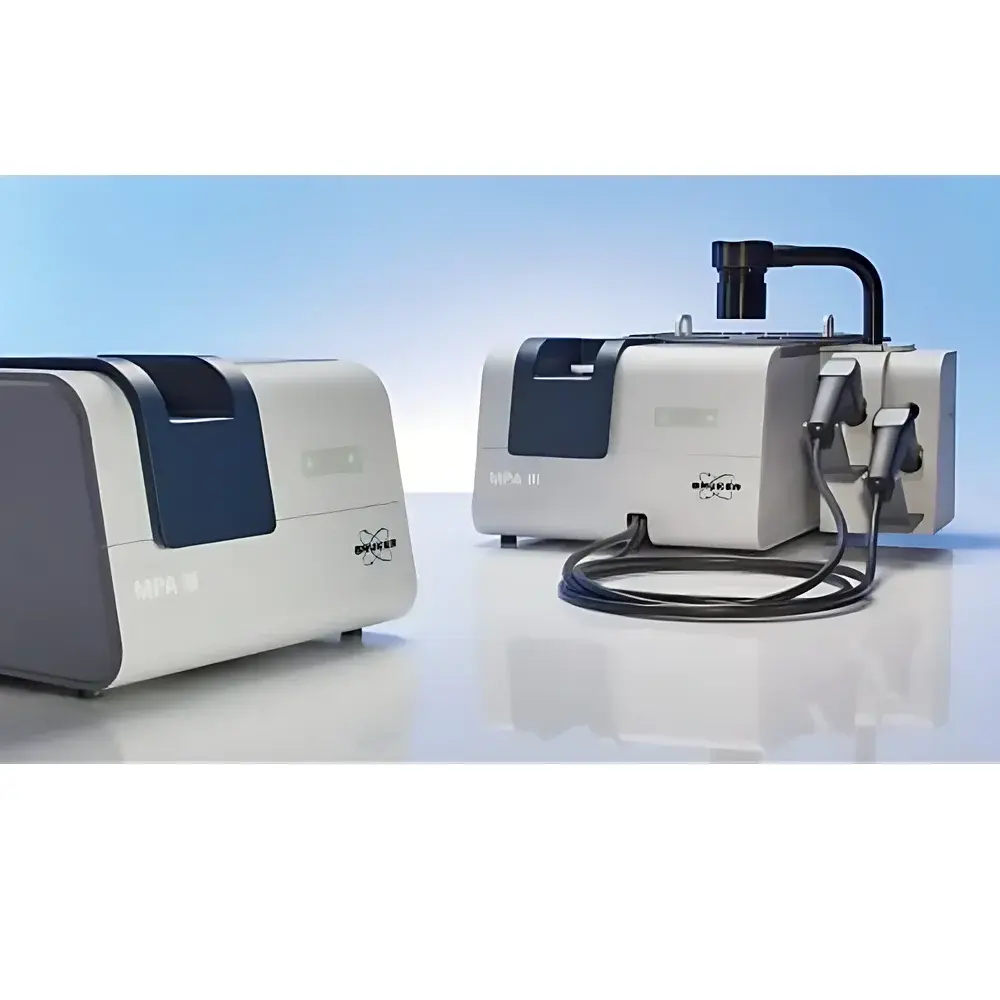
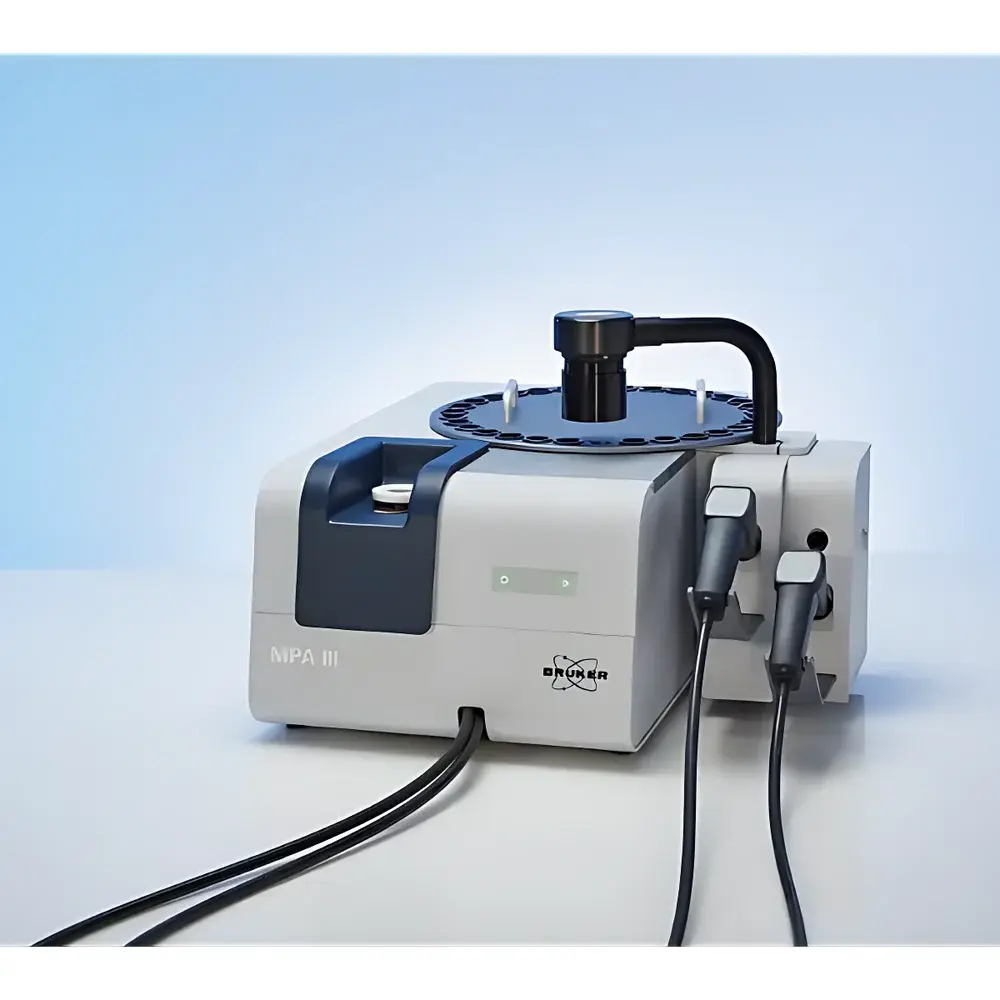
Bruker MPA III Modular FT-NIR Spectrometer
| Brand | Bruker |
|---|---|
| Origin | Germany |
| Model | MPA III |
| Instrument Type | Laboratory FT-NIR Spectrometer |
| Principle | Fourier Transform Near-Infrared Spectroscopy |
| Wavelength Range | 12500–3600 cm⁻¹ |
| Scan Speed | 8 scans/sec at 8 cm⁻¹ resolution |
| Data Sampling Interval | 2 cm⁻¹ |
| Sampling Modes | Diffuse Reflectance, Transmission, Diffuse Transmission, Fiber-Optic Probe |
| Chemometrics Software | OPUS |
Overview
The Bruker MPA III is a modular, high-performance Fourier Transform Near-Infrared (FT-NIR) spectrometer engineered for rigorous analytical demands across laboratory and industrial environments. Based on the interferometric principle of Michelson-type optical path difference modulation, the MPA III delivers precise, reproducible spectral data by measuring interference patterns generated from broadband NIR radiation—subsequently transformed via Fast Fourier Transform (FFT) algorithms into intensity-vs-wavenumber spectra. Its core architecture integrates RockSolid™ interferometry—a patented, permanently aligned, three-dimensional corner-cube mirror system with gold-coated optics—ensuring long-term mechanical stability, minimal alignment drift, and immunity to vibration or thermal perturbation. Coupled with a robust solid-state laser reference (10-year warranty), a long-life halogen source, and a high-sensitivity InGaAs detector with full-range linear response across 12500–3600 cm⁻¹, the MPA III achieves exceptional signal-to-noise ratio (SNR), spectral fidelity, and measurement repeatability—critical for quantitative calibration transfer and regulatory-compliant routine analysis.
Key Features
- RockSolid™ interferometer: Permanently aligned, monolithic corner-cube design with gold-coated mirrors for zero-maintenance optical stability and sub-pixel wavenumber accuracy.
- Modular sampling flexibility: Native support for diffuse reflectance, transmission, diffuse transmission, and fiber-optic probe configurations—enabling method optimization without hardware reconfiguration.
- High-speed acquisition: Up to 8 scans per second at 8 cm⁻¹ resolution, with 2 cm⁻¹ data sampling interval compliant with ASTM E1655 and ISO 12099 for spectral data density requirements.
- Real-time diagnostic monitoring: Embedded optical health monitoring continuously tracks source intensity, detector response, laser lock status, and interferogram quality—triggering user alerts upon deviation from factory-set thresholds.
- Portable deployment-ready: Ethernet-based communication (no proprietary interface cards), compact footprint, and optional trolley integration for at-line or mobile process monitoring in feed mills, grain silos, or production floors.
- 10-year warranty on interferometer moving parts and solid-state laser—reflecting Bruker’s confidence in mechanical longevity and metrological consistency under continuous operation.
Sample Compatibility & Compliance
The MPA III accommodates heterogeneous, non-destructive sample types common in agricultural and feed analysis—including whole grains, pelleted feed, meal powders, and liquid extracts—without requiring homogenization or chemical pretreatment. Its multi-mode sampling capability supports compliance with internationally recognized standards: ASTM D6134 (NIR analysis of animal feed), ISO 21542 (cereal and grain NIR calibration protocols), and AOAC Official Method 2007.01 (for moisture, protein, and fat quantification in feedstuffs). The instrument’s optical path design minimizes scattering artifacts in particulate matrices, while its stable wavenumber calibration satisfies FDA 21 CFR Part 11 requirements when paired with OPUS software’s audit-trail-enabled workflows and electronic signature functionality—supporting GLP/GMP-aligned QA/QC documentation.
Software & Data Management
Controlled exclusively via Bruker’s OPUS spectroscopy platform, the MPA III leverages a validated, ISO/IEC 17025-compatible software environment supporting full chemometric lifecycle management—from raw spectral acquisition and preprocessing (Savitzky-Golay smoothing, multiplicative scatter correction, standard normal variate) to PLS regression model development, validation (cross-validation, prediction residuals), and deployment. OPUS includes built-in tools for spectral library creation, outlier detection, and method transfer between instruments—essential for multi-site feed mill networks. All data files are stored in Bruker’s proprietary .0 format (binary, metadata-rich), with export options to CSV, JCAMP-DX, and ASCII for third-party statistical packages. Audit trails log every user action, parameter change, and calibration event—meeting traceability mandates under ISO/IEC 17025 Clause 7.7 and EU Annex 11 for computerized system validation.
Applications
The MPA III is extensively deployed in feed formulation, quality assurance, and incoming raw material verification—quantifying moisture (<0.1% RSD), crude protein (±0.2% absolute), crude fat (±0.15% absolute), and fiber content in cereal grains, soybean meal, corn distillers dried grains (DDGS), and compound feeds. Its portability enables real-time batch release testing at receiving docks; its modularity allows rapid transition from transmission analysis of oilseed cakes to fiber-optic probe-based in-situ monitoring of mixer homogeneity. Beyond feed, it supports pharmaceutical excipient identity testing (USP ), polymer blend composition analysis, and agricultural soil nutrient screening—where robustness, spectral reproducibility, and method agility are non-negotiable.
FAQ
What sampling modes does the MPA III support out-of-the-box?
Diffuse reflectance, transmission, diffuse transmission, and fiber-optic probe—each enabled via plug-and-play modules with automatic recognition.
Is the MPA III compliant with FDA 21 CFR Part 11 for electronic records?
Yes, when operated with OPUS software configured for audit trail logging, electronic signatures, and role-based access control—validated per GAMP 5 guidelines.
Can calibration models developed on one MPA III be transferred to another unit?
Yes, using OPUS’s Model Transfer Assistant and instrument standardization routines—minimizing recalibration effort across multi-unit installations.
What maintenance is required for the RockSolid™ interferometer?
None—its permanent alignment eliminates need for periodic realignment; only routine source and detector performance verification is recommended annually.
Does the MPA III support automated sample changers or process interfaces?
Yes, via optional integration with Bruker’s SampleManager automation suite and OPC UA-compatible process control systems for continuous at-line monitoring.
Related Products




