
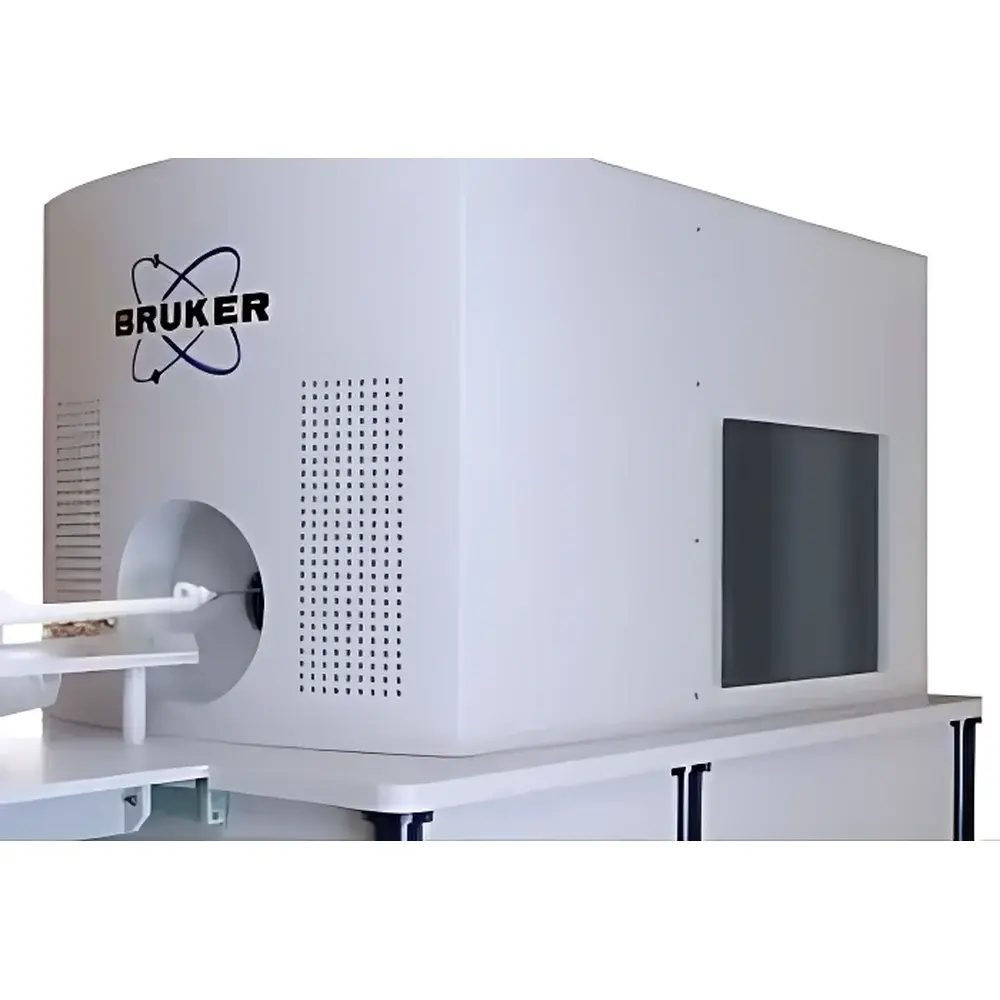
Bruker MPI Preclinical Magnetic Particle Imaging System
| Brand | Bruker |
|---|---|
| Origin | Germany |
| Manufacturer Type | Authorized Distributor |
| Origin Category | Imported |
| Model | MPI |
| Price Range | USD 420,000 – 700,000 |
| Instrument Type | Nuclear Imaging |
Overview
The Bruker MPI Preclinical Magnetic Particle Imaging System is a high-sensitivity, quantitative, and radiation-free tomographic imaging platform engineered exclusively for small-animal in vivo studies. Unlike conventional nuclear imaging modalities—such as PET or SPECT—MPI does not rely on radioactive tracers. Instead, it exploits the non-linear magnetization response of superparamagnetic iron oxide nanoparticles (SPIONs) under time-varying magnetic fields. The system employs a field-free point (FFP) scanning principle: spatial encoding is achieved by precisely shifting the FFP across the field of view using dynamic gradient and selection fields, while signal detection occurs via highly sensitive receive coils tuned to the harmonic frequencies generated by SPIONs’ non-linear magnetization. This physical principle enables real-time, high-temporal-resolution imaging (sub-50 ms per frame), zero ionizing radiation exposure, unlimited repeatability, and absolute quantification of tracer concentration—critical advantages for longitudinal pharmacokinetic, cell tracking, and functional vascular studies in murine models.
Key Features
- True quantitative imaging: Signal intensity is linearly proportional to local SPION concentration, enabling absolute tracer mass quantification without calibration curves.
- Sub-millisecond temporal resolution: Capable of capturing dynamic physiological processes—including cardiac pulsation, cerebral perfusion, and bolus transit—in real time.
- No ionizing radiation or radiolabeling required: Eliminates regulatory burdens associated with radioisotope handling and permits unlimited repeat imaging in the same subject.
- High spatial resolution: Engineered for <1.5 mm isotropic resolution at 30 mm FOV, optimized for murine and rat-scale anatomy.
- Integrated gradient and drive coil architecture: Designed in collaboration with Philips to ensure field homogeneity, FFP stability, and low harmonic distortion across the imaging volume.
- Dedicated preclinical gantry with animal handling module: Includes temperature-controlled stage, respiratory gating interface, and integrated anesthesia delivery ports compliant with IACUC and AAALAC standards.
Sample Compatibility & Compliance
The system is validated for use with FDA- and EMA-compliant clinical-grade SPION tracers (e.g., Perimag®, Synomag®-D) and research-grade custom formulations. It supports multi-modal co-registration with Bruker’s preclinical MRI and CT platforms via shared animal positioning systems and DICOM-based workflow integration. All hardware and software components comply with IEC 61000-6-3 (EMC) and IEC 61000-6-4 (industrial emission) standards. Data acquisition and storage adhere to ALCOA+ principles (Attributable, Legible, Contemporaneous, Original, Accurate, Complete, Consistent, Enduring, Available), supporting GLP-compliant study execution. Audit trail functionality and user access control meet FDA 21 CFR Part 11 requirements for electronic records and signatures.
Software & Data Management
Acquisition and reconstruction are managed through Bruker’s proprietary ParaVision® MPI software suite, built on a modular, scriptable framework compatible with MATLAB and Python APIs. Real-time reconstruction leverages GPU-accelerated iterative algorithms (e.g., system matrix-based deconvolution and compressed sensing). The software includes automated motion correction, spectral unmixing for multi-tracer studies, and voxel-wise quantification maps exported in NIfTI format. Raw k-space data and reconstructed volumes are stored in Bruker’s BIDS-compliant file structure, ensuring interoperability with open-source neuroimaging tools (FSL, AFNI, SPM). All processing steps are logged with timestamps, operator ID, and parameter sets to fulfill traceability requirements for regulatory submissions.
Applications
- Cell therapy monitoring: Quantitative tracking of SPION-labeled stem cells, macrophages, or CAR-T cells over days to weeks post-transplantation.
- Vascular physiology: High-frame-rate angiography of cerebral, coronary, or tumor microvasculature under pharmacological challenge or disease progression.
- Theranostic development: In vivo evaluation of SPION-based drug carriers, hyperthermia agents, or multimodal contrast agents.
- Inflammatory disease modeling: Dynamic assessment of monocyte recruitment in arthritis, atherosclerosis, or neuroinflammation models.
- Pharmacokinetics & biodistribution: Absolute quantification of nanoparticle accumulation in liver, spleen, lungs, and target tissues without decay correction.
FAQ
What type of tracers are required for MPI?
Only superparamagnetic iron oxide nanoparticles (SPIONs) with well-defined core size distribution (typically 15–30 nm hydrodynamic diameter) and high saturation magnetization are suitable. Clinical-grade tracers such as Perimag® and research-grade Synomag®-D are fully supported.
Can MPI be combined with MRI on the same animal?
Yes. The MPI system shares mechanical and coordinate alignment standards with Bruker’s preclinical MRI scanners. Co-registration accuracy is ≤0.3 mm using fiducial-based registration protocols and common animal holders.
Is MPI data compatible with standard image analysis pipelines?
Yes. Reconstructed volumes are exported in NIfTI-1 format with full header metadata (voxel size, orientation, TR/TE-equivalent timing parameters), enabling direct import into FSL, ITK-SNAP, or commercial platforms like Amira and Avizo.
Does the system support GMP-compliant tracer production validation?
While the MPI scanner itself is a Class I IVD device under EU MDR Annex XVI, its use in GMP environments requires integration with validated SOPs for tracer handling, calibration, and QC. Bruker provides IQ/OQ documentation packages and supports 3rd-party PQ validation per ISO 13485.




