
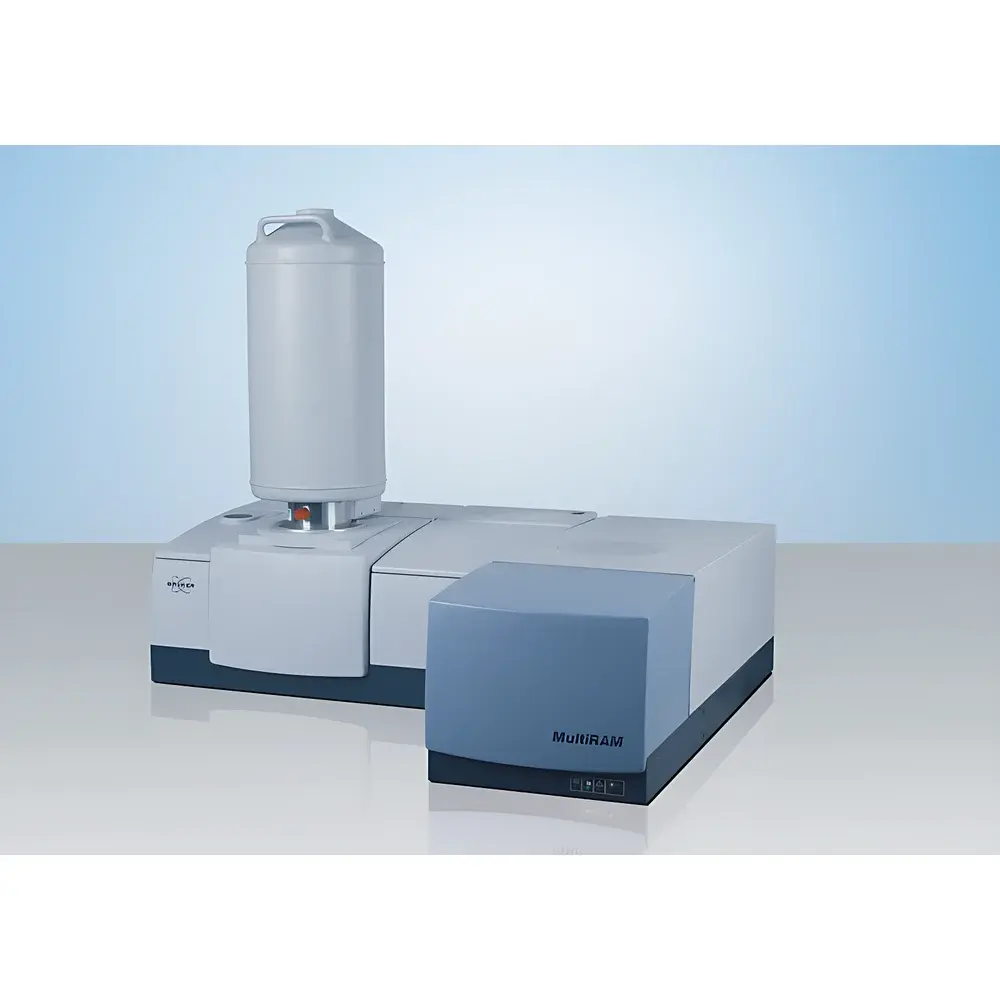
Bruker MultiRAM Fourier Transform Raman Spectrometer
| Brand | Bruker |
|---|---|
| Origin | Germany |
| Model | MultiRAM |
| Instrument Type | Fourier Transform Raman Spectrometer |
| Spectral Range | 3600 – 50 cm⁻¹ |
| Spectral Resolution | < 0.5 cm⁻¹ |
| Detector Options | Room-temperature InGaAs (1× or 2×), Liquid-nitrogen-cooled Ge photodiode |
| Laser Source | Software-controlled Nd:YAG, 1064 nm |
| Interferometer | RockSolid™ permanent-alignment, gold-coated optics |
| Beam Splitter | Broadband quartz |
| Sample Chamber | Triple-side access, switchable 90° scattering geometry, defocusing optics |
| Standard Accessories | Motorized sample stage, integrated white-light source for response calibration, dual fiber-coupling ports, polarization control module |
Overview
The Bruker MultiRAM is a high-performance, research-grade Fourier Transform Raman (FT-Raman) spectrometer engineered for quantitative molecular fingerprinting with exceptional signal-to-noise ratio, long-term spectral stability, and operational robustness. Unlike dispersive Raman systems, the MultiRAM employs a Michelson-type interferometer with Bruker’s proprietary RockSolid™ optical design—featuring permanently aligned, gold-coated mirrors and broadband quartz beam splitters—to deliver intrinsic mechanical stability and high optical throughput across the full mid- to far-IR Raman shift range (3600 – 50 cm⁻¹). The system utilizes a software-tunable Nd:YAG laser operating at 1064 nm, minimizing fluorescence interference while enabling precise power modulation for thermally sensitive or photo-labile samples. Its FT architecture ensures inherent wavelength accuracy via HeNe laser referencing, compliant with ISO 17025 traceability requirements for analytical instrumentation.
Key Features
- RockSolid™ interferometer with monolithic, frictionless flexure guidance and gold-coated optics for zero realignment over years of operation
- Sub-0.5 cm⁻¹ unapodized spectral resolution, verified per ASTM E1421 and ISO 18381 standards
- Dual-detector capability: configurable with one or two room-temperature InGaAs detectors plus an optional liquid-nitrogen-cooled germanium photodiode for ultra-low-signal detection
- Extended cryogenic hold time: ≥168 hours per LN₂ fill, supporting unattended overnight and multi-shift acquisition protocols
- Triple-access sample chamber with motorized XYZ stage, integrated white-light reference source, and switchable 90° scattering geometry with defocusing optics to mitigate local heating
- Modular optical interface: dual fiber-coupling ports, automated polarization control, and compatibility with external excitation sources or remote sampling probes
Sample Compatibility & Compliance
The MultiRAM accommodates solids, powders, gels, liquids, and thin films—either in bulk cuvettes, microscope slides, or custom holders. Its 1064 nm excitation minimizes fluorescence from organic matrices, making it suitable for pharmaceutical APIs, polymers, carbon allotropes (e.g., graphene, CNTs), geological specimens, and biological tissues. Optional accessories include temperature-controlled stages (–196 °C to +600 °C), automated sample changers (up to 120 positions), and hyphenated interfaces for coupling with FT-IR microscopes or RamanScope III/SENTERRA II micro-Raman platforms. All firmware and OPUS software modules comply with FDA 21 CFR Part 11 for electronic records and signatures, including full audit trail, user role management, and data integrity safeguards required under GLP and GMP environments.
Software & Data Management
Controlled entirely by Bruker’s OPUS spectroscopy software suite, the MultiRAM supports method-driven workflows—from instrument alignment and laser power optimization to spectral acquisition, baseline correction, peak fitting, and multivariate analysis (PCA, PLS). Real-time spectral preview enables immediate assessment of signal quality, SNR, and laser-sample interaction prior to full acquisition. Raw interferograms and processed spectra are stored in Bruker’s proprietary .OPUS format, fully convertible to JCAMP-DX, ASCII, or HDF5 for third-party chemometric tools. Data security features include encrypted project files, timestamped metadata embedding, and export logs meeting ISO/IEC 17025 documentation requirements.
Applications
- Pharmaceutical solid-state characterization: polymorph identification, hydrate/anhydrate differentiation, and API-excipient interaction studies
- Materials science: stress/strain mapping in semiconductors, crystallinity assessment in polymeric blends, defect analysis in 2D materials
- Forensic and cultural heritage analysis: non-destructive pigment identification in paintings, ink differentiation, and polymer-based evidence profiling
- Geochemistry: mineral phase quantification in silicates and carbonates without KBr pellet preparation
- Quality control in battery R&D: SEI layer composition monitoring on Li-ion electrode surfaces under inert atmosphere
FAQ
What is the primary advantage of FT-Raman over dispersive Raman for routine lab use?
FT-Raman provides superior wavenumber accuracy (< ±0.05 cm⁻¹), higher throughput (Jacquinot advantage), and inherent rejection of stray light—critical for low-intensity signals in highly scattering or fluorescent samples.
Can the MultiRAM be integrated into automated QC workflows?
Yes—via OPC UA and LabVIEW-compatible drivers, it supports integration into LIMS and MES platforms; optional auto-samplers enable walk-away batch analysis with SOP-defined pass/fail criteria.
Is spectral calibration traceable to international standards?
Yes—built-in HeNe laser referencing and polystyrene standard validation routines align with NIST-traceable procedures defined in ASTM E1421 and ISO 18381.
Does the system support spectral subtraction for background correction?
Yes—OPUS includes real-time interactive subtraction, polynomial baseline removal, and Mie scattering correction algorithms optimized for turbid media.
What maintenance is required beyond LN₂ refills?
None—RockSolid™ interferometer requires no periodic realignment; gold-coated optics eliminate humidity-induced degradation; only routine detector dark-current verification is recommended quarterly.





