
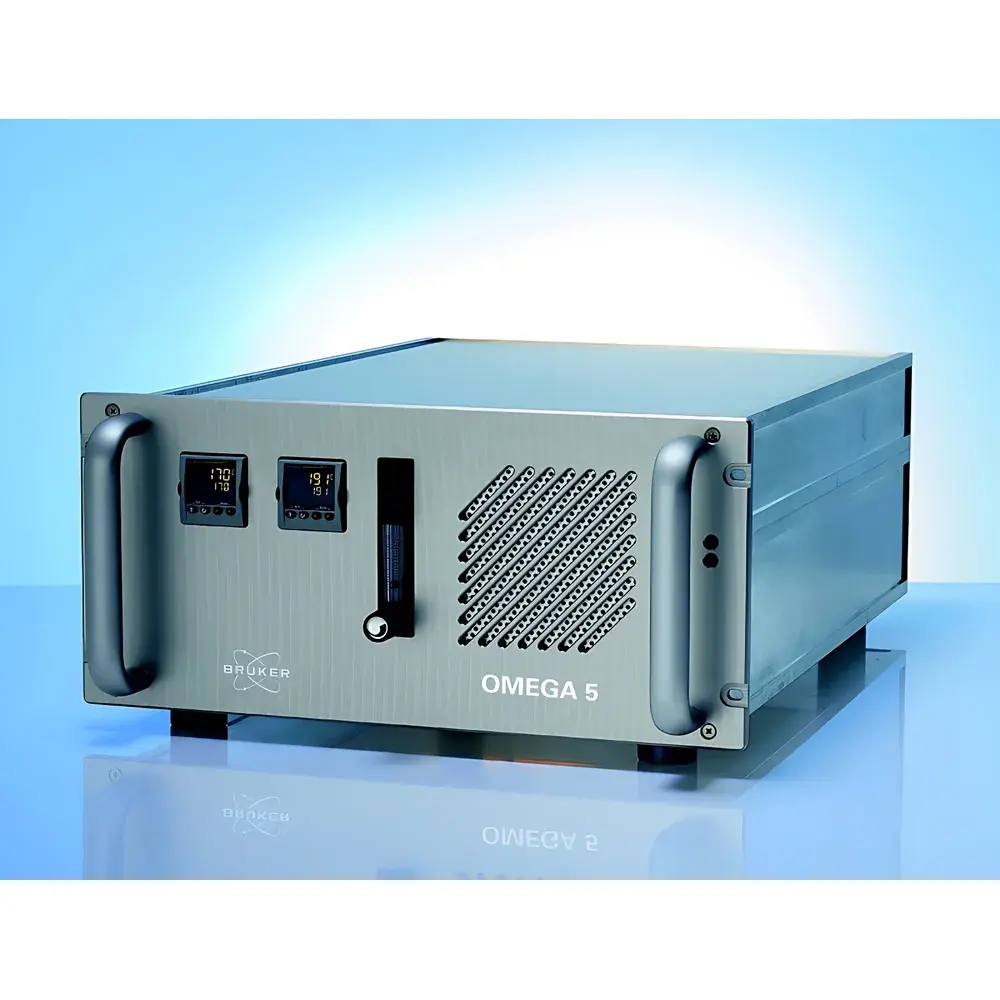
Bruker OMEGA 5 Fourier Transform Infrared (FTIR) Multicomponent Gas Analyzer
| Brand | Bruker |
|---|---|
| Origin | Germany |
| Model | OMEGA 5 |
| Principle | Infrared Absorption Spectroscopy (FTIR) |
| Type | Online, Real-time |
| Response Time | <1 s |
| Detection Range | ppb to 100% |
| Sample Compatibility | >300 gas compounds |
| Gas Cell | 5 m multipass reflective cell with nickel-plated body and gold-coated mirrors |
| Interferometer | RockSolid™ permanent alignment |
| Detector | Thermoelectrically cooled MCT |
| Light Source | CenterGlow™ broadband IR source |
| Software | OPUS GA v8.x with spectral library and nonlinear fitting engine |
| Compliance | ASTM D6348, ISO 12039, USP <1227>, GLP/GMP-ready audit trail |
Overview
The Bruker OMEGA 5 is a compact, high-performance Fourier Transform Infrared (FTIR) multicomponent gas analyzer engineered for continuous, real-time quantitative analysis of complex gas mixtures in industrial, environmental, and research settings. Unlike single-gas electrochemical or NDIR sensors, the OMEGA 5 leverages full-spectrum FTIR spectroscopy—measuring absorption across the mid-infrared region (typically 600–4000 cm⁻¹)—to simultaneously identify and quantify over 300 gaseous compounds without prior calibration. Its core measurement principle relies on Beer–Lambert law-based spectral deconvolution, where raw interferograms are transformed into absorbance spectra and fitted against reference libraries using robust nonlinear least-squares algorithms. The integrated 5-meter multipass gas cell enables sub-ppb detection limits for many analytes while maintaining fast response (<1 s), making it suitable for dynamic process monitoring, catalytic reaction studies, and trace impurity verification.
Key Features
- RockSolid™ interferometer with permanent alignment—no moving parts requiring recalibration; delivers long-term spectral stability under vibration, thermal drift, or mechanical stress.
- 5-meter multipass gas cell with nickel-plated housing and gold-coated mirrors—resistant to corrosive gases (e.g., HCl, HF, SO₂, NH₃) and optimized for high optical throughput and low baseline noise.
- CenterGlow™ broadband infrared source and thermoelectrically cooled mercury cadmium telluride (MCT) detector—eliminates need for liquid nitrogen cooling while sustaining signal-to-noise ratios >10,000:1 (4 cm⁻¹ resolution, 1 min scan).
- Integrated temperature and pressure sensors within the gas cell—enabling real-time compensation in OPUS GA’s quantification engine for accurate concentration calculation per ideal gas law.
- Hermetically sealed and purgeable optical compartment—minimizes atmospheric interference from ambient H₂O and CO₂, critical for high-fidelity analysis of polar or low-concentration species.
- 19-inch rack-mount industrial chassis (4U height)—designed for seamless integration into PLC-controlled systems, mobile labs, or cleanroom environments with IP20-rated enclosure.
Sample Compatibility & Compliance
The OMEGA 5 supports direct analysis of undiluted, humid, hot, or corrosive gas streams—provided appropriate inlet conditioning (e.g., particulate filtration, condensate trap, or heated sampling line) is applied. It complies with key international standards governing gas emission monitoring and laboratory analysis, including ASTM D6348 (determination of volatile organic compounds in stack gas), ISO 12039 (FTIR determination of gaseous pollutants), and USP (validation of analytical procedures for residual solvents). Its software architecture supports 21 CFR Part 11 compliance through electronic signatures, role-based access control, and immutable audit trails—making it suitable for regulated pharmaceutical, chemical, and energy sectors operating under GLP or GMP frameworks.
Software & Data Management
OPUS GA (Gas Analysis) software is a dedicated, standalone application built exclusively for Bruker FTIR gas analyzers. It features a graphical user interface designed for non-specialist operators, enabling one-click measurement initiation, automated spectral acquisition, and real-time display of concentration trends. The software includes an expandable spectral library containing >300 validated reference spectra (including isotopologues and temperature-broadened variants), all traceable to NIST-certified standards. Users may import custom reference spectra, perform batch reprocessing of archived interferograms, and export fully annotated reports in PDF, CSV, or XML formats. All raw data—including interferograms, absorbance spectra, fit residuals, and uncertainty estimates—are stored in Bruker’s proprietary OPUS format (.0, .1, .2), ensuring full traceability and reproducibility.
Applications
- Industrial process monitoring: Real-time tracking of reactants, by-products, and impurities in petrochemical crackers, ammonia synthesis loops, and semiconductor etch tools.
- Catalysis research: In situ/operando analysis of surface reactions, transient intermediates, and catalyst deactivation pathways under varying T/P conditions.
- Environmental emissions testing: Continuous stack monitoring for NOₓ, SO₂, CO, CH₄, N₂O, VOCs, and halogenated compounds per EU Directive 2010/75/EU (IED).
- Biogas and syngas quality control: Simultaneous quantification of CH₄, CO₂, H₂, H₂S, NH₃, and siloxanes for upgrading and combustion optimization.
- Pharmaceutical residual solvent analysis: Verification of cleaning validation endpoints in API manufacturing per ICH Q5C and USP .
- Academic and national lab research: Isotope ratio tracking, kinetic modeling, and atmospheric simulation chamber studies.
FAQ
Does the OMEGA 5 require daily calibration with certified gas standards?
No. OPUS GA performs absolute quantification via first-principles spectral fitting against reference libraries. Routine calibration is not required; however, annual performance verification using NIST-traceable span gases is recommended for regulatory compliance.
Can the OMEGA 5 operate in explosive atmospheres?
The base unit is rated for general-purpose indoor use (IEC 61000-6-3, CE). For Zone 1/2 hazardous areas, optional ATEX-certified sampling interfaces and explosion-proof enclosures must be integrated externally.
What maintenance intervals are specified for the interferometer and detector?
The RockSolid™ interferometer is maintenance-free for ≥10 years under normal operation. The TE-cooled MCT detector has a typical service life exceeding 8 years with no consumables or scheduled replacement parts.
Is remote monitoring and data export supported?
Yes. OPUS GA supports OPC UA and Modbus TCP protocols for integration into SCADA/MES systems. Historical data can be streamed to SQL databases or cloud platforms via configurable ODBC drivers.
How does the system handle overlapping spectral bands from co-eluting gases?
The nonlinear fitting algorithm applies constrained multivariate regression, incorporating temperature-dependent line shapes, pressure broadening, and cross-interference correction matrices derived from high-resolution reference measurements.
Related Products







